Experiment of frictional force on rolling object

Click For Summary

Homework Help Overview

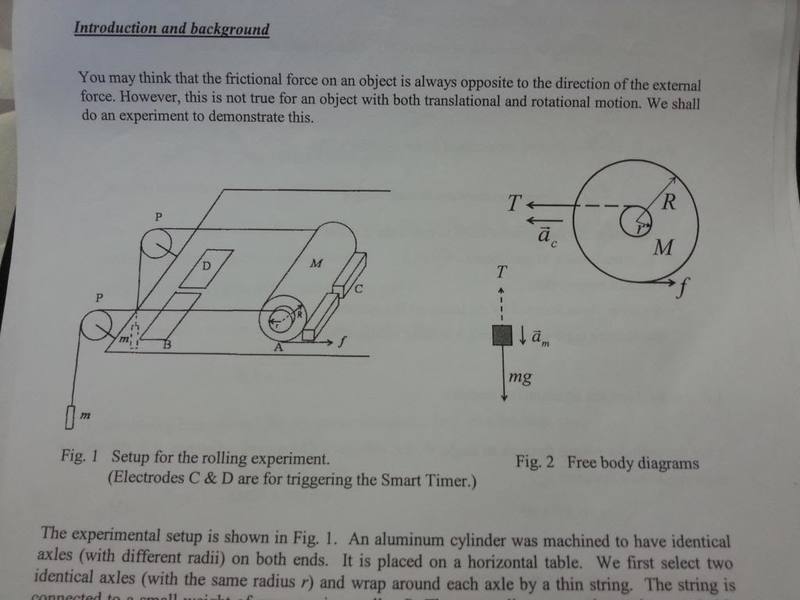
The discussion revolves around an experiment investigating the frictional force on a rolling object, specifically a yoyo-like setup on a horizontal table. The original poster has conducted multiple trials with varying axle radii and is comparing experimental data to a theoretical equation for frictional force.

Discussion Character

  • Exploratory, Assumption checking, Problem interpretation

Approaches and Questions Raised

  • The original poster attempts to understand discrepancies between experimental data and theoretical predictions, questioning the validity of their results and the potential for errors in data collection or unit conversion. Participants inquire about specific parameters used in the experiment and suggest possible reasons for the observed deviations.

Discussion Status

The discussion is ongoing, with participants providing insights into potential errors and encouraging the original poster to consider various factors that may affect the results. There is acknowledgment of a possible bad data point, and participants are exploring alternative explanations for the differences in the graphs.

Contextual Notes

The original poster notes a reminder from their professor regarding the non-linear nature of the graph and the implications for data fitting. There is also mention of a significant unit conversion error that may have influenced the results.

Illusion
Messages
2
Reaction score
0
Recently, I have done an experiment of frictional on rolling object.

In the experiment, I have done 7 trials with different axle radii, similar to that of a yoyo on a horizontal table.

the experimental was set as this
20140407_172809.jpg


As derived by the lab manual i received, frictional force can be plotted as a function of axle radius.

f=2mgMR(R-2r)/(3MR^2+4m(R+r)^2)

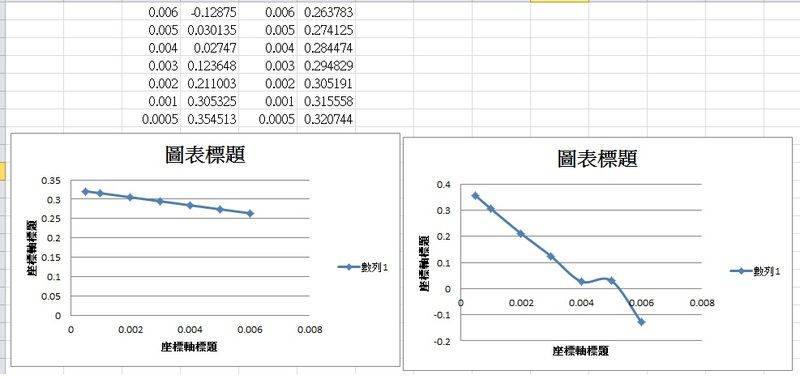
The graph plotted using my experimental data is very strange...

expt6.jpg


Both graphs are plotted by f as a function of r. The one on the right is plotted according to my experimental data. The one on the left is a plot of the equation above. Why the graphs are so different? Is there anything wrong?
 
Last edited:
Physics news on Phys.org
It seems like you have one bad data point in your experimental graph and the plot of the function is incorrect. What were the masses m and M and what is the radius R? The function ought to change signs at r=R/2.
 
dauto said:
It seems like you have one bad data point in your experimental graph and the plot of the function is incorrect. What were the masses m and M and what is the radius R? The function ought to change signs at r=R/2.

M = 5.743 kg

m = 50.42 g

R = 0.06355 m

i see the problem...it is a horrible and stupid mistake in changing unit...thanks for reminding


our professor reminded us that the graph is non-linear and do not have to do fitting

but the graph is fairly linear except the "bad data".

is there any other possible explanation leading to this deviation?
 
Illusion said:
but the graph is fairly linear except the "bad data".

is there any other possible explanation leading to this deviation?

A good guess would be that the value +0.030135 should be -0.030135.
 

Similar threads

  • · Replies 59 ·
2
Replies
59
Views
5K
  • · Replies 42 ·
2
Replies
42
Views
4K
  • · Replies 8 ·
Replies
8
Views
6K
  • · Replies 30 ·
2
Replies
30
Views
4K
  • · Replies 2 ·
Replies
2
Views
2K
  • · Replies 77 ·
3
Replies
77
Views
6K
  • · Replies 3 ·
Replies
3
Views
2K
Replies
13
Views
2K
  • · Replies 3 ·
Replies
3
Views
2K
  • · Replies 5 ·
Replies
5
Views
3K