Explanation of capacitance formula

Click For Summary

Discussion Overview

The discussion centers around the formula for capacitance, exploring its components and the appearance of π within the context of electronics. Participants seek to clarify the formula's meaning and its implications, particularly for those new to the subject.

Discussion Character

  • Exploratory
  • Technical explanation
  • Conceptual clarification
  • Debate/contested
  • Homework-related

Main Points Raised

  • One participant expresses confusion about the capacitance formula and the significance of π, requesting a simplified explanation.
  • Another participant notes that the appearance of 4π is relevant in Gaussian units and relates it to Gauss's law, but questions the correctness of the equation presented.
  • A different participant challenges the use of 4π, suggesting that it may be incorrect and asks for clarification on the source of the equation.
  • One participant shares a source for the capacitance formula and mentions the dependence of the constant ε on the unit system used.
  • Another participant suggests that understanding the formula in depth may not be necessary for practical applications, emphasizing the relationship between area, spacing, and capacitance without delving into electromagnetic theory.
  • A participant reflects on the puzzling nature of constants like π and their implications, hinting at broader philosophical questions about the universe.

Areas of Agreement / Disagreement

Participants express varying levels of understanding and confusion regarding the capacitance formula, with no consensus on the correctness of the equations discussed. Multiple competing views and interpretations of the formula and its constants remain present.

Contextual Notes

Some participants mention the need for clarity on unit systems and the implications of constants, indicating that assumptions about the equations may not be universally accepted. There are unresolved questions about the accuracy of specific formulations and their contexts.

Who May Find This Useful

This discussion may be useful for beginners in electronics, students seeking clarification on capacitance, and those interested in the theoretical underpinnings of electrical concepts.

Niaboc67
Messages
249
Reaction score
3
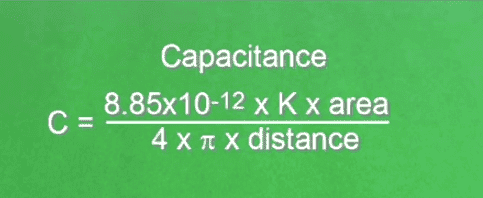
Hello, I am new to electronics and am having trouble understanding this formula for capacitance:
7cgnZPY.png


Could someone please break this down into layman terms? Interestingly π appears? I'd like to understand why that exists in capacitance.

Thank you all in advance!
 
Physics news on Phys.org
Actually, that equation you got is very strange... 8.85*10^-12 looks like the value for vacuum permittivity (in F/m) in SI units, but I think that 4pi is wrong. Where did you get that equation?
 
Thank you for the replies thus far. I got the image from this video at 1:05:
I was wondering how I could make a capacitor from scratch. I am only up to pre-calculus so not entirely well-versed in mathematical reasoning yet.
 
Yes, I think he mixed up his units..

Basically..

##C = ε * \frac{A}{d}##

where ε is a constant. The form of the constant depends on the unit system used.

http://en.wikipedia.org/wiki/Capacitance

In CGS units the equation has the form:[2]
2884456a177ca663f706bb41c56182a1.png
He seems to have used the SI value for ε0
 
Niaboc67 said:
Hello, I am new to electronics and am having trouble understanding this formula for capacitance:

7cgnZPY.png


Could someone please break this down into layman terms? Interestingly π appears? I'd like to understand why that exists in capacitance.

Thank you all in advance!
I think that's asking a bit too much. It's not a "layman's" subject. Unless you want to get into EM theory at some depth then it's quite OK just to use the formula (subject to it being the correct on - see the other posts. The nearest thing to helping you is to say that the Capacitance will be proportional to the total area (double the area = double the Capacitance) and inversely proportional to the spacing (double the spacing = half the Capacitance). The rest of the formula can be treated as 'just constants', which will give you the right answer in Farads. (I am not being snobby about this - many brilliant Engineers are prepared to do this and use formulas that they don't fully understand - in the same way that they used equipment that they could never hope to build for themselves)
BTW π appears all over the place in Science and Maths. The bit about the area of a circle is only one of the many places you will find π - it is just the most familiar example :).
 
Thank you all for the replies...I've got a lot to learn. I guess when in doubt consult wikipedia. π and phi and all constants are becoming particularly puzzling for me. For the sheer fact that a constant that relates to all things exists makes me think the universe was programmed...or the multiverse must be accurate. Sorry for being so tangential.
 

Similar threads

  • · Replies 11 ·
Replies
11
Views
2K
  • · Replies 5 ·
Replies
5
Views
3K
  • · Replies 2 ·
Replies
2
Views
1K
  • · Replies 5 ·
Replies
5
Views
2K
  • · Replies 1 ·
Replies
1
Views
3K
  • · Replies 2 ·
Replies
2
Views
2K
  • · Replies 13 ·
Replies
13
Views
7K
  • · Replies 7 ·
Replies
7
Views
2K
  • · Replies 10 ·
Replies
10
Views
5K
  • · Replies 2 ·
Replies
2
Views
1K