SUMMARY
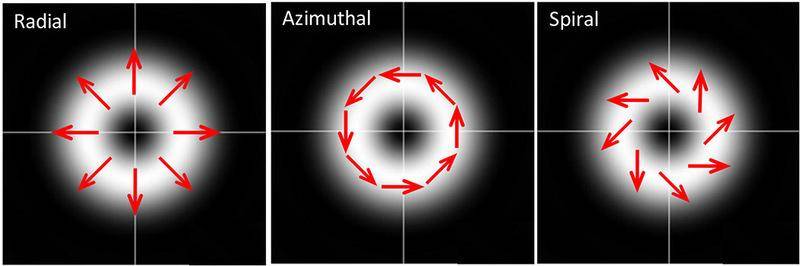
The discussion centers on the behavior of a radially polarized beam when focused to a single point. It concludes that while destructive interference may occur, diffraction limits the extent of focusing, resulting in a finite beam width and a characteristic diffraction pattern. The energy of the beam does not completely cancel out at the focus; instead, it produces a bright diffraction ring around the center. The phenomenon has been documented in the study titled "3-dimensional local field polarization vector mapping of a focused radially polarized beam using gold nanoparticle functionalized tips," published in OPTICS EXPRESS.
PREREQUISITES
- Understanding of radially polarized beams
- Knowledge of diffraction patterns and their implications
- Familiarity with constructive and destructive interference
- Basic principles of electromagnetic field vectors
NEXT STEPS
- Research the principles of diffraction and its effects on beam focusing
- Study the paper "3-dimensional local field polarization vector mapping of a focused radially polarized beam using gold nanoparticle functionalized tips"
- Explore advanced optics techniques for manipulating polarized light
- Investigate applications of radially polarized beams in nanotechnology and imaging
USEFUL FOR
Optical physicists, researchers in photonics, and engineers working with laser technologies will benefit from this discussion, particularly those focused on beam manipulation and polarization effects.