Fermat's principle seems indefinite

Click For Summary
SUMMARY

The discussion centers on the application of Fermat's principle to a salt solution with a vertical gradient in refractive index. Participants analyze how light behaves when transitioning between different media, specifically addressing the paths a laser beam can take from point A to point B. The conversation highlights that while Fermat's principle suggests that light takes an extremal path, it does not account for all possible trajectories, particularly in cases of vertical gradients. The participants conclude that a horizontal path perpendicular to the gradient should not experience deviation, contradicting Fermat's assertion of extremal paths.

PREREQUISITES
  • Understanding of Fermat's principle in optics
  • Knowledge of refractive index and its implications
  • Familiarity with Snell's law of refraction
  • Basic concepts of gradient-index optics
NEXT STEPS
  • Research the implications of Fermat's principle in gradient-index optics
  • Study Snell's law and its applications in various media
  • Explore Huygens' principle and its relation to wave propagation
  • Investigate total internal reflection and its conditions in different refractive indices
USEFUL FOR

Students and professionals in physics, particularly those focusing on optics, as well as educators seeking to explain complex concepts related to light behavior in varying media.

Anton Alice
Messages
68
Reaction score
1
Hello forum,

please take a look at the following picture:
neuebitmap.png
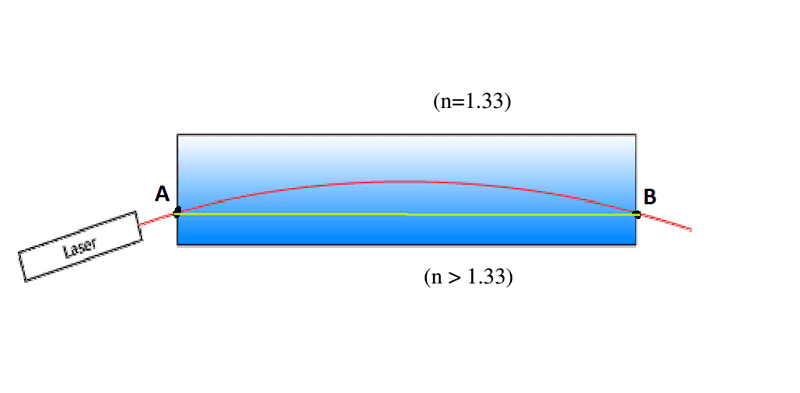
It's a salt solution, with increasing refractive index, as you go down the solution.

How can I explain this with Fermat's principle?
Let's set the starting point A to the point, where the laser beam penetrates the left wall of the container.
The ending point B shall be the intersection of the laser beam with the right container wall. I suppose, that A and B are at same height.

Fermat says, that a path between a starting point A and an ending point B needs to be extremal in terms of optical pathlength.
Apparently the optical path length of the red arc in the picture is shorter than the linear green path from A to B, because the linear path is in a more refractive medium.
But I could also go from A to B on a linear path by pointing the laser perpendicular to the container wall, so that the beam travels along a constant index of refraction, and therefore experiencing no deviation from the linear path.

Seemingly Fermat's Principle doesn't give all possible solutions here. In fact, Fermat's principle would forbid the green path, because its not extremal in terms of path length.
 
Science news on Phys.org
AFAIK Fermat mention about the path which require minimum travel time, not merely straight line distance.
 
Anton Alice said:
But I could also go from A to B on a linear path by pointing the laser perpendicular to the container wall, so that the beam travels along a constant index of refraction, and therefore experiencing no deviation from the linear path.
If you have a vertical gradient in the whole container, then the beam will deviate from the horizontal, and won't reach B anymore.

If you have no vertical gradient at the elevation of A & B, just somewhat above them, then you have two local extrema, which both satisfy Fermat's principle:

https://en.wikipedia.org/wiki/Fermat's_principle
...a more modern statement of the principle is that rays of light traverse the path of stationary optical length with respect to variations of the path.[2] In other words, a ray of light prefers the path such that there are other paths, arbitrarily nearby on either side, along which the ray would take almost exactly the same time to traverse.
 
Last edited:
I stated Fermats Principle correctly:
Anton Alice said:
Fermat says, that a path between a starting point A and an ending point B needs to be extremal in terms of optical pathlength.
I just used a german speaking style. I called it "extremal", which has the same meaning like saying, the functional of path length is stationary at a certain path-function.

A.T. said:
If you have a vertical gradient in the whole container, then the beam will deviate from the horizontal, and won't reach B anymore.

If you have no vertical gradient at the elevation of A & B, just somewhat above them, then you have two local extrema, which both satisfy Fermat's principle

Well, there is a vertical gradient. But if I take a horizontal path, which is perpendicular to the gradient, then the path should not experience a deviation, because Snells law say so: The path is going along a layer of constant index of refraction.
And the problem is, that Fermat would forbid this path, because this path is not a stationary point of the length-functional. Right? Why do I think that? Because there is a vertical gradient. For example: If I make a small upward deviation, such that the green path now becomes more like the red path, i.e. a lightly curved path, then the optical path should become a little shorter. If I curve down the green path slightly, then the optical length should become a little longer, because the index of refraction increases, as we go down the solution. Therefore, If the one deviation makes the path shorter, and the other makes it longer, then the green path cannot be a stationary point (unless it is a saddle point or something like that...)
 
Aha, ok. So if I have for example a water surface (n=1,3), and air above it(n=1), then if I point a laser beam exactly along the surface plane of the water-air transition, then the laser beam should be refracted into the water? How does it come to that?

I can only explain that, by inverting the direction of a beam, that is just totally internally reflected.
But normally, in case of total internal reflexion, the beam goes from inside the water to the transition zone, and gets completely reflected according to fresnel ( transmission = 0). So there is actually no beam refracted along the water surface. And I find it curious, to invert the direction of a beam, that does not exist.
 
Anton Alice said:
Aha, ok. So if I have for example a water surface (n=1,3), and air above it(n=1), then if I point a laser beam exactly along the surface plane of the water-air transition, then the laser beam should be refracted into the water? How does it come to that?
A water surface is a discontinuity, not a smooth gradient. You should try to understand how refraction follows from differential propagation speeds:

300px-Refraction_-_Huygens-Fresnel_principle.svg.png
img_mid_39724.gif


This should make obvious, what happens if the propagation speed has a gradient perpendicular to the beam direction. Also demonstrated here:

 
Cool video. the Grass stripe acts like a waveguide.

Referring to the pictures of huygens principle:

It is now quite clear, why there is a refraction into the lower medium, if the incoming beam travels along the surface transition.
But shouldn't be there actually two refractions? one into the lower medium, and one into the upper medium?I think that, because the secondary spherical waves by huygens should propagate in both media.
 
Last edited:

Similar threads

  • · Replies 8 ·
Replies
8
Views
1K
  • · Replies 42 ·
2
Replies
42
Views
5K
  • · Replies 3 ·
Replies
3
Views
2K
  • · Replies 6 ·
Replies
6
Views
4K
  • · Replies 6 ·
Replies
6
Views
2K
  • · Replies 2 ·
Replies
2
Views
5K
  • · Replies 2 ·
Replies
2
Views
2K
  • · Replies 12 ·
Replies
12
Views
2K
  • · Replies 9 ·
Replies
9
Views
3K
  • · Replies 3 ·
Replies
3
Views
2K