Find average acceleration from two given velocities each at a given ti

Click For Summary
SUMMARY

The discussion focuses on calculating the average acceleration of an object transitioning from a velocity of 40 m/s due North at t=0 seconds to 30 m/s due East at t=5 seconds. The correct method involves vector addition rather than the Pythagorean Theorem, which yielded an incorrect result of 50 m/s at 36.9 degrees East of North. To find the average acceleration, one must determine the change in velocity components in both the North-South and East-West directions and then divide by the time interval of 5 seconds.

PREREQUISITES
  • Understanding of vector addition in physics
  • Knowledge of acceleration calculations
  • Familiarity with components of velocity
  • Basic proficiency in trigonometry
NEXT STEPS
  • Study vector addition techniques in physics
  • Learn how to calculate average acceleration from velocity changes
  • Explore the concept of velocity components in different directions
  • Review trigonometric functions related to angles and direction
USEFUL FOR

Students studying physics, educators teaching kinematics, and anyone interested in understanding vector motion and acceleration calculations.

tylertwh
Messages
22
Reaction score
0
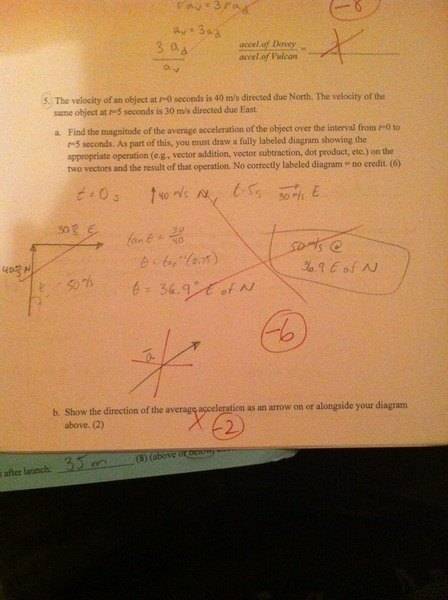
The velocity of an object at t=0 seconds is 40 m/s directed due North. The velocity of the same object at t=5 seconds is 30 m/s directed due east.

Find the magnitude of the average acceleration of the object over the time interval from t=0 to t=5 seconds.

Also, show the direction of the average acceleration. So... I am not quite sure how to even approach this problem. I originally tried it and did it with Pythagorean Theorem, but my answer was incorrect.

The answer I got using Pythagorean Theorem was 50 m/s at 36.9 East of North.

Please help!
ImageUploadedByPhysics Forums1367026211.697246.jpg
 
Physics news on Phys.org
Judging from your diagrams, you did a vector addition of the two velocities. You want the change involved in going from one velocity to the other. What operation should you use?
 
First consider the component of acceleration in the north-south direction. What is the change in the velocity component in this direction? From this, what is the acceleration (don't forget to divide by the time)?

Now do the same thing for the east-west direction.
 

Similar threads

  • · Replies 7 ·
Replies
7
Views
1K
  • · Replies 2 ·
Replies
2
Views
3K
  • · Replies 8 ·
Replies
8
Views
2K
  • · Replies 5 ·
Replies
5
Views
3K
Replies
5
Views
2K
  • · Replies 16 ·
Replies
16
Views
2K
  • · Replies 13 ·
Replies
13
Views
7K
Replies
1
Views
2K
Replies
8
Views
1K
Replies
5
Views
1K