Find S/E in Filtres & OPAMP Circuits: A Complex Schema

  • Thread starter Thread starter ace130
  • Start date Start date
  • Tags Tags
    Amp Opamp
Click For Summary
SUMMARY

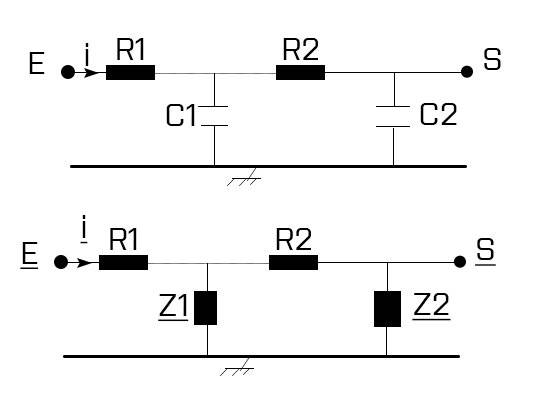
The discussion focuses on finding the function S/E in complex filtre and operational amplifier (OPAMP) circuits. Participants clarify that R2 and Z2 are in series, leading to the equivalent impedance Zeq(1) as R2 + Z2. The correct approach involves treating Zeq(1) in parallel with Z2, which is then in series with R1. The use of Ohm's Law is emphasized for calculating current through the equivalent impedance, with a note that alternative methods may exist but are not yet learned by the participants.

PREREQUISITES
  • Understanding of series and parallel impedance calculations
  • Familiarity with Ohm's Law
  • Knowledge of voltage dividers
  • Basic concepts of operational amplifier circuits
NEXT STEPS
  • Study complex impedance in AC circuits
  • Learn advanced techniques for analyzing OPAMP circuits
  • Explore voltage divider principles in depth
  • Investigate alternative methods for solving circuit equations
USEFUL FOR

Electrical engineering students, circuit designers, and anyone involved in analyzing filtre and OPAMP circuits will benefit from this discussion.

ace130
Messages
8
Reaction score
0
So this is the circuit of a filtre and it's complex schema :
x7TeCWd.jpg

The question was find the fonction S/E .In order to find S/E , I had to sum up impedances in serie or parallel, for example R2 and Z2 have the same current so we put R2+Z2=Z', but can I sum Z1+Z' ? since they have different current and voltage,The rule says that serie means same current and parallel means same voltage .
My first attempt is to consider Z1 and Z' are in parallel but the result was weird.
I want to know if that green statement is correct , and if you wish you can give me a hint or solution the find S/E.
 

Attachments

  • x7TeCWd.jpg
    x7TeCWd.jpg
    12.1 KB · Views: 624
Physics news on Phys.org
(1) The green statement is correct.
(2) Assuming no current flows out of S, then you are correct that R2 and Z2 are in series.
(3) The correct next step is to consider Z1 and Z'=R2+Z2 in parallel. What was "weird" about this?
(4) Do you then see how to incorporate R1?
 
I'm a little confused, here is my friend attempt (E=Ve, S=Vs , Z'=Zeq1) , considering that his part 2 is correct , so the voltage at Z1(Zc1) is V1 , but the voltage at Z' is obviously V1-S

Gw5GmBG.jpg
 

Attachments

  • Gw5GmBG.jpg
    Gw5GmBG.jpg
    46.9 KB · Views: 737
ace130 said:
I'm a little confused, here is my friend attempt (E=Ve, S=Vs , Z'=Zeq1) , considering that his part 2 is correct , so the voltage at Z1(Zc1) is V1 , but the voltage at Z' is obviously V1-S

View attachment 219463
not quite.
R2 and Z2 are in series. so Zeq(1) will be R2 + Z2, note the other end of Zeq(1) has to be tied to ground.

By doing this you "lose" your Vs node. You will have to resolve for this later.

Then Zeq(1) is in parallel with Z2, the combo of which is in series with R1. You should then be able to use ohms law to find Ie = Ve / (R1 + (Zeq || Z2)). You then solve for the current through Zeq, and go from there!

note: there are other easier ways to solve this, but you likely have not learned them yet.
 
well, I knew that Vs would cause problems when adding R2 and Z2 , so I tried to find E/S without sum up any component , instead I wrote E/S= (V1/S)*(E/V1) and calculate each expression , it takes more time but the result seems to be more convenient , the problem is I can't find a "stable" solution , I don't know which method is correct
 
ace130 said:
instead I wrote E/S= (V1/S)*(E/V1)

that is not a true statement though. where did you get it?

DO you know what a voltage divider is?
 
donpacino said:
that is not a true statement though. where did you get it?

DO you know what a voltage divider is?
It is ! it's simple math ? I just inverse it , because I'm using a Right-to-left Keyboard... my bad
SGHzRVM.jpg
 

Attachments

  • SGHzRVM.jpg
    SGHzRVM.jpg
    8.9 KB · Views: 265

Similar threads

  • · Replies 5 ·
Replies
5
Views
3K
Replies
2
Views
2K
  • · Replies 26 ·
Replies
26
Views
3K
  • · Replies 1 ·
Replies
1
Views
2K
  • · Replies 4 ·
Replies
4
Views
2K
  • · Replies 5 ·
Replies
5
Views
2K
Replies
39
Views
6K
  • · Replies 1 ·
Replies
1
Views
3K
  • · Replies 2 ·
Replies
2
Views
2K
  • · Replies 3 ·
Replies
3
Views
2K