Find the potential difference between 2 junctions (nodes)

Click For Summary

Discussion Overview

The discussion revolves around determining the potential difference between two junctions in a circuit containing two electromotive forces (emfs). Participants explore methods to calculate the potential at specific points using circuit analysis techniques, including the junction rule and loop rule.

Discussion Character

  • Technical explanation, Conceptual clarification, Debate/contested, Homework-related

Main Points Raised

  • One participant suggests using the junction rule to determine current at junctions but expresses uncertainty about how to find the potential at those points due to unknown resistances.
  • Another participant advises that all currents are given, recommending the use of Ohm's law with known currents and resistances to find unknown voltages.
  • A participant questions whether to add the potentials from both batteries and resistors or to apply Ohm's law at a specific point, indicating confusion about resistance values at junctions.
  • One participant notes the degradation of an ASCII representation of the circuit, suggesting that setting a ground reference could simplify finding unknown voltages.
  • Another participant confirms that the voltage across a specific resistor can be equated to the potential at one of the junctions, reinforcing the use of Ohm's law.
  • There is a reiteration that determining currents is unnecessary since they are provided, emphasizing a more straightforward approach to solving the problem.

Areas of Agreement / Disagreement

Participants express differing views on the necessity of determining currents versus using given information to find potentials. The discussion remains unresolved regarding the best approach to calculate the potential difference.

Contextual Notes

Some participants indicate limitations in the clarity of the circuit representation, which may affect the discussion of specific points and calculations. There is also uncertainty regarding the resistance values at junctions.

Who May Find This Useful

This discussion may be useful for students or individuals interested in circuit analysis, particularly those grappling with concepts of potential difference and the application of Ohm's law in complex circuits.

CogitoEAS
Messages
9
Reaction score
0
Hello,

I'm wondering how to determine the value of the potential difference between two points (junctions specifically) in a circuit with 2 emfs. The junctions are points x and y in the circuit below.
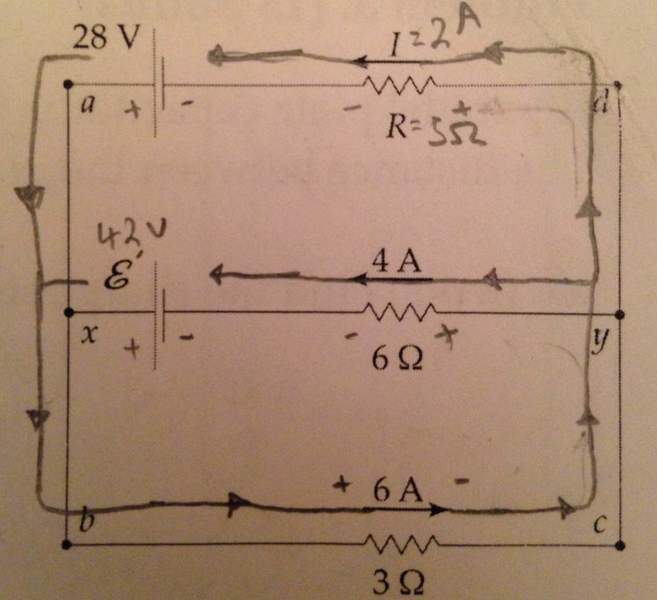
IMG_2838.jpg


I thought I could use the junction rule to determine the current at each junction, but I don't see how that can help me find the potential at those points as I don't see how I can find the resistance there. Then I tried using the loop rule on loop abcda to find the difference of the potentials (-(2A*5ohms)+28)-(-6A)(3ohms)=36V) but I'm not sure if that's correct, and this is a written assignment so I can't check if the answer is right or wrong.

Thanks
 
Last edited:
Physics news on Phys.org
Also, I tried to edit the title to read "Find" but I guess it won't update.....don't judge me
 
CogitoEAS said:
I'm wondering how to determine the value of the potential difference between two points (junctions specifically) in a circuit with 2 emfs.
...
I thought I could use the junction rule to determine the current at each junction
You don't need to determine the currents. All of the currents are already given. Just use Ohms law with the known currents and known resistances to determine any unknown voltages.

PS, I fixed the title.
 
Thanks for the reply! So if I want to calculate the potential at x I would add the potentials at both batteries and resistors 1 & 2? Or are you telling me to use ohms law at that point with the given current? In which case I don't know what the value for resistance would be at a junction
 
Unfortunately, your ascii art got seriously degraded, so I cannot tell you about specific points and so forth. From what I can tell, if you set your ground on the left then the only unknown voltage is on the right. So just use Ohm's law across any of the resistors to obtain it.
 
Sorry about that - this is actually my first post and I didn't realize you could add an attachment. I've attached an image of the circuit to this reply and the original post. Just so we're clear, you're suggesting that the voltage across the 3 ohm resistor is equal to the potential at point y?

IMG_2837.jpg
 
Last edited:
DaleSpam said:
You don't need to determine the currents. All of the currents are already given. Just use Ohms law with the known currents and known resistances to determine any unknown voltages.

PS, I fixed the title.

Absolutely.
It is often very tempting to feel you have to solve the whole circuit when they give you more than minimal information. You can save yourself loads of time by reading questions carefully before plunging in and doing the whole thing. It's smart not bad.
 

Similar threads

  • · Replies 6 ·
Replies
6
Views
2K
  • · Replies 5 ·
Replies
5
Views
2K
  • · Replies 4 ·
Replies
4
Views
2K
  • · Replies 7 ·
Replies
7
Views
4K
  • · Replies 9 ·
Replies
9
Views
2K
Replies
12
Views
2K
  • · Replies 3 ·
Replies
3
Views
1K
  • · Replies 1 ·
Replies
1
Views
1K
  • · Replies 9 ·
Replies
9
Views
2K
  • · Replies 12 ·
Replies
12
Views
2K