Find the RMS current drawn from the 240 Vrms supply

Click For Summary

Discussion Overview

The discussion revolves around calculating the RMS current drawn from a 240 Vrms supply in a circuit involving resistors and reactive components. Participants explore methods for determining the total impedance of the circuit, including the use of Kirchhoff's laws and complex impedance calculations.

Discussion Character

  • Technical explanation
  • Mathematical reasoning
  • Debate/contested

Main Points Raised

  • One participant suggests finding the total impedance of the circuit but questions the validity of simplifying two parallel resistors into a single 0.5 Ohm resistor.
  • Another participant agrees that finding the total impedance is necessary and emphasizes the need for an equation for the complex impedance of the parallel circuit.
  • Concerns are raised about the correctness of the equations used in the right loop, particularly regarding the mixing of voltage and current terms.
  • One participant acknowledges a transcription error in their equations, clarifying that they should have included resistance in their calculations.
  • Another participant expresses uncertainty about the original equations and suggests that something seems off, indicating a potential misunderstanding in the formulation.

Areas of Agreement / Disagreement

Participants generally agree on the need to calculate the total impedance and the appropriateness of using Kirchhoff's laws. However, there is disagreement regarding the specific equations and methods employed, with some participants questioning the correctness of the initial approach.

Contextual Notes

Participants express uncertainty about the transcription of equations and the mixing of voltage and current terms, indicating potential limitations in the clarity of the original post's equations.

youmei0426
Messages
18
Reaction score
0
Homework Statement
For the circuit below find:
the rms current drawn from the 240 V rms supply if the frequency is 50 Hz, and the phase of the current relative to the applied voltage.
Relevant Equations
Z(R) = R
Z(C) = -i/(wC)
Z(L) = iwL
where Z is complex impedance, R is resistance, w is angular frequency, L is inductance and C is capacitance
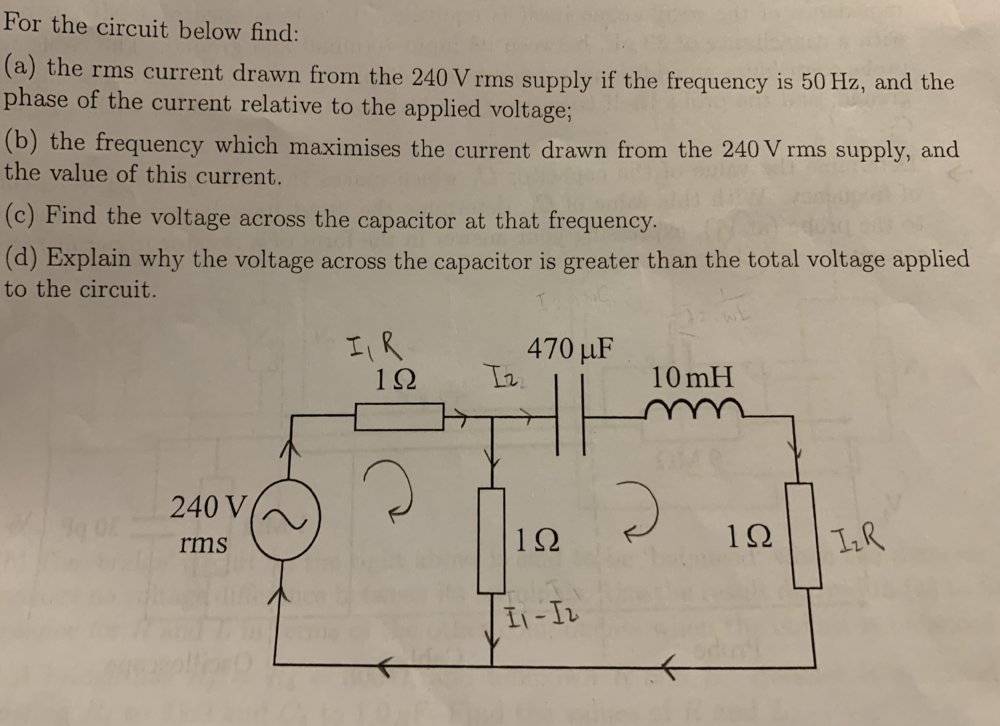
My first idea was to find the total impedance of the circuit, but I think viewing the two parallel resistors as one resistor of 0.5 Ohm isn't the correct way? I don't know how to simply this series / parallel circuit further to find Z total.

Then I tried to use Kirchhoff's law to the loop on the left, and got the equation 240 - I1R - (I1-I2)R = 0. Since R = `1, the equation was simplified into
I2 - 2I1 + 240 = 0.

Doing the same thing for the loop on the right, and getting the voltages by using IZ, I had the equation
-I2*(-i/(wC)) - I2*iwL - I2 + (I1 - I2)=0

Making the real part of the above equation to zero and solving for the two equations, I got I1 = 160A and I2 = 80A. However, the answer is supposed to be 126 A with a phase difference of 6.4 degree.

Am I approaching the question in the wrong way?? Thanks in advance for your help!
IMG_5921.jpg
 
Physics news on Phys.org
youmei0426 said:
I don't know how to simply this series / parallel circuit further to find Z total.
You don't. You have the left ##1 \ \Omega## in series with a parallel circuit consisting of
##1\ \Omega## in the left branch and
## \displaystyle {1\over j \omega C} + j\omega L + 1 \ \Omega## in the right branch.

You need an equation for the complex impedance of this parallel circuit. Simple.

youmei0426 said:
My first idea was to find the total impedance of the circuit
That is indeed what is required
 
I agree with the first idea (just not the 0.5 Ohms). Equation for a parallel circuit is a good approach, but KCL or KVL should have worked too.

Something in your equations for the right loop doesn't look right to me because you are describing voltages... first terms are voltages, but the last ones are currents. I'm not sure if it's a problem from transcribing or if this is what you put into the calculator (I'm not even sure if it truly is wrong or right I'm just saying my gut feeling is telling me something doesn't look right for the reason of adding currents with voltages). This is the equation that doesn't look right to me (from original post): -I2*(-i/(wC)) - I2*iwL - I2 + (I1 - I2)=0
 
BvU said:
You don't. You have the left ##1 \ \Omega## in series with a parallel circuit consisting of
##1\ \Omega## in the left branch and
## \displaystyle {1\over j \omega C} + j\omega L + 1 \ \Omega## in the right branch.

You need an equation for the complex impedance of this parallel circuit. Simple.

That is indeed what is required

Ah okay, I will just have to work through the very long equations to find the phase and real part then. Thanks!
 
Joshy said:
I agree with the first idea (just not the 0.5 Ohms). Equation for a parallel circuit is a good approach, but KCL or KVL should have worked too.

Something in your equations for the right loop doesn't look right to me because you are describing voltages... first terms are voltages, but the last ones are currents. I'm not sure if it's a problem from transcribing or if this is what you put into the calculator (I'm not even sure if it truly is wrong or right I'm just saying my gut feeling is telling me something doesn't look right for the reason of adding currents with voltages). This is the equation that doesn't look right to me (from original post): -I2*(-i/(wC)) - I2*iwL - I2 + (I1 - I2)=0

Ah since the impedance is equal to the resistance which is 1 Ohm in both cases, I wrote just I2 and (I1-I2) instead of I2*R and (I1-I2)*R. Sorry should have made that clearer!
 
No need to be sorry. I should have noticed it was 1 Ohm :) Thanks!
 
  • Like
Likes   Reactions: youmei0426

Similar threads

  • · Replies 7 ·
Replies
7
Views
2K
  • · Replies 5 ·
Replies
5
Views
2K
  • · Replies 4 ·
Replies
4
Views
2K
  • · Replies 1 ·
Replies
1
Views
3K
  • · Replies 4 ·
Replies
4
Views
7K
  • · Replies 4 ·
Replies
4
Views
2K
  • · Replies 18 ·
Replies
18
Views
3K
  • · Replies 6 ·
Replies
6
Views
2K
  • · Replies 7 ·
Replies
7
Views
2K
  • · Replies 4 ·
Replies
4
Views
7K