Computing the Maximum Power delivered to a Resistor

Click For Summary

Discussion Overview

The discussion revolves around the computation of the maximum power delivered to a resistor using Thevenin's theorem. Participants explore the methods for determining Thevenin resistance (Rth) and Thevenin voltage (Vth) through various circuit analysis techniques, including mesh analysis and nodal analysis. The conversation includes attempts to verify calculations and clarify the application of circuit theory concepts.

Discussion Character

  • Technical explanation
  • Debate/contested
  • Homework-related
  • Mathematical reasoning

Main Points Raised

  • One participant computes Rth using mesh analysis and finds a value of 2.5 ohms, while another participant states that the correct value is 1.92 ohms using nodal analysis.
  • There is a discussion about the proper treatment of independent sources in circuit analysis, with some participants emphasizing that independent voltage sources should be set to zero (shorted) rather than removed.
  • Another participant expresses confusion about the purpose of finding Rth and suggests an alternative approach by focusing on the current in a specific resistor.
  • One participant indicates that the method taught for finding maximum power through Thevenin's theorem is valid but questions the correctness of the calculations performed.
  • A later reply clarifies that the circuit contains a dependent voltage source, not a dependent current source, which may affect the analysis.

Areas of Agreement / Disagreement

Participants do not reach a consensus on the correct approach to finding Rth or the validity of the calculations presented. Multiple competing views on circuit analysis methods and interpretations of the problem remain unresolved.

Contextual Notes

Participants express uncertainty regarding the treatment of dependent sources and the application of circuit analysis techniques. There are indications of missing assumptions and potential confusion stemming from earlier mistakes in analysis.

Who May Find This Useful

This discussion may be useful for students and practitioners interested in circuit analysis, particularly those learning about Thevenin's theorem and the computation of maximum power in electrical circuits.

jisbon
Messages
475
Reaction score
30
Homework Statement
-
Relevant Equations
-
Hi all,
Checking my answers here as it doesn't seem to match with the answers given to me. Would appreciate if anyone could point out the mistakes I made.
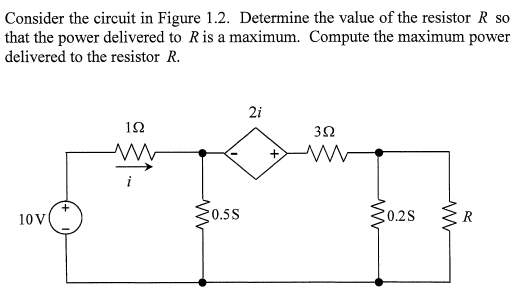
1598842471679.png

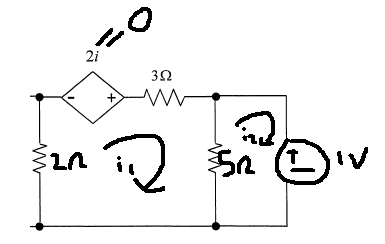
First I will compute Rth. Offing all independent sources, applying a known voltage across R (in this case 1v) and using mesh analysis,
1598842668041.png

2i1+0 (since i =0) + 3i1+5(i1-i2) = 0
10i1=5i2
5i1=2.5i2 -- Equation 1
2nd Loop:
5(i2-i1)+1 =0
Combing this with equation 1,
5i2 - 2.5i2 +1 =0
i2 = -0.4A
Hence Rth = 1/0.4 = 2.5 ohms.
Note: For Rth, the answer stated was 1.92ohms using nodal analysis.

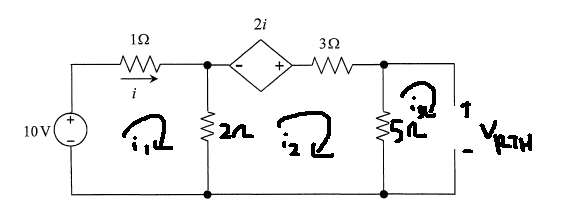
Now to find Vth, I will just use normal mesh analysis for the normal circuit:
1598842887588.png

Mesh 1:
=-10+i1+2(i1-i2)=0 --> -10+3i1-2i2=0 --> **2i2 = 10+3i1**
Mesh 2:
2(i2-i1) - 2i1 +3i2+5(i2-i3) =0 --> **i1 = (-10i2+5i3)/4**
Mesh 3:
5(i3-i2)+Vr= 0 --> Vr= 5i2-5i3
Around whole loop:
=-10+i1-2i1+3i2+Vr=0 --> Using Mesh 3 equation, **i1=8i2-5i3-10**

Solving these 3 equations, i3 = 0.5A, i2 = 1.25A
Hence Vrth = 5( 1.25- 0.5) = 3.75V

Pmax =(Vrth^2)/4Rth = 1.40W?

Thanks.
 
Physics news on Phys.org
jisbon said:
Homework Statement:: -
Relevant Equations:: -

Offing all independent sources
You don't remove those sources, you set them to zero. Voltage sources intrinsically have zero impedance, since if you inject a finite current through them their voltage doesn't change, like a zero ohm resistor. Current sources have intrinsically infinite impedance, since if you inject a finite voltage across them the current doesn't change, like an infinite resistor.

So, a 0V independent voltage source is the same as a short circuit. A 0A independent current source is the same as an open circuit.
 
  • Like
Likes   Reactions: cnh1995
DaveE said:
You don't remove those sources, you set them to zero. Voltage sources intrinsically have zero impedance, since if you inject a finite current through them their voltage doesn't change, like a zero ohm resistor. Current sources have intrinsically infinite impedance, since if you inject a finite voltage across them the current doesn't change, like an infinite resistor.

So, a 0V independent voltage source is the same as a short circuit. A 0A independent current source is the same as an open circuit.
Ah okay. But what I did in my working was also simply setting them to zero, isn't it? Why will the solution be wrong here?
 
Sorry, I just didn't follow why you want to find Rth, or even what it is. Thevenin resistance, I guess, but which one, where? I'm not saying your approach is wrong, I'm saying I didn't follow it. A combination of my laziness, confusion because of some mistake you made early on, and perhaps a lack of a clear definition of what process you are following.

My approach would be different. To start with, what is the current in the 2 ohm resistor? Can you solve for i, just looking at the left-most loop?

edit: sorry I skipped your question: No you didn't set the INDEPENDENT sources to zero, you removed them. Refer to my previous comment. Then you concluded that the dependent source (=2i) was zero. Perhaps you should rethink that part.

Frankly, I don't really understand why your setting anything to zero. This circuit can be analyzed as it is using KCL and KVL. The source transformation theorems (Thevenin, etc.) should be used to simplify problems, not applied always, not if they make things more complicated.

Your solution is wrong because you have made mistakes in the analysis.
 
Last edited:
DaveE said:
Sorry, I just didn't follow why you want to find Rth, or even what it is. Thevenin resistance, I guess, but which one, where? I'm not saying your approach is wrong, I'm saying I didn't follow it. A combination of my laziness, confusion because of some mistake you made early on, and perhaps a lack of a clear definition of what process you are following.

My approach would be different. To start with, what is the current in the 2 ohm resistor? Can you solve for i, just looking at the left-most loop?

edit: sorry I skipped your question: No you didn't set the INDEPENDENT sources to zero, you removed them. Refer to my previous comment. Then you concluded that the dependent source (=2i) was zero. Perhaps you should rethink that part.

Frankly, I don't really understand why your setting anything to zero. This circuit can be analyzed as it is using KCL and KVL. The source transformation theorems (Thevenin, etc.) should be used to simplify problems, not applied always, not if they make things more complicated.

Your solution is wrong because you have made mistakes in the analysis.

I was taught that to compute maximum power, I will need to find out the Thevenin resistance and voltage. To find Thevenin resistance, I will need to off any independent sources, and then use any form of circuit analysis to solve for the Thevenin resistance
Since it (the voltage source) is set to 0,
1598867101127.png

I then again use mesh analysis to solve for i1, 2 and 3, and found that i3 = -1/80 A. (which is evidently wrong).
May I know if the approach I am taught is wrong? or..?
 
jisbon said:
I was taught that to compute maximum power, I will need to find out the Thevenin resistance and voltage.
OK, that method will work. I don't think it makes the problem any easier though.

So, using your method, how will you find Rth? You've already described an approach, but I don't think you've actually done it correctly yet. You will want to simplify the problem by finding out what you can about the dependent current source. Again, what is the current in the 2 ohm resistor?

Hint: because the confusing part of the circuit is a current source, using KCL may be helpful.
 
Note that the circuit contains a dependent voltage source, not a dependent current source.
 
@jisbon , Have you made any progress on this problem?
 

Similar threads

  • · Replies 14 ·
Replies
14
Views
3K
  • · Replies 7 ·
Replies
7
Views
2K
  • · Replies 3 ·
Replies
3
Views
3K
  • · Replies 4 ·
Replies
4
Views
2K
  • · Replies 6 ·
Replies
6
Views
3K
  • · Replies 7 ·
Replies
7
Views
2K
  • · Replies 187 ·
7
Replies
187
Views
59K
  • · Replies 4 ·
Replies
4
Views
3K
  • · Replies 4 ·
Replies
4
Views
2K
  • · Replies 1 ·
Replies
1
Views
2K