Find the total power developed in the circuit given the readout

  • Thread starter Thread starter PhDeezNutz
  • Start date Start date
  • Tags Tags
    Circuit Power
Click For Summary

Homework Help Overview

The discussion revolves around calculating the total power developed in a circuit based on given readouts. The original poster expresses confusion regarding the application of the passive sign convention and the implications of their calculations, suggesting that the circuit does not develop power, which contradicts the problem statement.

Discussion Character

  • Conceptual clarification, Assumption checking, Mixed

Approaches and Questions Raised

  • Participants explore the implications of power calculations based on the passive sign convention, questioning the original poster's reasoning about power being destroyed rather than developed. Some suggest that the circuit may be a power source, while others seek clarification on the schematic and the nature of the components involved.

Discussion Status

The discussion is ongoing, with participants providing feedback on calculations and interpretations. Some have pointed out potential errors in the original poster's reasoning, particularly regarding the sign of power for certain elements. There is a recognition of the complexity of the problem, with suggestions to reconsider the assumptions made.

Contextual Notes

Participants note the importance of accurately interpreting the schematic and the potential for confusion in the problem's setup. There is an acknowledgment of the need to clarify the roles of different circuit elements in power delivery and dissipation.

PhDeezNutz
Messages
851
Reaction score
561
Homework Statement
Given the reference polarities for current directions along with the current/voltage readout.....find the power developed in the circuit. (See picture below)
Relevant Equations
##p = vi## if reference current is in direction of decreasing potential (##+## to ##-##)
##p = - vi## if reference current is in the opposite direction of decreasing potential (##-## to ##+##)
Here is the problem with my power calculations in blue. My reasoning is that + terminal is higher potential, − terminal is lower potential and if the reference goes in the direction of decreasing potential then p=vi and if it goes against the decreasing potential then p=−vi. I've applied this reasoning and I have concluded that this circuit doesn't develop power. Which seems counterintuitive given that the problem statement is "how much power does the circuit develop?".
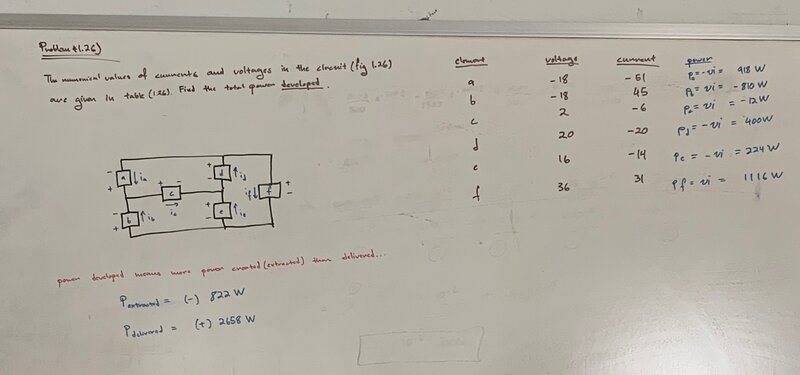
IMG_5206.jpeg


Again I am concluding that the power extracted is less than power delivered and therefore power is being destroyed and not developed?

Do I have serious misunderstandings of passive sign convention or is this a trick question?

Any help is appreciated in advance.
 
Physics news on Phys.org
Sorry, I'm not able to read the image well enough to help yet. Are those all resistors in the drawing? If so, where are any voltages or current inputs coming from?

Can you post a better copy of the schematic please? Thanks.
 
  • Like
Likes   Reactions: PhDeezNutz
berkeman said:
Sorry, I'm not able to read the image well enough to help yet. Are those all resistors in the drawing? If so, where are any voltages or current inputs coming from?

Can you post a better copy of the schematic please? Thanks.
4195AA43-294F-4B4F-A94E-3C86F4C241FA_1_201_a.jpeg


Hopefully that is easier to read

I figure for element A ##p=-vi## since reference current is going against the potential drop hence ##p_a =- vi = 918W##

I figure for element B ##p = vi## since reference current is going with the potential drop hence ##p_b = vi = -810W##

Following this pattern

I get

##p_a = -vi = 918W##
##p_b = vi = -810 W##
##p_c = vi = -12 W##
##p_d = -vi = 400W##
##p_e = -vi = 224W##
##p_f = vi = 1116W##

adding up all the negatives as power extracted and all the positives as power delivered, I get

##p_{extracted} = 822 W##
##p_{delivered} = 2658 W##

Less power is extracted from than delivered to so I am inclined to think power is destroyed and not developed which is counter to the problem statement. I must have some conceptual misunderstandings.
 
Well if it's a physical circuit, no power is "created" or "destroyed". If it is a closed circuit, the power delivered should equal the power dissipated. I'll try to take a look...
 
berkeman said:
Well if it's a physical circuit, no power is "created" or "destroyed". If it is a closed circuit, the power delivered should equal the power dissipated. I'll try to take a look...

I think this is a question where conservation of energy is supposed to be violated and we are supposed to interpret it.
 
Already on "a" I think I get a different result. If the current is flowing from - potential to +potential, that is a power source. If positive power is dissipated in a resistor for example, negative power is the power delivered to the circuit. Why is your answer for "a" positive?
 
The diagram shows the directions of current and voltage for "a" implying that it is a power source, and they happen to negate *both* of those directions with the data in the table. So it is still a power source element...
 
berkeman said:
Already on "a" I think I get a different result. If the current is flowing from - potential to +potential, that is a power source. If positive power is dissipated in a resistor for example, negative power is the power delivered to the circuit. Why is your answer for "a" positive?
Sh** I made a mistake. Thanks for pointing it out. I think that one sign error (all the rest are right I think) changes the whole solution.

I then get ##1740W## are delivered and ##1740W## are extracted in total. Therefore no power is developed.

Do you agree? This seems sensible.

I can't believe i messed up on multiplication. I am embarrassed.
 
Yeah, it looks like only your sign for "a" is wrong.
 
  • Like
Likes   Reactions: PhDeezNutz
  • #10
I am so embarrassed haha. oh well it happens to the best of us.
 
  • Like
Likes   Reactions: berkeman
  • #11
PhDeezNutz said:
I can't believe i messed up on multiplication. I am embarrassed.
No need to be. The problem is being confusing on purpose, but it seems like you have it figured out well now. :smile:
 
  • Like
Likes   Reactions: PhDeezNutz
  • #12
BTW, the power balance is always a good way to double-check your work. :wink:
 
  • Like
Likes   Reactions: bob012345 and PhDeezNutz
  • #13
berkeman said:
No need to be. The problem is being confusing on purpose, but it seems like you have it figured out well now. :smile:

Appreciate it man. I don't say it enough but posters like you and @hutchphd are cornerstones of this great community.
 
  • Like
Likes   Reactions: Steve4Physics, bob012345 and berkeman
  • #14
PhDeezNutz said:
negatives as power extracted and all the positives as power delivered

It helped me a great deal to first redraw the pluses and the minuses as well as the arrows in the diagram in such a way that all values in the table are positive.

##\ ##
 
  • Like
Likes   Reactions: PhDeezNutz

Similar threads

  • · Replies 1 ·
Replies
1
Views
2K
Replies
4
Views
2K
  • · Replies 21 ·
Replies
21
Views
2K
  • · Replies 13 ·
Replies
13
Views
6K
  • · Replies 3 ·
Replies
3
Views
2K
Replies
1
Views
3K
  • · Replies 7 ·
Replies
7
Views
2K
Replies
1
Views
2K
  • · Replies 4 ·
Replies
4
Views
3K
  • · Replies 3 ·
Replies
3
Views
2K