Find the volume of the parallelepiped

  • Thread starter Thread starter chwala
  • Start date Start date
  • Tags Tags
    Volume
Join the discussion
Registration is free. Ask a follow-up in this thread, or start your own.
5 replies · 4K views
chwala
Gold Member
Messages
2,844
Reaction score
434
Homework Statement
see attached
Relevant Equations
vector calculus
Am refreshing on this; see attached below
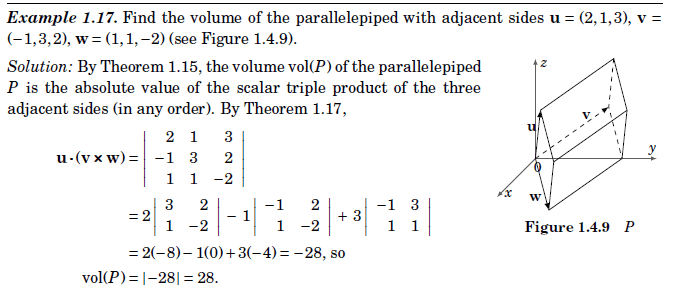
1643256849273.png
ok we can also use the form ##[i×j=k, k×i=j , j×k=i]## right?

to give us say, ##w⋅(u ×v)=v⋅(w ×u)## in realizing same solution.
 
Physics news on Phys.org
Please elaborate on what you mean by "the form ##[i×j=k, k×i=j , j×k=i]##".
 
I wanted to indicate,
For any vectors in 3-dimensional space it follows that,
##w⋅(u ×v)=v⋅(w ×u)=u⋅(v ×w)##... yap with this, i should realize the same value of the required volume... the form ##[i×j=k, k×i=j , j×k=i]## is not applicable here...
 
chwala said:
the form ##[i×j=k, k×i=j , j×k=i]## is not applicable here...
Thank you for your reply.
 
Nice sysprog...I am refreshing on this area, its long since I looked at vector calculus...of course I should be able to check and prove (some of the questions that I ask) the concept given, I just want to be certain that it's mathematically acceptable from the great minds here...cheers
 
It seems to me that you're trying to solidify your understanding of the relation that the dot product has to the cross product.

It's true that if ##u##, ##v## and ##w##, are vectors in 3-space, then ##w · (u × v) = v · (w × u) = u · (v × w)##.

Interchanging two rows changes the sign of a determinant, so interchanging two rows twice results in the same-sign determinant.
 
Reply
  • Like
Likes   Reactions: chwala