Find Vout as a function of V1 and V2 (OP Amps)

  • Context: Engineering 
  • Thread starter Thread starter rugerts
  • Start date Start date
  • Tags Tags
    Amps Function Op amps
Click For Summary

Discussion Overview

The discussion revolves around finding the output voltage (Vout) as a function of two input voltages (V1 and V2) in a circuit involving operational amplifiers (op amps). Participants explore the discrepancies between hand calculations and LTSpice simulations, focusing on the implications of using real-world op amps versus ideal models.

Discussion Character

  • Exploratory
  • Technical explanation
  • Debate/contested
  • Mathematical reasoning

Main Points Raised

  • One participant reports a simulation result of Vout around -13 V, which does not align with their hand calculations when V1 and V2 are both set to 5 V.
  • Another participant suggests there may be an input polarity error in the LTSpice circuit and requests a clearer circuit diagram with labeled voltages.
  • A participant highlights the constraints imposed by the op amp's power supply (Vcc) and the limitations of the LM741 op amp's output swing, indicating that real-world components cannot achieve full rail output.
  • Some participants discuss the difference in analysis when considering ideal op amps versus real-world components, noting that the latter introduces constraints that affect output voltage.
  • One participant mentions their goal of deriving a general expression for Vout based on any V1 or V2, while acknowledging the assumptions made in their hand calculations.
  • Several participants point out that the polarity for the last op amp in the LTSpice simulation is incorrect, which could be contributing to the discrepancies observed.
  • There is a suggestion to replace the 741 op amps in the simulation with a generic op amp model that does not have real-world limitations.
  • Another participant proposes adjusting the input voltage (V1) to a lower value to avoid driving the op amps to their output limits.

Areas of Agreement / Disagreement

Participants express differing views on the behavior of the op amps in the circuit, particularly regarding the impact of using real-world components versus ideal models. There is no consensus on the correct approach to resolve the discrepancies between hand calculations and simulation results.

Contextual Notes

Participants note that the hand calculations assume ideal op amp behavior, while the LTSpice simulation reflects real-world constraints, including output swing limitations of the LM741 op amp. The discussion highlights the importance of considering these factors when analyzing circuit behavior.
rugerts
Messages
153
Reaction score
11
Homework Statement
Find an expression for the output voltage as a function of the input voltages
Relevant Equations
KVL, KCL, ideal op amp assumptions
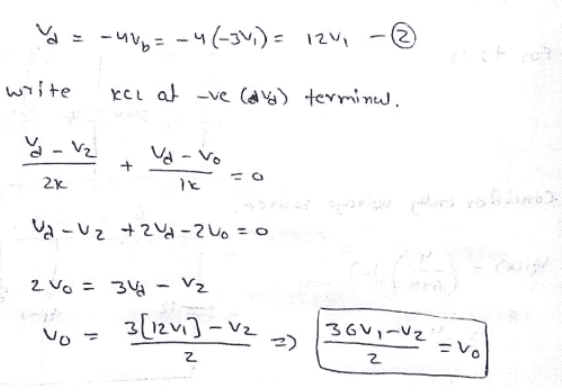
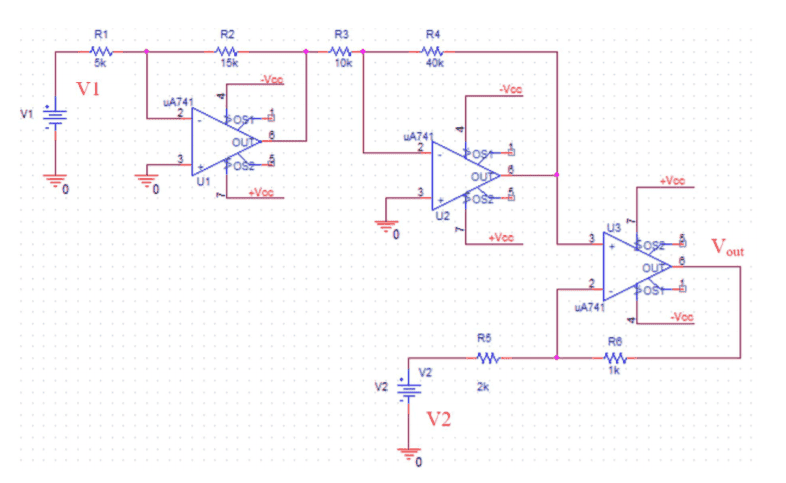
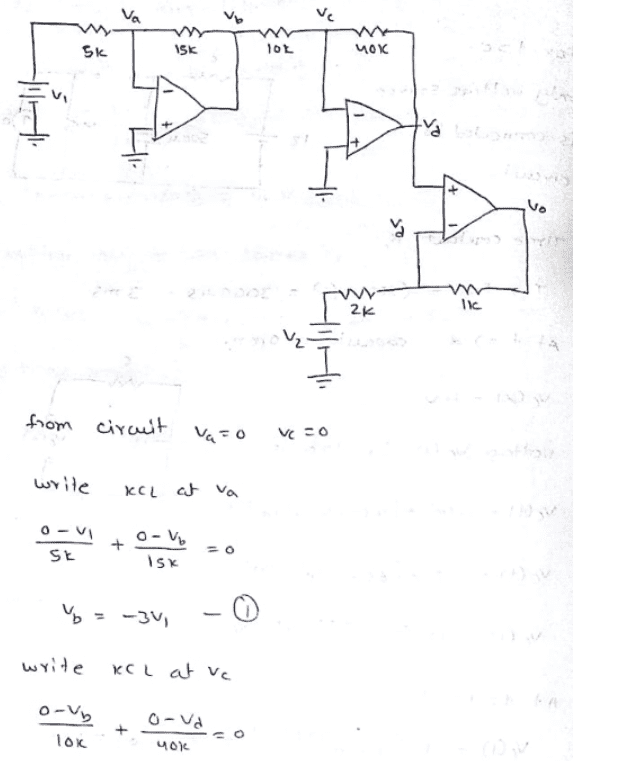
Here's the circuit in question:
1573932365241.png

Solution:
1573932390559.png
1573932409810.png


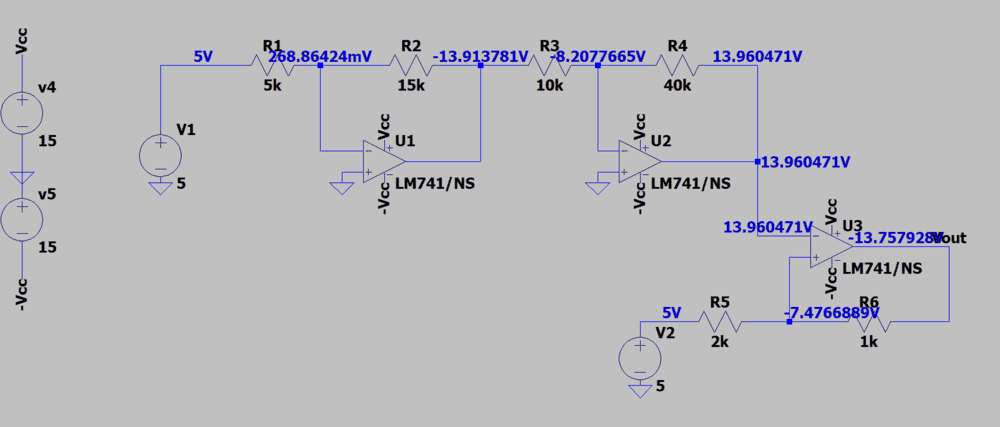
Now, when I try simulating in LTSpice, this is what I get:
1573932481696.png


So, Vout appears to be around -13 V, which doesn't agree with the equation if V1=V2= 5 is plugged in.

Does anyone see the mistake here?
THanks.
 
Physics news on Phys.org
Your final LTSpice circuit seems to have an input polarity error for U3.

You didn't state it in your problem statement (I may have missed it), but V1=V2=5V? I see that at the end of your post. I don't see those numbers in your handwritten calculations (but again I may be not understanding).

Can you unambiguously draw the circuit and label each node with the voltage? Thanks.
 
Ponder what constraints the Vcc supplies for the op amps imply, and also what real world constraints there are for LM741's maximum output swing.

From your LTSpice diagram it seems that the Vcc voltages for the opamps are ±15 V. That's fine. However, if you look at the first stage, that 5 V input voltage is going to want to push 1 mA into the 5 kΩ input resistor. That 1 mA will want to drop 15 V across the 15 kΩ feedback resistor. That's the full rail potential as set by Vcc.

A real life 741 opamp can't achieve a full rail swing (the opamp output can only approach to within about a volt of the Vcc voltages at best, and often closer to one and a half or more volts). That's why your simulation shows -13.9 V for Vb.

The next stage has a theoretical gain of -40/10 = 4, but with the input already at -15 V (well, -13.9 for "real life" parts) it clearly can't perform that operation, and its output must swing as close as it can to the appropriate rail. So another 13.9 V result.

I'll leave it there and encourage you to take a fresh look at the final stage using the concepts introduced above.
 
  • Like
Likes   Reactions: berkeman
In my reply above I assumed that you were working with "real world" components rather than ideal op amps, since you chose specific components in your simulation. If the op amps are instead considered ideal with no constraints on the output voltage swing, clearly the analysis would go in a different direction since the achievable output swings for the op amps would no longer be a constraint to impose.
 
@berkeman
@gneill

So, for the hand calculations, I'm doing them for any V1 or V2 since my goal is to find an expression for Vout as a function of V1 and V2.
For the LTSpice simulation, I just plugged in 5V for both sources and 15V for the OP Amps. There's no particular reason for these number choices, I sort of just assumed they would work.

In my hand calculations, there is the assumption of the ideal op amp. In the simulated LTSpice circuit, I think it does just a good approximation of the ideal state.

Good point about the polarities. That's sort of confusing me. I tried changing them around but it's still not getting me the result I obtained doing the hand calculation.
 
The calculation (handwritten) is correct - however, the polarity for the last opamp (LT simulation) is wrong (as mentioned already by berkeman)
 
LvW said:
The calculation (handwritten) is correct - however, the polarity for the last opamp (LT simulation) is wrong (as mentioned already by berkeman)
It seems like it's still wrong.
1574013375238.png

1574013949697.png

Based on the hand calculation, I'm expecting Vout = (36*5-5)/2 = 87.5 V
 
Last edited:
rugerts said:
Based on the hand calculation, I'm expecting Vout = (36*5-5)/2 = 87.5 V
With 741 op amps running with Vcc = 15 V? That'll never happen. See post #3.

Try replacing the 741's in your simulation with the generic "opamp" component. No Vcc specification required.
 
gneill said:
With 741 op amps running with Vcc = 15 V? That'll never happen. See post #3.

Try replacing the 741's in your simulation with the generic "opamp" component. No Vcc specification required.
How so? We used 741 OP Amps in lab running on 15V. Unless you mean for this specific configuration shown? Also, in the original schematic up top shown it says 741 next to each op amp.
 
  • #10
rugerts said:
How so? We used 741 OP Amps in lab running on 15V. Also, in the original schematic up top shown it says 741 next to each op amp.
You are wondering why your hand calculations are not matching the simulation. The explanation is in post #3. If you want the simulation to match your calculations, replace the "real world" 741's with generic opamps that don't have any "real world" limitations.

Alternatively, change your V1 value to something that won't drive the op amps to the rails. Try V1 = 0.5 V for example.
 
  • #11
gneill said:
You are wondering why your hand calculations are not matching the simulation. The explanation is in post #3. If you want the simulation to match your calculations, replace the "real world" 741's with generic opamps that don't have any "real world" limitations.

Alternatively, change your V1 value to something that won't drive the op amps to the rails. Try V1 = 0.5 V for example.
Understood and thank you. Simulation works and agrees with hand calculation.
 
  • Like
Likes   Reactions: gneill

Similar threads

  • · Replies 1 ·
Replies
1
Views
2K
Replies
15
Views
3K
  • · Replies 13 ·
Replies
13
Views
3K
  • · Replies 8 ·
Replies
8
Views
2K
  • · Replies 1 ·
Replies
1
Views
2K
  • · Replies 59 ·
2
Replies
59
Views
5K
  • · Replies 8 ·
Replies
8
Views
2K
  • · Replies 17 ·
Replies
17
Views
3K
  • · Replies 4 ·
Replies
4
Views
2K
  • · Replies 0 ·
Replies
0
Views
2K