Finding an expression for the efficiency of a heat engine

Click For Summary
SUMMARY

The discussion centers on the efficiency of a heat engine, specifically addressing discrepancies between a user's calculations and the provided answer key. The user identifies a potential algebraic error related to the temperature ratios Tc/Th and Tc/Tm. They emphasize that when the cold reservoir temperature (Tc) approaches 0 K, the efficiency should theoretically reach 100%, contradicting the answer key's results. The standard formula for efficiency, 1 - (Tc/Th), is confirmed as correct, highlighting the flaws in the book's answer which yields negative efficiency values.

PREREQUISITES
  • Understanding of thermodynamic principles, particularly heat engines
  • Familiarity with the concept of temperature ratios in thermodynamics
  • Knowledge of algebraic manipulation for solving equations
  • Basic grasp of the Carnot efficiency formula
NEXT STEPS
  • Study the Carnot efficiency formula in detail
  • Explore the implications of absolute zero on thermodynamic efficiency
  • Review common algebraic errors in thermodynamic calculations
  • Investigate the derivation of efficiency equations for various heat engine cycles
USEFUL FOR

This discussion is beneficial for students of thermodynamics, engineers working with heat engines, and educators seeking to clarify concepts related to engine efficiency and temperature effects.

guyvsdcsniper
Messages
264
Reaction score
37
Homework Statement
A reversible heat engine extracts
heat QH > 0 from a reservoir at temperature TH and heat QM = aQH > 0
from a reservoir at temperature TM ≤ TH while rejecting waste heat QC > 0
to a reservoir at temperature TC ≤ TM.

Derive an expression for the effi ciency of this three- reservoir heat
engine in terms of a and the three temperatures TH, TM, and TC ,
where the effi ciency is the total work produced divided by the total
heat extracted from the two hotter reservoirs.
Relevant Equations
(1 − TH /TC )/(1 + a) + (1 − TM /TC )a/(1 + a)
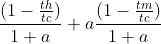
My book states the answer to this problem is
gif.gif
.

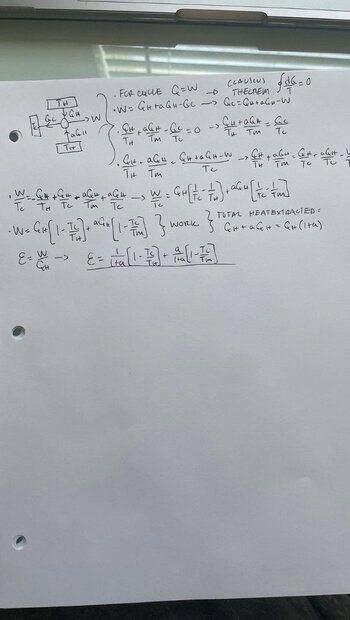
I have gotten very close to the answer. My problem is my Tc/th and tc/tm are flipped compared to the solution.

I feel like I am missing something in my algebra but can't see where I am going wrong. Could I get some help identifying where my mistake is.
IMG_8465.JPG
 
Physics news on Phys.org
The answer key wherever it's coming from doesn't make sense. Remember if the cold reservoir has 0 K, you are supposed to get 100% efficiency which is not happening with the answer key you cited.
 
  • Like
Likes vela, Steve4Physics and guyvsdcsniper
Thank you. I was breaking my head over this but letting Tc = 0k really does help illuminate the answer
 
Another handy check is to let ##a=0##. This gives a simple heat engine working between ##T_h## and ##T_c##. The efficiency should then be ##1 - \frac {T_c}{T_h}## (standard formula).
 
guv said:
The answer key wherever it's coming from doesn't make sense. Remember if the cold reservoir has 0 K, you are supposed to get 100% efficiency which is not happening with the answer key you cited.
You might also notice that the book's answer always results in a negative number for the efficiency. It can't possibly be correct.
 
The book claims the answer is that all the magnitudes are the same because "the gravitational force on the penguin is the same". I'm having trouble understanding this. I thought the buoyant force was equal to the weight of the fluid displaced. Weight depends on mass which depends on density. Therefore, due to the differing densities the buoyant force will be different in each case? Is this incorrect?

Similar threads

Replies
1
Views
1K
Replies
14
Views
2K
  • · Replies 5 ·
Replies
5
Views
2K
  • · Replies 3 ·
Replies
3
Views
4K
  • · Replies 2 ·
Replies
2
Views
3K
  • · Replies 2 ·
Replies
2
Views
2K
  • · Replies 20 ·
Replies
20
Views
3K
  • · Replies 2 ·
Replies
2
Views
1K
Replies
2
Views
2K
  • · Replies 32 ·
2
Replies
32
Views
4K