Finding angular speed geometrically

Click For Summary
The discussion focuses on finding angular speed geometrically using trigonometric relationships. The initial approach involves differentiating the tangent function but leads to confusion about the validity of the approximations used. A calculation error is identified, specifically regarding the inversion of the secant function in the derived equations. The participants clarify that the correct relationship should involve sine rather than the differential angle, highlighting the importance of accurate notation. Ultimately, the conversation emphasizes the need for careful attention to detail in mathematical derivations.
PhysHobbiest
Messages
7
Reaction score
3
Homework Statement
As the title says, I was simply looking to geometrically find the angular speed of an object traveling along a line on the x axis with respect to a position at a height h on the z axis.
Relevant Equations
tan(θ) = x/h
So clearly the easiest way to relate the angular speed to the linear speed would be to start from ##\tan(θ) = x/h## and take a time derivative of both sides. However, it also shouldn't be difficult to find the angular speed geometrically. Using the diagram below one can see that:
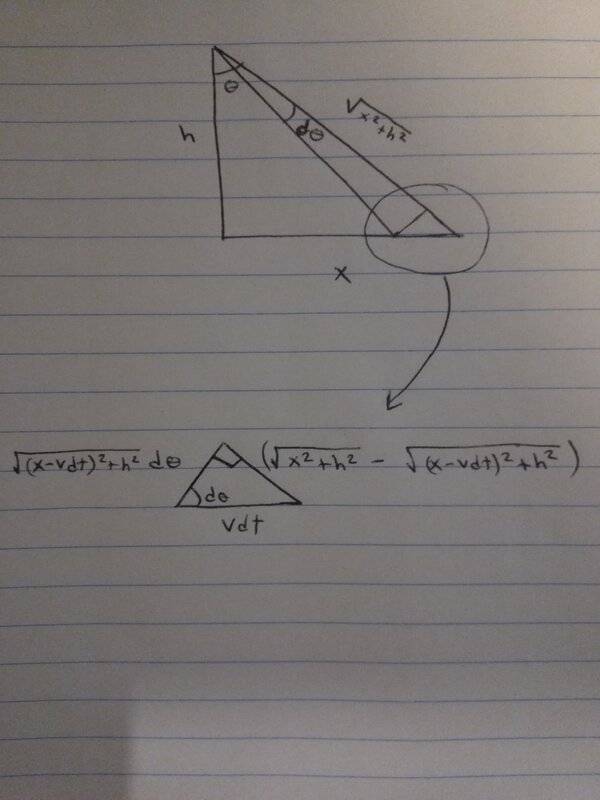
IMG_20210130_181315.jpg


##sin(dθ) = \frac {{\sqrt {x^2+h^2}}-{\sqrt {(x-vdt)^2+h^2}}} {vdt}##

which is approximately (after a small angle approx and using the definition of the derivative)

##dθ = \frac {d} {dx} \sqrt {x^2+h^2}##

which yields

##dθ = \frac {x} {\sqrt {x^2+h^2}}##

Now this I believe is nonsense, and I'm having difficulty figuring out exactly what went wrong. Did I mess up along the way, or were the approximations I made not good ones? My guess is any approximation that would leave an infinitesimal value on only one side of the equation is a bad one. Just looking for confirmation here.
 
Last edited:
Physics news on Phys.org
Please check your result with my calculation.
x=h\tan\theta
\frac{dx}{dt}=h \sec^2\theta \frac{d\theta}{dt}=\frac{h^3}{h^2+x^2}\frac{d\theta}{dt}

EDIT calculation error as pointed out in #3. Thanks.
 
Last edited:
anuttarasammyak said:
Please check your result with my calculation.
x=h\tan\theta
\frac{dx}{dt}=h \sec^2\theta \frac{d\theta}{dt}=\frac{h^3}{h^2+x^2}\frac{d\theta}{dt}
Thanks for the input, I believe you accidentally inverted ##\sec^2\theta## when you expanded it out. The answer should look like

##\frac {dx} {dt} = \frac {h^2 + x^2} {h} \frac {d\theta}{dt}##

I'm aware of what the answer should be, I was simply looking for the flaw in my above reasoning. It was unsettling to me that the simple geometric reasoning I was using was yielding the nonsense that I got.
 
  • Like
Likes anuttarasammyak
The first formula in post #1
\sin(d\theta)=...
should be
\sin\theta =... ?
If so it tells just obvious
sin \theta = \frac{x}{\sqrt{x^2+h^2}}
 
Last edited:
  • Like
Likes PhysHobbiest
oof, thanks for being another set of eyes on that. I don't know how I mistaked θ with dθ there.
 
  • Like
Likes anuttarasammyak
Question: A clock's minute hand has length 4 and its hour hand has length 3. What is the distance between the tips at the moment when it is increasing most rapidly?(Putnam Exam Question) Answer: Making assumption that both the hands moves at constant angular velocities, the answer is ## \sqrt{7} .## But don't you think this assumption is somewhat doubtful and wrong?

Similar threads

  • · Replies 2 ·
Replies
2
Views
1K
  • · Replies 3 ·
Replies
3
Views
2K
  • · Replies 3 ·
Replies
3
Views
2K
  • · Replies 4 ·
Replies
4
Views
2K
  • · Replies 1 ·
Replies
1
Views
2K
  • · Replies 2 ·
Replies
2
Views
2K
Replies
9
Views
2K
  • · Replies 11 ·
Replies
11
Views
2K
Replies
6
Views
3K
Replies
67
Views
4K