ananonanunes
- 19
- 6
- Homework Statement
- _
- Relevant Equations
- _
Suppose the switch has been closed for a long time so that the capacitor is fully charged and current is constant.
a)Find the current in each resistor and charge Q of the capacitor.
b)The switch is now opened at t=0s. Write the equation for the current for the resistor of 15kΩ as a function of time and find the time interval needed for the charge to drop to 1/5 of its original value.
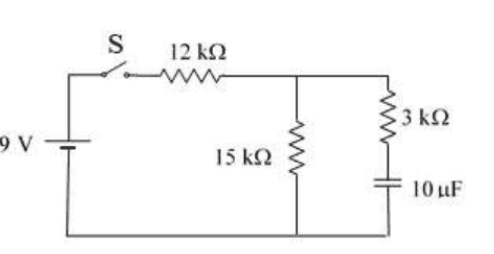
I was able to find the current in the resistors. I assumed the current would be 0A in the resistor of ##3k\Omega## and since there is no current in this "branch", the other two resistors are in series so ##I_{R_1}=I_{R_2}## and ##R_{eq}=12+15=27k \Omega##. ##I=\frac{\mathcal{E}}{R_{eq}}=333mA##.
I don't know how to find the charge in the capacitor. I thought that, because it was fully charged, ##Q=C\mathcal{E}## but that is not the correct answer.
a)Find the current in each resistor and charge Q of the capacitor.
b)The switch is now opened at t=0s. Write the equation for the current for the resistor of 15kΩ as a function of time and find the time interval needed for the charge to drop to 1/5 of its original value.
I was able to find the current in the resistors. I assumed the current would be 0A in the resistor of ##3k\Omega## and since there is no current in this "branch", the other two resistors are in series so ##I_{R_1}=I_{R_2}## and ##R_{eq}=12+15=27k \Omega##. ##I=\frac{\mathcal{E}}{R_{eq}}=333mA##.
I don't know how to find the charge in the capacitor. I thought that, because it was fully charged, ##Q=C\mathcal{E}## but that is not the correct answer.