Finding global minima of nth degree polynomials

Join the discussion
Registration is free. Start your own thread to ask a follow-up.
2 replies · 2K views
Mayhem
Messages
441
Reaction score
326
Is it possible (read: reasonably easy) to find global minima of an nth degree polynomial of the general form $$a_nx^n + a_{n-1}x^{n-1} ... a_2x^2 +a_1x + a_0 = 0$$ It seems to have applications in computational chemistry as I have a "hunch" that polynomial regression could be used to somewhat accurately predict the lowest conformational energy levels of complicated molecules.

Inspiration for this hunch:
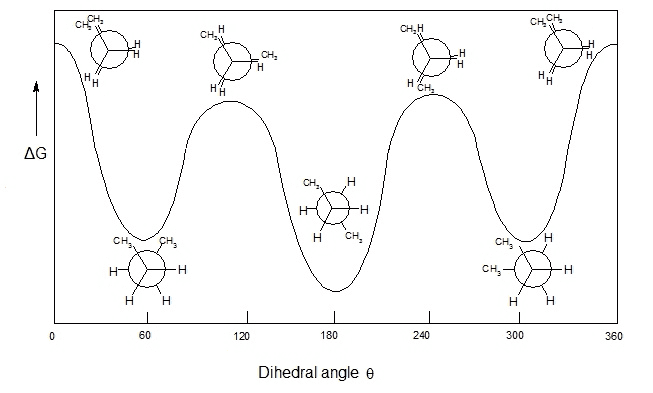
1606155042698.png

Finding extrema for a given polynomial requires finding zeroes of its first derivatives. I heard this gets difficult quickly.

Any input? This is purely out of curiosity.
 
Last edited:
Physics news on Phys.org
Mayhem said:
Is it possible (read: reasonably easy) to find global minima of an nth degree polynomial of the general form $$a_nx^n + a_{n-1}x^{n-1} ... a_2x^2 +a_1x + a_0 = 0$$ It seems to have applications in computational chemistry as I have a "hunch" that polynomial regression could be used to somewhat accurately predict the lowest conformational energy levels of complicated molecules.

Of course, some polynomials like ##f(x) = x^3## and ##f(x) = -2x^2## do not have global minima. From you graph, it looks like local minima are what is useful.

As far as finding approximate solutions for the extrema of polynomials using computers, this is well known territory.

As far as writing an answer as a one-line formula in symbols using common mathematical functions, this is not easy and not even possible using what most people regard as common mathematical functions.
 
  • Like
Likes   Reactions: Mayhem
If you restrict your polynomials to a compact subset of ℝ (closed and bounded), global extrema can be found either among the local extrema or among the values on the border of the subset.