Discussion Overview
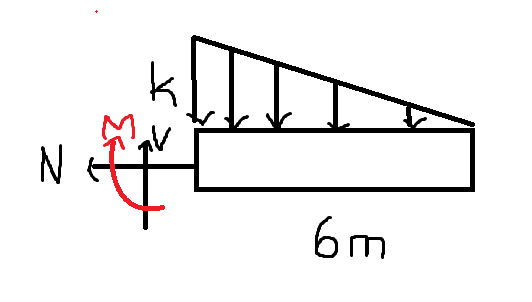
The discussion revolves around determining the resultant internal loadings acting on a cross section of a cantilevered beam, specifically at point C. Participants explore the calculations of shear forces and bending moments in the context of a triangular distributed load, engaging in both theoretical and practical aspects of structural analysis.
Discussion Character
- Homework-related
- Technical explanation
- Mathematical reasoning
- Debate/contested
Main Points Raised
- Some participants calculate the resultant force from the triangular load and find it to be 540 N, using the area under the curve.
- There is a discussion about the relationship between shear force and bending moment, with some suggesting that shear force causes bending moment.
- Participants question the location of the centroid of the triangular load and its relevance to calculating moments.
- One participant asserts that the moment at the free end of the cantilever is zero, leading to discussions about what the moment must be at point C for equilibrium.
- There is a calculation of the moment due to the applied force, with a participant stating it is 1080 Nm, derived from the resultant force and its distance from point C.
- Another participant highlights the importance of the sign of the moment, indicating that a negative moment suggests an anti-clockwise rotation.
Areas of Agreement / Disagreement
Participants express differing views on the relationship between shear force and bending moment, as well as the implications of the calculated moment at point C. The discussion remains unresolved regarding the exact interpretation of these relationships and calculations.
Contextual Notes
Participants reference various assumptions, such as the uniformity of the beam and the nature of the loading, which may affect their calculations. The discussion also highlights the need for clarity on the definitions of moments and centroids in the context of structural analysis.