Finding Ki, Kp & Kv Using Final Value Theorem

Click For Summary
SUMMARY

The discussion centers on calculating the PID controller gains Kp, Ki, and Kv using the Final Value Theorem for a ramp input. Participants emphasize the need for a complete transfer function to apply the theorem correctly, suggesting that the original problem was not adequately presented. It is concluded that the transfer function should ideally be second-order to effectively utilize the Final Value Theorem and eliminate transient responses.

PREREQUISITES
  • Understanding of PID controller parameters (Kp, Ki, Kv)
  • Familiarity with the Final Value Theorem in control systems
  • Knowledge of transfer functions and their order
  • Basic concepts of system response to ramp inputs
NEXT STEPS
  • Study the application of the Final Value Theorem in control systems
  • Learn how to derive PID controller gains from transfer functions
  • Explore second-order transfer functions and their characteristics
  • Investigate transient response analysis in control systems
USEFUL FOR

Control engineers, students studying control systems, and anyone involved in designing or tuning PID controllers.

vtaela
Messages
25
Reaction score
0
hi

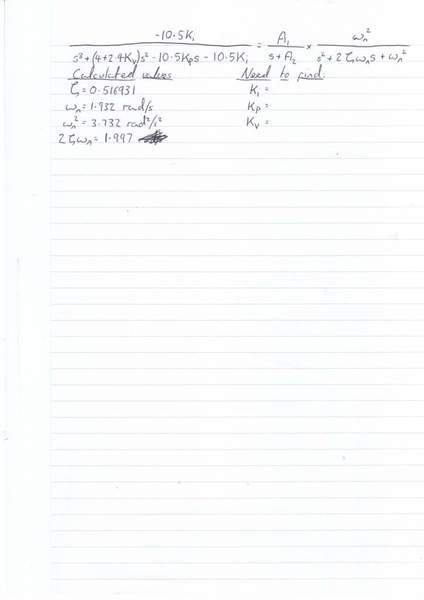
i need to perform a final value theorem for the ramp input shown below in order to find Ki Kp and Kv.

could someone guide me on how to find these values?

Scan.jpg


thank you
 
Engineering news on Phys.org
Is this a homework problem or some problem from a book you're trying to solve?

In any case, your attachment doesn't provide enough information to solve for your unknowns. Are Kp, Ki and Kv gains for a PID controller?

I can't see what you would gain by applying the final value theorem.
 
It certainly looks like homework, but beyond that you should have provided the original problem. To me, it looks like you applied the ramp incorrectly, but I can't be sure without the original problem.

Is that your transfer function on the left that you tried to apply a ramp to? My suspicion is that it should have been 2nd order, then you can apply the ramp to the transfer function, then apply the final value theorem to remove the transient portion of the transfer function.
 

Similar threads

Replies
2
Views
2K
  • · Replies 5 ·
Replies
5
Views
3K
Replies
1
Views
3K
  • · Replies 1 ·
Replies
1
Views
1K
  • · Replies 3 ·
Replies
3
Views
2K
Replies
4
Views
2K
  • · Replies 56 ·
2
Replies
56
Views
5K
  • · Replies 13 ·
Replies
13
Views
2K
  • · Replies 11 ·
Replies
11
Views
3K
  • · Replies 2 ·
Replies
2
Views
3K