Finding Ki, Kp & Kv Using Final Value Theorem

Join the discussion
Ask a follow-up here, or get your own question answered by working scientists, mathematicians and engineers — people, not an autocomplete.
Real named experts · corrections over time · the nuance an AI answer skips
2 replies · 3K views
vtaela
Messages
25
Reaction score
0
hi

i need to perform a final value theorem for the ramp input shown below in order to find Ki Kp and Kv.

could someone guide me on how to find these values?
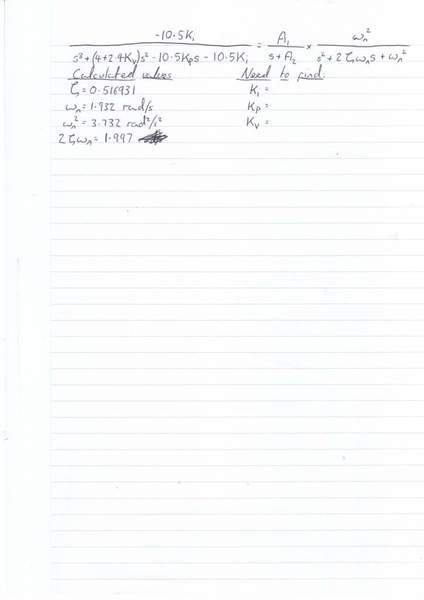

Scan.jpg


thank you
 
Engineering news on Phys.org
Is this a homework problem or some problem from a book you're trying to solve?

In any case, your attachment doesn't provide enough information to solve for your unknowns. Are Kp, Ki and Kv gains for a PID controller?

I can't see what you would gain by applying the final value theorem.
 
It certainly looks like homework, but beyond that you should have provided the original problem. To me, it looks like you applied the ramp incorrectly, but I can't be sure without the original problem.

Is that your transfer function on the left that you tried to apply a ramp to? My suspicion is that it should have been 2nd order, then you can apply the ramp to the transfer function, then apply the final value theorem to remove the transient portion of the transfer function.