Finding Radius from chord length and tangent distance

Click For Summary
SUMMARY

This discussion focuses on calculating the radius (R) of a circle using the chord length (C) and the distance from the chord to the tangent surface (S). The participants detail a method involving the coordinates of three points representing the centers of balls at the ends of calipers, leading to the equation R + r = (x1² + d²) / (2d). The conversation emphasizes the use of algebraic methods over trigonometric approaches for simplicity and accuracy in solving for R.

PREREQUISITES
  • Understanding of basic geometry, specifically circles and chords
  • Familiarity with algebraic equations and coordinate systems
  • Knowledge of the intersecting chords theorem
  • Basic trigonometry concepts (optional for deeper understanding)
NEXT STEPS
  • Study the intersecting chords theorem in detail
  • Learn how to derive the equation of a circle from given points
  • Explore algebraic methods for solving geometric problems
  • Practice drawing and analyzing geometric figures to enhance spatial understanding
USEFUL FOR

Engineering students, mathematicians, and anyone involved in geometric problem-solving or reverse engineering applications will benefit from this discussion.

LT72884
Messages
335
Reaction score
49
Ok, i have a question. First, i am an engineering student and have done all math requirements up to linear alg. HOWEVER, my geometry is terrible, oh so terrible and i need some spoon feeding right now because i am stuck on a problem.

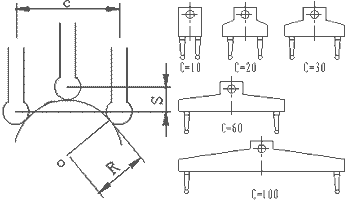
Ok, i saw a really cool tool the other day called a radius dial gauge. it measures the radius of an arc so if you are reverse engineering parts, you can find the radius of curvature if needs be.

here is a pic of it: the two end calipers do not move, they have a constant chord length of C. But different tools will have wider calipers to find bigger radii.
jaws.gif


i am wanting to understand the math behind it. How do we find R based off of the constant chord length(C), the distance of the chord to the tangent surface of the circle? or S, the center point of the caliper

thank you so much for this help:)
 

Attachments

  • jaws.gif
    jaws.gif
    3.5 KB · Views: 862
Mathematics news on Phys.org
The circle that actually is computed is has radius ##R+r ##, where ## r ## is the radius of the balls at the end of the posts. You basically have 3 points## (-x_1,-d),(0,0)##, and ## (+x_1,-d) ##, (which are the centers of the 3 balls), to fit to the equation ## x^2+(y-k)^2=(R+r)^2 ##. (You really only need two of the points, because we threw out the ## h ## term in the ## (x-h)^2 ##). You solve for ##R+r ## and then finally compute ##R ##. ## \\ ## To write it out in detail: ##x_1^2+(d+k)^2=(R+r)^2 ##, and ## k^2=(R+r)^2 ##. ## \\ ## ##x_1 ## and ## d ## are known. Solve for ## k ## and ## (R+r) ##. Two equations and two unknowns.
 
Last edited:
  • Like
Likes   Reactions: LT72884
The distance between O and the centers of the probes is R+x where x is the radius of the probes. Now draw a triangle with O, the center of the top probe and the center of one other probe. You know all lengths in the triangle and you know one height (S/2). that's all the geometry you need, the rest is trigonometry. Solve for R.
 
  • Like
Likes   Reactions: Janosh89 and LT72884
Study the attached drawing. Here ##AC =2d##. Also ##\beta = 90^o-\alpha## and ##\beta-\alpha =90^o-2\alpha##.
Now ##R=s+z=s+R\sin(\beta-\alpha)=s+R\cos(2a)=s+R(\cos^2\alpha-\sin^2\alpha)##.

In terms of the fixed distance between the outer sensors ##2d## and the measured distance ##s##, $$\cos^2\alpha-\sin^2\alpha=\frac{d^2}{d^2+s^2}-\frac{s^2}{d^2+s^2}.$$ Substitute and solve for ##R##. It's a simple expression.

Gauge.png
 

Attachments

  • Gauge.png
    Gauge.png
    5.7 KB · Views: 797
  • Like
Likes   Reactions: Janosh89
@kuruman One problem this has is that unless you choose the radius to be ## R+r ##, the distance ## AC ## is not precisely known. The distance ## AC ## needs to be the distance between the centers of the two outside balls, rather than the point of contact to the radius ## R ##. ## \\ ## Edit: Your ##d ## is my ## x_1 ##, and your ## s ## is my ## d ## of post 2. With this correction to your calculation, I have verified that your answer is the same as mine: ##R+r=\frac{x_1^2+d^2}{2d} ##, using the notation of post 2. ## \\ ## Additional comment: I think for this one, trigonometry-based solutions are somewhat difficult. The algebra-based solution of post 2 appears to be much simpler.
 
Last edited:
  • Like
Likes   Reactions: kuruman
Charles Link said:
@kuruman One problem this has is that unless you choose the radius to be ## R+r ##, the distance ## AC ## is not precisely known. The distance ## AC ## needs to be the distance between the centers of the two outside balls, rather than the point of contact to the radius ## R ##. ## \\ ## Edit: Your ##d ## is my ## x_1 ##, and your ## s ## is my ## d ## of post 2. With this correction to your calculation, I have verified that your answer is the same as mine: ##R+r=\frac{x_1^2+d^2}{2d} ##, using the notation of post 2. ## \\ ## Additional comment: I think for this one, trigonometry-based solutions are somewhat difficult. The algebra-based solution of post 2 appears to be much simpler.
Yes, of course.
 
  • Like
Likes   Reactions: Charles Link
thanks guys, I am still lookin over it and soon will have me answer. My geometry is lacking, and it has been a bit since i have used trig and any of the identities. guess its time to practice haha
 
  • Like
Likes   Reactions: Charles Link
"The distance between O and the centers of the probes is R+x where x is the radius of the probes. Now draw a triangle with O, the center of the top probe and the center of one other probe. You know all lengths in the triangle and you know one height (S/2). that's all the geometry you need, the rest is trigonometry. Solve for R."

From what i can tell, the length of two of the legs of the triangle are R+x while the length of the leg from center left probe to center middle probe is unknown. maybe I am drawing a different triangle.

Here is my drawing:
https://photos.app.goo.gl/Lhxmtr51BMyCvXkn1
Lhxmtr51BMyCvXkn1
 
Charles Link said:
The circle that actually is computed is has radius ##R+r ##, where ## r ## is the radius of the balls at the end of the posts. You basically have 3 points## (-x_1,-d),(0,0)##, and ## (+x_1,-d) ##, (which are the centers of the 3 balls), to fit to the equation ## x^2+(y-k)^2=(R+r)^2 ##. (You really only need two of the points, because we threw out the ## h ## term in the ## (x-h)^2 ##). You solve for ##R+r ## and then finally compute ##R ##. ## \\ ## To write it out in detail: ##x_1^2+(d+k)^2=(R+r)^2 ##, and ## k^2=(R+r)^2 ##. ## \\ ## ##x_1 ## and ## d ## are known. Solve for ## k ## and ## (R+r) ##. Two equations and two unknowns.

so where is (0,0)? is that the center of the circle we are trying to find R for or is it the center of the middle post? ANd -d is that down from the center of one of the posts? i am trying to draw this out so i can see what is going on haha.

thanks
 
  • #10
LT72884 said:
so where is (0,0)? is that the center of the circle we are trying to find R for or is it the center of the middle post? ANd -d is that down from the center of one of the posts? i am trying to draw this out so i can see what is going on haha.

thanks
(0,0) is the coordinate of the center of the center ball. The center of the circle of radius ## R +r ## is at ## (h,k) ## and we've selected ## h=0 ##. ## \\ ## And incidentally, I was unable to readily solve for this from the @mfb suggestion. @kuruman showed the complexity involved in a trigonometry-based solution. I recommend you use the method of post 2.
 
  • Like
Likes   Reactions: LT72884
  • #11
Charles Link said:
(0,0) is the coordinate of the center of the center ball. The center of the circle of radius ## R +r ## is at ## (h,k) ## and we've selected ## h=0 ##. ## \\ ## And incidentally, I was unable to readily solve for this from the @mfb suggestion. @kuruman showed the complexity involved in a trigonometry-based solution. I recommend you use the method of post 2.
that is the one i am trying but I am getting lost in the weeds because I am having trouble translating what -d is and -x1. Correct me if i am wrong, but i think that (-x1,-d) is saying go in negitive x direction from (0,0) and negitive d distance in y direction?

am I on the right track here?

EDIT oh and the positive d in (d+k), how did y get substituted with a d?

thanks a lot for all the help. i appreciate it
 
  • Like
Likes   Reactions: Charles Link
  • #12
Yes, you are on the right track. ##(-x_1,-d ) ## is the coordinate of the center of the left ball. The distance ## d ## is the distance between the vertical position of the center prong and the ones on the left and the right. ## \\ ## A little algebraic help: ## x^2+y^2=r^2 ## is the equation for a circle centered at the origin of radius ## r ##. ## \\ ## The equation we need though is a slightly modified form: ## (x-h)^2+(y-k)^2=r^2 ## is the equation of a circle of radius ## r ## with center at ## (h,k) ##. Meanwhile the radius is ## R+r ##, and all 3 points must lie on this circle. We only need to use two of the points because we have defined the circle of radius ## R+r ## as one that has x-coordinate=## h=0 ## for the center. (The center prong has been chosen to lie on the y-axis, making it so that we don't need to solve for ## h ##.). Thereby, the left and right points would give us the same equation when we put them into ##(x-h)^2+(y-k)^2=(R+r)^2 ##. ## \\ ## And I did it previously, but let's repeat it: Putting in the left point we get (with ## h=0 ##): ## x_1^2+(-d-k)^2=(R+r)^2 ##. (If we use the right point, we get the exact same equation). ## \\ ## And putting in the center point that lies on the circle (And note: it's not the center of the big circle. It's the center of the center ball.): ## (0-0)^2+(0-k)^2=(R+r)^2 ## gives us ## k^2=(R+r)^2 ##. ## \\ ## Combining these two expressions, we get ## x_1^2+d^2+2dk+k^2=k^2 ##, so that ## k=-\frac{x_1^2+d^2}{2d} ##. ## \\ ## But ## k^2=(R+r)^2 ## , so that ## R+r=\frac{x_1^2+d^2}{2d} ##.
 
Last edited:
  • #13
Charles Link said:
Yes, you are on the right track. ##(-x_1,-d ) ## is the coordinate of the center of the left ball. The distance ## d ## is the distance between the vertical position of the center prong and the ones on the left and the right. ## \\ ## A little algebraic help: ## x^2+y^2=r^2 ## is the equation for a circle centered at the origin of radius ## r ##. ## \\ ## The equation we need though is a slightly modified form: ## (x-h)^2+(y-k)^2=r^2 ## is the equation of a circle of radius ## r ## with center at ## (h,k) ##. Meanwhile the radius is ## R+r ##, and all 3 points must lie on this circle. We only need to use two of the points because we have defined the circle as one that has x-coordinate=## h=0 ## for the center. Thereby, the left and right points would give us the same equation when we put them into ##(x-h)^2+(y-k)^2=(R+r)^2 ##. ## \\ ## And I did it previously, but let's repeat it: Putting in the left point we get (with ## h=0 ##): ## x_1^2+(-d-k)^2=(R+r)^2 ##. (If we use the right point, we get the exact same equation). And putting in the center point that lies on the circle (And note: it's not the center of the big circle. It's the center of the center ball.): ## (0-0)^2+(0-k)^2=(R+r)^2 ## gives us ## k^2=(R+r)^2 ##. Combining these two expressions, we get ## x_1^2+d^2+2dk+k^2=k^2 ##, so that ## k=-\frac{x_1^2+d^2}{2d} ##. But ## k^2=(R+r)^2 ## , so that ## R+r=\frac{x_1^2+d^2}{2d} ##.
oh ok, so d is S in the original image i posted.
I just noticed that the equation ## x_1^2+d^2+2dk+k^2=r^2 ## is the general form of a circle where they FOIL'd the ##(y-k)^2## portion.
from here, you just throw in your three points(two for us since the center probe is (0,0) and our BIG circle has (0,-y) as its center.

see, in all my math that i have done in college, we never went over this. Not even in math1050 which is right before trig. I just finished calc 3, but like i have said, none ofthis was ever went over. man, i would love a class in this stuff.

one method i was thinking of is the idea that perpendicular bisectors of 3 chords always meet in the center of a circle, so i could use a line equation to find the equations of the perp bisectors and then set them equal to each other to find center of circle then solve for radius.

im still reading over your post and doing the math and drawing it out to make sure i get it haha.

tahnks again
 
  • Like
Likes   Reactions: Charles Link
  • #14
Here is a simple, fully geometric approach, no trig. Refer to the drawing in post #4 where the radius of the circle is actually ##R+r##. From the intersecting chords theorem ##(AD)\times(DC)=s\times[2R-s]##. Solve for ##R## which is really ##R+r##.
https://en.wikipedia.org/wiki/Intersecting_chords_theorem
 
Last edited:
  • Like
Likes   Reactions: mfb and Charles Link

Similar threads

Replies
4
Views
6K
  • · Replies 7 ·
Replies
7
Views
5K
  • · Replies 1 ·
Replies
1
Views
2K
  • · Replies 2 ·
Replies
2
Views
24K
  • · Replies 6 ·
Replies
6
Views
13K
  • · Replies 5 ·
Replies
5
Views
2K
  • · Replies 9 ·
Replies
9
Views
3K
Replies
4
Views
2K
  • · Replies 6 ·
Replies
6
Views
3K
  • · Replies 13 ·
Replies
13
Views
10K