Finding the Determinant to find out if the matrix is invertible

Click For Summary
The discussion revolves around the calculation of a matrix's determinant to determine its invertibility. The user correctly found a determinant of 0 using one method, indicating the matrix is not invertible, but encountered a different result (40) using a second method. Confusion arose regarding the theorem that states the determinant should remain unchanged when a multiple of one row is added to another. A participant pointed out a calculation error in the user's second attempt, specifically in the determinant calculation. The user acknowledged the mistake and expressed gratitude for the clarification.
Sunwoo Bae
Messages
60
Reaction score
4
Homework Statement
I am given the following matrix. I solved the question and found out that the resulting determinant is 0, thus the matrix is not invertible. However, I tried the question in another method, and I am getting a different answer for the determinant. Why is the second method not working?
Relevant Equations
Theorem: if a multiple of one row of A is added to another row to produce matrix B, then det B = det A
question:
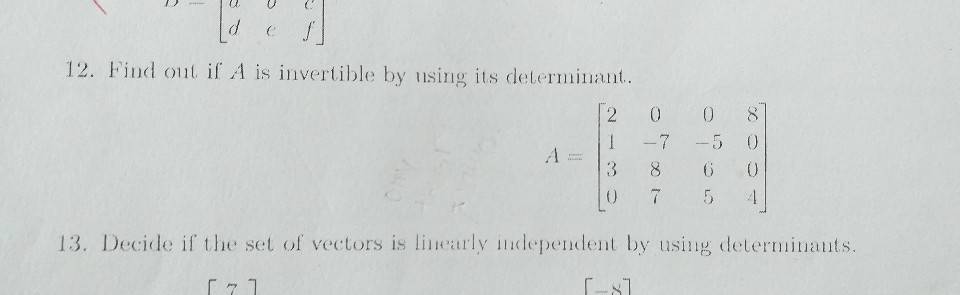
q.jpg


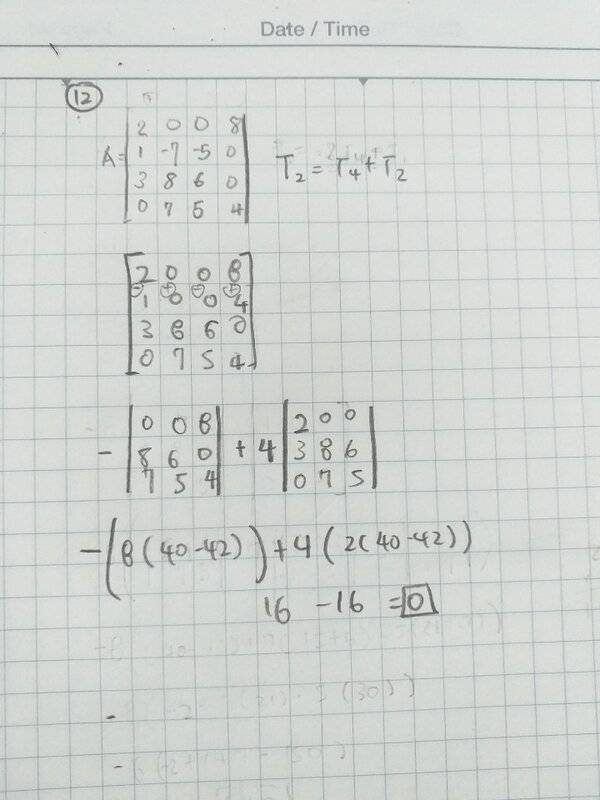
My first attempt:
ma1.jpg


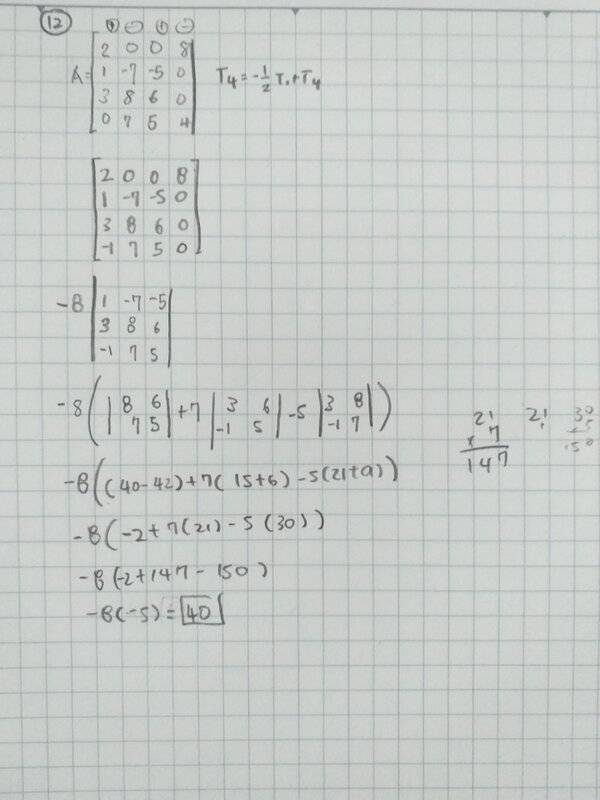
my second attempt:
ma.jpg
So I am getting 0 (the right answer) for the first method and 40 for the second method. According to the theorem, shouldn't the determinant of the matrix remain the same when the multiple of one row is added to another row? Can anyone explain why the second method is not working?

Thank you very much!
 
Physics news on Phys.org
Sunwoo Bae said:
Homework Statement:: I am given the following matrix. I solved the question and found out that the resulting determinant is 0, thus the matrix is not invertible. However, I tried the question in another method, and I am getting a different answer for the determinant. Why is the second method not working?
Relevant Equations:: Theorem: if a multiple of one row of A is added to another row to produce matrix B, then det B = det A

question:
View attachment 266772

My first attempt:
View attachment 266773

my second attempt:
View attachment 266774So I am getting 0 (the right answer) for the first method and 40 for the second method. According to the theorem, shouldn't the determinant of the matrix remain the same when the multiple of one row is added to another row? Can anyone explain why the second method is not working?

Thank you very much!
You made a mistake in your second attempt, in the 4th row above the bottom. Take another look at the 3rd deteriminant. You have (-8)(-1) = 9.
 
  • Like
Likes romsofia
Mark44 said:
You made a mistake in your second attempt, in the 4th row above the bottom. Take another look at the 3rd deteriminant. You have (-8)(-1) = 9.
I got it! Thank you so much!
 
Question: A clock's minute hand has length 4 and its hour hand has length 3. What is the distance between the tips at the moment when it is increasing most rapidly?(Putnam Exam Question) Answer: Making assumption that both the hands moves at constant angular velocities, the answer is ## \sqrt{7} .## But don't you think this assumption is somewhat doubtful and wrong?

Similar threads

Replies
1
Views
2K
  • · Replies 3 ·
Replies
3
Views
3K
  • · Replies 2 ·
Replies
2
Views
2K
  • · Replies 5 ·
Replies
5
Views
2K
Replies
1
Views
2K
  • · Replies 2 ·
Replies
2
Views
2K
  • · Replies 5 ·
Replies
5
Views
12K
Replies
10
Views
2K
  • · Replies 10 ·
Replies
10
Views
2K
  • · Replies 37 ·
2
Replies
37
Views
6K