Finding the maximum load of a bar from the yield strength

Click For Summary
To calculate the maximum load a flat steel bar can withstand, first determine the moment of inertia using the formula (1/12) * base * height^3. Given the yield strength of 250 MPa, apply the bending stress formula to assess the stress at the midpoint of the bar under a concentrated load. The bar, fixed at both ends, behaves as a statically indeterminate beam, complicating the analysis compared to simply supported beams. Reaction forces at the supports can be calculated, with symmetry providing equal vertical reactions of 50N. Ultimately, the internal moments and stresses must be evaluated to ensure the bar does not exceed its yield strength.
amir azlan
Messages
6
Reaction score
0
I have a flat steel bar (30 mm width, 5 mm thick, 1100 mm long).
The bar has a load applied in the centre of 100N.

the bar is fixed at both ends with a single concentrated load P applied mid-span

the maximum yield stress is 250 MPa (250x10^6 Pa)

How do I calculate the maximum load the bar can take?
Which formula do I need to use?
i) Stress= Force/ Area
ii) Stress = MY / I
 
Engineering news on Phys.org
From the way you described it, it sounds like the bar will fail due to bending stress. If the beam we are talking about is fixed at either end with cantilever supports, then the analysis goes something like this:...

Moment of inertia for the beam: ##\frac{1}{12}base*height^3##. Calculate that, being mindful of your units.

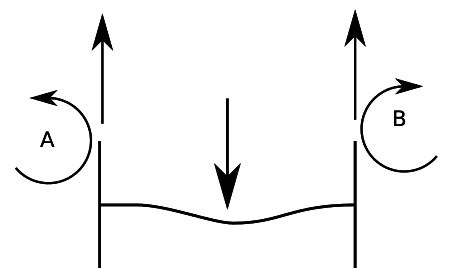
Calculate the reaction forces and moments at the beam supports: Symmetry makes the vertical reactions pretty easy, 50N up at both supports. However, when we do the sum of the moments, notice that we have two moments which we can't solve for using a simple sum of moments equation, we have to move use...
upload_2015-12-17_15-42-24.png


This equation: ##EI\frac{d^2}{dx^2} = M(x)##. Where "v" in that equation is the vertical deflection, this is where things get weird... We know that 1/4th of the way across the beam, ##\frac{d^2}{dx^2} = 0##, right? Because we that ##\frac{dv}{dx} = 0## at both the base (because cantilever) and at the midpoint (because of symmetry), so it makes sense that the inflection point is equal to zero half way in between those two points, like sines and cosines. Armed with that knowledge, we can make an imaginary "cut" at that point (1/4th of the way across) and find the necessary reactionary moment at A to ensure that there is no moment at this point. E.i, the internal moment at A and the vertical reaction force times distance must equal zero...

The moment is at A must be ##\frac{reaction- at- A * Length}{4}## or ##{Force*L}{8}## ... that is the moment reaction at the base. Only this reaction will ensure that there is no internal moment 1/4th of the way across the beam. The base is where the beam will snap, if you calculate the internal moment at the beam center, it's less, I will leave that for you if you want to compare the two.

So yes, once you have the moment of inertia, max moment and Y, (5mm/2), you can calculate stress.
reference: http://www.engineersedge.com/beam_bending/beam_bending18.htm

If you were actually talking about simply supported beams (not cantilever) everything is a lot easier.
 
amir azlan said:
the bar is fixed at both ends with a single concentrated load P applied mid-span

If the bar is actually fully fixed at both ends then it is classed as an "statically indeterminate beam". For a discussion on the solution for the beam you describe see the below web site.
http://nptel.ac.in/courses/105101085/Slides/Module-5/Lecture-1/5.1_5.html
 
What mathematics software should engineering students use? Is it correct that much of the engineering industry relies on MATLAB, making it the tool many graduates will encounter in professional settings? How does SageMath compare? It is a free package that supports both numerical and symbolic computation and can be installed on various platforms. Could it become more widely used because it is freely available? I am an academic who has taught engineering mathematics, and taught the...

Similar threads

Replies
5
Views
2K
  • · Replies 3 ·
Replies
3
Views
3K
  • · Replies 5 ·
Replies
5
Views
2K
  • · Replies 6 ·
Replies
6
Views
9K
  • · Replies 4 ·
Replies
4
Views
2K
  • · Replies 8 ·
Replies
8
Views
5K
  • · Replies 1 ·
Replies
1
Views
4K
  • · Replies 1 ·
Replies
1
Views
3K
  • · Replies 8 ·
Replies
8
Views
2K