Discussion Overview
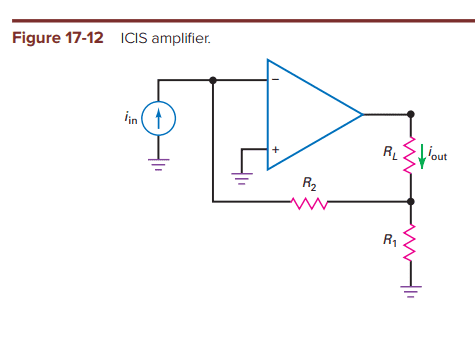
The discussion revolves around deriving the output impedance of a Current Controlled Current Source (ICIS) circuit. Participants explore various methods and assumptions related to the calculation of output impedance, including the treatment of input and output currents, and the implications of negative feedback on impedance values.
Discussion Character
- Technical explanation
- Debate/contested
- Mathematical reasoning
Main Points Raised
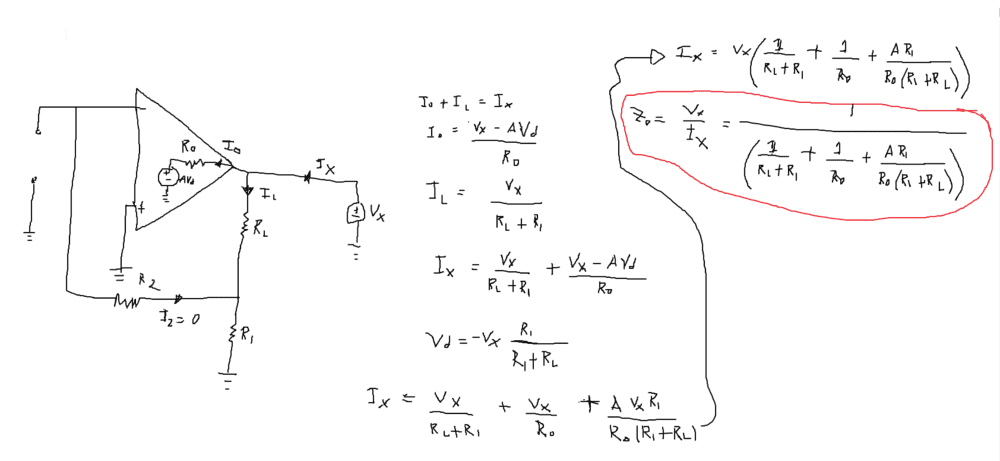
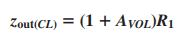
- One participant expresses confusion over their derived output impedance equation not matching the textbook, suggesting that negative feedback should increase output impedance.
- Another participant asserts that I2 cannot be zero, questioning the implications of this assumption on the analysis.
- Several participants discuss the relationship between input current (Iin) and I2, with one stating that Iin should be set to zero when calculating output impedance.
- A participant proposes a method involving applying a test voltage to find output impedance but notes potential contradictions in their equations.
- There is a suggestion that the circuit is misidentified as a TIA rather than an ICIS, which affects the interpretation of output variables.
- One participant provides a Mathematica code snippet to derive output impedance, indicating that their result aligns with another participant's but in a different form.
- Another participant emphasizes the importance of considering the quiescent operating point and suggests a derivative approach to calculate output impedance.
Areas of Agreement / Disagreement
Participants express differing views on the treatment of currents and the correct approach to calculating output impedance. There is no consensus on the correct method or the implications of certain assumptions, indicating ongoing debate and exploration of the topic.
Contextual Notes
Participants highlight potential misunderstandings regarding circuit identification and the treatment of various currents in the analysis, which may affect the derived equations and conclusions.