Finding the solution to an IVP Problem. Basic Differential Equations problem.

Click For Summary
The discussion focuses on solving an initial value problem (IVP) represented by the differential equation ty' + 7y = 2t^2 e^(2t) with the condition y(1) = 7. The participant struggles with a complicated integration involving (t^7)(2te^(2t)) and seeks clarification on whether the equation is linear and the interval of solution existence. Suggestions include performing indefinite integration with a constant or integrating from 1 to t while applying the initial condition. The integration process requires multiple applications of integration by parts, ultimately leading to a successful resolution of the problem. The participant confirms that their final approach was correct despite the challenges faced.
cyturk
Messages
8
Reaction score
0
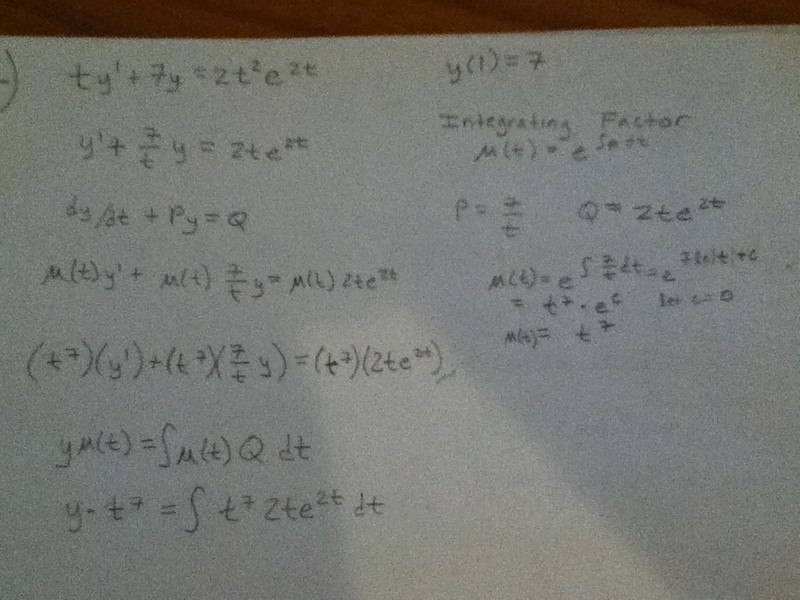
I am trying to solve an IVP problem and I seem to be stuck on it because I am getting an integration that seems very complicated and I think I messed up on it, I have my work so far below.

Homework Statement


Find the solution to the IVP

ty^'+7y=2t^2 e^2t, y(1)=7

Is this equation linear? Determine in what interval the solutions exist.

Homework Equations


The Attempt at a Solution


rs1nk.jpg


The image has my work so far, as you can see the integration for (t^7)(2te^2t) is a beast and that is why I think I am wrong so far. Here is the integration answer http://www.wolframalpha.com/input/?i=integrate+%28t^7%29%282te^%282t%29%29.
 
Physics news on Phys.org
The primitives of (t^8)exp(2t) are on the form P(x)exp(2t) were P(x) is a 8th degree polynomial.
Derive this function and find the coefficients of the polynomial by indentification with (t^8)exp(2t)
 
You started out very well, and from:
<br /> \frac{d}{dt}(t^{7}y)=2t^{8}e^{2t}<br />
I think you have made an error, you can do two things: 1) You can do an indefinite integration and add an integration constant and find that constand by using the initial condition or 2) integrate from 1 to t both sides and use Y(1)=7.
 
Integrate 2t8e2t using integration by parts- 8 times!
 
HallsofIvy said:
Integrate 2t8e2t using integration by parts- 8 times!

Thanks for everyone else and this is what I ended up doing. It was the correct way of solving the problem even though it was a little bit of a hassle! :)
 
Question: A clock's minute hand has length 4 and its hour hand has length 3. What is the distance between the tips at the moment when it is increasing most rapidly?(Putnam Exam Question) Answer: Making assumption that both the hands moves at constant angular velocities, the answer is ## \sqrt{7} .## But don't you think this assumption is somewhat doubtful and wrong?

Similar threads

  • · Replies 3 ·
Replies
3
Views
2K
Replies
7
Views
2K
  • · Replies 2 ·
Replies
2
Views
2K
Replies
8
Views
3K
  • · Replies 2 ·
Replies
2
Views
1K
  • · Replies 3 ·
Replies
3
Views
2K
  • · Replies 6 ·
Replies
6
Views
2K
  • · Replies 7 ·
Replies
7
Views
2K
  • · Replies 25 ·
Replies
25
Views
2K
Replies
14
Views
2K