Finding the Spring Constant: Angular Velocity vs Hooke's Law

Click For Summary
The discussion revolves around an experiment to determine the spring constant (k) using various methods, including Hooke's Law and oscillation measurements. Despite obtaining similar values of k from most methods, the values derived from angular velocity and acceleration calculations were significantly lower, raising questions about potential errors or assumptions made. Participants seek clarification on the calculations, specifically regarding the measurement of acceleration, the definition of velocity used, and the period of oscillation. There is also confusion about the terminology used, particularly the reference to angular velocity and acceleration in the context of a mass-spring system. The conversation highlights the complexities involved in accurately measuring and calculating the spring constant.
Robert Hilderman
Messages
2
Reaction score
0
THIS HOMEWORK WAS POSTED IN ANOTHER FORUM, SO NO TEMPLATE
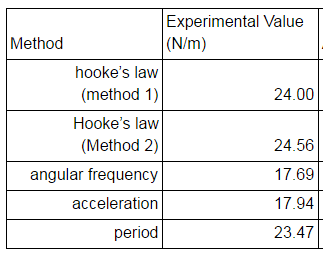
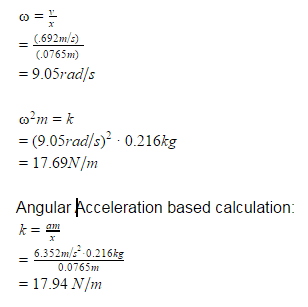
So I'm doing an experiment where I am using five different methods to find the spring constant of a spring. These three values of k should be the same but alas, they are not :( and I am at a loss as to why. The first method was by using hooke's law and finding the displacement and graphing the applied force over displacement (I called this method 1 in the picture below). Method 2 was oscillating the spring attached to a force sensor and having a position sensor under it. I graphed Force over Position (I had the force sensor zeroed at the spring's equilibrium so "position" was the spring's displacement). Method 5 was timing the period of the oscillation and plugging that into k=4pi^2m/T^2. All these methods gave a similar experimental value of k. However, when I used the position vs. time data to find k using angular velocity/acceleration, my values were 25% lower. My calculations are in the picture below. I used the maximum displacement, velocity, and acceleration values which were derived from the graphs. What I'm wondering is 1) did I do something wrong? and if not 2) what assumption is made that makes these values so off. Thank you so much. (In the picture, I accidentally called angular velocity "angular frequency". My bad)
dsf.PNG
Capture.PNG
 
Physics news on Phys.org
I assume 0.0765m is the amplitude of oscillation. How did you measure acceleration?
I don't understand the v/x calculation. The x seems to be the amplitude again, but what is v here? The max velocity? If so, how measured?
What value did you measure for the period?

Edit: why do you refer to angular velocity and angular acceleration? Isn't this just a mass bouncing up and down on the end of a suspended spring?
Any idea what the mass of the spring was?
 
The book claims the answer is that all the magnitudes are the same because "the gravitational force on the penguin is the same". I'm having trouble understanding this. I thought the buoyant force was equal to the weight of the fluid displaced. Weight depends on mass which depends on density. Therefore, due to the differing densities the buoyant force will be different in each case? Is this incorrect?

Similar threads

Replies
7
Views
4K
Replies
20
Views
1K
Replies
29
Views
3K
  • · Replies 14 ·
Replies
14
Views
4K
  • · Replies 17 ·
Replies
17
Views
3K
Replies
3
Views
1K
Replies
9
Views
910
  • · Replies 3 ·
Replies
3
Views
2K
Replies
7
Views
1K
Replies
17
Views
2K