Finding the Tangent Line to a Parametric Curve at t=\frac{\pi}{4}

Click For Summary

Discussion Overview

The discussion revolves around finding the tangent line to a parametric curve at the specific parameter value of t=\frac{\pi}{4}. Participants explore the mathematical process involved, including the calculation of the slope and the point on the curve, while addressing issues related to software input formats.

Discussion Character

  • Technical explanation, Debate/contested, Homework-related, Mathematical reasoning

Main Points Raised

  • One participant presents their initial attempt to find the tangent line but expresses uncertainty about the correctness of their answer.
  • Another participant provides a detailed calculation of the slope of the tangent line using the derivative of the parametric equations, confirming the slope as -\frac{3\sqrt{\pi}}{40}.
  • The same participant calculates the point on the curve at t=\frac{\pi}{4} and derives the equation of the tangent line, which matches the initial participant's work.
  • There is a suggestion that the software may require a different form of the tangent line equation, indicating potential discrepancies in expected input formats.
  • A later reply acknowledges the assistance received and suggests consulting the professor regarding the question's requirements.

Areas of Agreement / Disagreement

Participants generally agree on the calculations for the slope and the point on the curve, but there is uncertainty regarding the correct format for the tangent line equation as required by the software.

Contextual Notes

There are unresolved issues regarding the software's requirements for input formatting, which may affect the perceived correctness of the answers provided.

TheFallen018
Messages
52
Reaction score
0
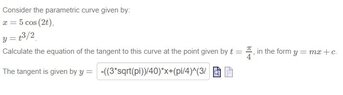
Hey guys, I've got this problem I can't seem to get past. I need to find the tangent line to a parametric curve at t=\frac{\pi}{4}

I thought I solved the equation, but my answer doesn't seem to be registered as correct. I'm guessing that means I stuffed up the equation, but I can't see where. If anyone could point me in the right direction, I would be very grateful. Here's a screenshot of my problem.

View attachment 8091

Here's the answer I came up with

$$y=-\frac{3\sqrt{\pi}}{40}x+(\frac{\pi}{4})^\frac{3}{2}$$

(My latex code doesn't seem to be working either. Is there a way I should be initialising it?)

Thanks
 

Attachments

  • Screenshot_8.jpg
    Screenshot_8.jpg
    10.9 KB · Views: 134
Physics news on Phys.org
The slope of the line can be found from:

$$\frac{dy}{dx}=\frac{dy}{dt}\cdot\frac{dt}{dx}=\frac{\dfrac{3}{2}\sqrt{t}}{-10\sin(2t)}=-\frac{3\sqrt{t}}{20\sin(2t)}$$

Hence:

$$\left.\frac{dy}{dx}\right|_{t=\frac{\pi}{4}}=-\frac{3\sqrt{\dfrac{\pi}{4}}}{20}=-\frac{3\sqrt{\pi}}{40}$$

The point on the curve is:

$$(x,y)=\left(5\cos\left(2\cdot\frac{\pi}{4}\right),\left(\frac{\pi}{4}\right)^{\Large\frac{3}{2}}\right)=\left(0,\left(\frac{\pi}{4}\right)^{\Large\frac{3}{2}}\right)$$

Thus, the line is given by:

$$y=-\frac{3\sqrt{\pi}}{40}x+\left(\frac{\pi}{4}\right)^{\Large\frac{3}{2}}\quad\checkmark$$

Your work looks correct to me.

edit: perhaps the software wants the form:

$$y=-\frac{3\sqrt{\pi}}{40}x+\frac{\pi\sqrt{\pi}}{8}$$
 
[DESMOS]advanced: {"version":5,"graph":{"viewport":{"xmin":-5.219804697224658,"ymin":-0.4416683969175965,"xmax":13.115553015424458,"ymax":5.919253619612934}},"expressions":{"list":[{"id":"graph1","type":"expression","latex":"\\left(5\\cos\\left(2t\\right),t^{\\frac{3}{2}}\\right)","domain":{"min":"0","max":"\\pi"},"color":"#2d70b3"},{"id":"3","type":"expression","latex":"\\left(0,\\left(\\frac{\\pi}{4}\\right)^{\\frac{3}{2}}\\right)","showLabel":true,"label":"Tangent Point","color":"#fa7e19","style":"POINT"},{"id":"4","type":"expression","latex":"y=-\\frac{3\\sqrt{\\pi}}{40}x+\\frac{\\pi\\sqrt{\\pi}}{8}","color":"#388c46"},{"id":"5","type":"expression","color":"#000000"}]}}[/DESMOS]
 
MarkFL said:
The slope of the line can be found from:

$$\frac{dy}{dx}=\frac{dy}{dt}\cdot\frac{dt}{dx}=\frac{\dfrac{3}{2}\sqrt{t}}{-10\sin(2t)}=-\frac{3\sqrt{t}}{20\sin(2t)}$$

Hence:

$$\left.\frac{dy}{dx}\right|_{t=\frac{\pi}{4}}=-\frac{3\sqrt{\dfrac{\pi}{4}}}{20}=-\frac{3\sqrt{\pi}}{40}$$

The point on the curve is:

$$(x,y)=\left(5\cos\left(2\cdot\frac{\pi}{4}\right),\left(\frac{\pi}{4}\right)^{\Large\frac{3}{2}}\right)=\left(0,\left(\frac{\pi}{4}\right)^{\Large\frac{3}{2}}\right)$$

Thus, the line is given by:

$$y=-\frac{3\sqrt{\pi}}{40}x+\left(\frac{\pi}{4}\right)^{\Large\frac{3}{2}}\quad\checkmark$$

Your work looks correct to me.

edit: perhaps the software wants the form:

$$y=-\frac{3\sqrt{\pi}}{40}x+\frac{\pi\sqrt{\pi}}{8}$$
Thank mark, I really appreciate the help. Turns out the software didn't want that form either, but that's ok. As long as I know that I've done all I can, I'm happy.
 
TheFallen018 said:
Thank mark, I really appreciate the help. Turns out the software didn't want that form either, but that's ok. As long as I know that I've done all I can, I'm happy.

I would speak to the professor to see what's up with that question. :)
 

Similar threads

  • · Replies 1 ·
Replies
1
Views
1K
  • · Replies 14 ·
Replies
14
Views
2K
  • · Replies 1 ·
Replies
1
Views
2K
  • · Replies 4 ·
Replies
4
Views
2K
  • · Replies 5 ·
Replies
5
Views
2K
  • · Replies 2 ·
Replies
2
Views
3K
  • · Replies 1 ·
Replies
1
Views
2K
  • · Replies 1 ·
Replies
1
Views
2K
  • · Replies 2 ·
Replies
2
Views
2K
  • · Replies 18 ·
Replies
18
Views
4K