Flame in a centrifuge will go oblique?

  • Context: Undergrad 
  • Thread starter Thread starter simplex
  • Start date Start date
  • Tags Tags
    Centrifuge
Click For Summary

Discussion Overview

The discussion revolves around the behavior of a flame in a centrifuge, specifically whether the flame will become oblique as the rotational speed increases. Participants explore the implications of centrifugal forces on the flame's orientation within a closed container, considering both theoretical and experimental perspectives.

Discussion Character

  • Exploratory
  • Technical explanation
  • Debate/contested
  • Mathematical reasoning

Main Points Raised

  • Some participants propose that the flame will become increasingly oblique as the rotational speed of the centrifuge increases, suggesting that it will not point straight up but rather parallel to the ground at high speeds.
  • One participant describes an experiment involving a candle in a sealed container to observe the flame's behavior under rotation, emphasizing that air movement should not affect the flame's position.
  • Another participant presents a mathematical demonstration involving centrifugal acceleration and the angle of artificial gravity, suggesting that the angle of the flame relative to the vertical will decrease with higher rotational speeds.
  • Some participants discuss the nature of the flame's shape, with one suggesting it may become skinnier and taller as rotation increases, drawing a parallel to tornado formation.
  • There is a correction regarding the mathematical formulation of centrifugal acceleration, with a participant noting the need to use angular velocity instead of linear velocity in calculations.
  • Another participant questions the assumption of the flame's axis of rotation and suggests that the angle of the flame may vary along its length, depending on its distance from the rotation axis.
  • One participant expresses uncertainty about decomposing a long flame into smaller segments for analysis, questioning the validity of conclusions drawn from such an approach.

Areas of Agreement / Disagreement

Participants express differing views on the behavior of the flame in a centrifuge, with no consensus reached regarding the exact nature of the flame's orientation or the validity of the proposed mathematical models.

Contextual Notes

Some limitations in the discussion include unresolved mathematical steps, varying assumptions about the flame's behavior, and the complexity introduced by the rotational aspect of the experiment.

simplex
Messages
40
Reaction score
0
Flame in a centrifuge will go oblique (nearly parallel to the ground if the device is spinning extremely fast).

Flame in a centrifuge will not point straight up but go more and more oblique as the rotational speed increases (see the picture)

Experiment:
1) Put a candle in a preferably sealed container, or even one that has a few small holes on its top and bottom to avoid starving the flame of oxygen too fast.
2) Lit the candle, close the jar and rotate it.

The flame should go more and more oblique as the speed increases (see the picture).

NOTE: The position of the flame has nothing to do with blowing air on it from one side because the container is sealed.
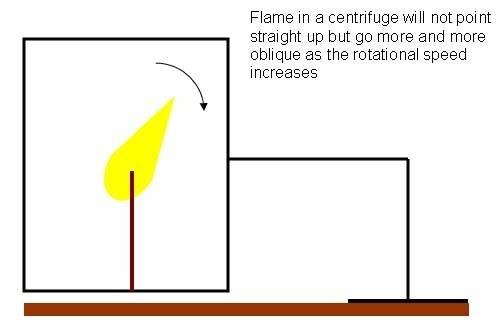

attachment.php?attachmentid=42221&stc=1&d=1324933737.jpg


Source: << Link deleted by berkeman >>

QUESTION: Will the flame really go oblique?
 

Attachments

  • FlameInACentrifuge.JPG
    FlameInACentrifuge.JPG
    13.4 KB · Views: 766
Last edited by a moderator:
Physics news on Phys.org
simplex said:
Flame in a centrifuge will go oblique (nearly parallel to the ground if the device is spinning extremely fast).

Flame in a centrifuge will not point straight up but go more and more oblique as the rotational speed increases (see the picture)

Experiment:
1) Put a candle in a preferably sealed container, or even one that has a few small holes on its top and bottom to avoid starving the flame of oxygen too fast.
2) Lit the candle, close the jar and rotate it.

The flame should go more and more oblique as the speed increases (see the picture).

NOTE: The position of the flame has nothing to do with blowing air on it from one side because the container is sealed.


attachment.php?attachmentid=42221&stc=1&d=1324933737.jpg


Source: << Link deleted by berkeman >>

QUESTION: Will the flame really go oblique?

If you are trying to ask a question about how acceleration affects the flame, you need to think about how the flame is formed -- why it normally points up. Do you know?

And a better-framed question would eliminate the rotational aspect of the question, since that introduces extra complications (like air movement inside the centrifuge). Instead, just ask if the flame is affected in an elevator as it rises up sharply...
 
The flame is in a closed container that spins at constant speed about a pivot.
Air movement inside the spinning container should be the same as in a static container excepting the fact that the static pressure will act oblique not straight down.

Is this demonstration correct:

"For high speeds like 100 rot/s the flame will point less than one degree away from the direction of the ray that rotate about the pivot.

Demonstration:
g0 = 9.81 m/s2 (perpendicular to the ground)
ar = 2*pi*f*R (centrifugal acceleration parallel to the ground, to the plane of rotation)
R = the length of the ray
f = frequency (rot/s)

artificial g will be g0 + ar as vectors

The angle of the artificial g relative to the plane of rotation will be: (360 / (2*pi)) * arctan(9.81/(2*pi*f*R))

for R = 1 m, if:
f = 1 rot/s the angle is ~ 57 degree
f = 10 rot/s the angle is ~ 9 degree
f = 100 rot/s the angle is ~ 1 degree which means that the flame points nearly parallel to the ground."
 
Last edited:
Which way is "up"? It is not up and outward. It's up and inward, toward the rotation axis.

The flame will get skinnier and taller as the rotation of the gas increases. This is similar to how tornados form.
 
The gas does not rotate about the symmetry axis of the container.
The container, with the flame inside, is at one end of a horizontal bar that has its other end welded to a pivot.

The flame is inside a machine similar to those used for training jet fighter pilots, to test their resistance when acceleration goes to a few g.

There is no tornado in the container.
 
Last edited:
simplex said:
Is this demonstration correct:

It's hard to follow your demonstration but the conclusion is correct. This situation sometimes occurs in jet engines if there is a fire in the rotating compressor or turbine. The fire damage is always concentrated along the smallest (inside) radius of the space, not the outside.
 
Ah, I see. I assumed the axis of rotation was the center of the cylinder.

Your solution is incorrect. Look at the units. 2*pi*f*R has units of velocity. You should be using ω2r = (2*pi*f)2r.

Note that I am using r, not R. R is the distance between the rotation axis and the base of the flame while r is the distance between the rotation axis and some point in the flame. This latter quantity decreases as the flame moves toward the axis of rotation. This means the angle with respect to vertical will be greatest at the base of the flame and will decrease as the flame progresses from the base. The flame will start out at some angle with respect to vertical and curve slightly upward along the length of the flame.
 
1) Yes ar = (2*pi*f)^2*R and not 2*pi*f*R.
I will redo the calculations.

2) If three candles are distributed along the ray R at intervals d then the flame in the middle of the container, considered to be a small flame, will stay at an angle relative to the horizontal plane given by:
AngleFlame(R) = arctan [ g / ( (2*pi*f)^2*R ) ]
the next one will stay at:
AngleFlame(R-d) = arctan [ g / ( (2*pi*f)^2*(R-d) ) ]
and the third at:
AngleFlame(R-2d) = arctan [ g / ( (2*pi*f)^2*(R-2*d) ) ]
(the three flames can be at different heights from the ground level)

However, I am not sure if we can suppose a long flame can be decomposed in small (infinitesimal) flames to draw the conclusion that a single long flame "will start out at some angle with respect to vertical and curve slightly upward along the length of the flame."
 

Similar threads

  • · Replies 22 ·
Replies
22
Views
3K
  • · Replies 8 ·
Replies
8
Views
2K
  • · Replies 2 ·
Replies
2
Views
3K
  • · Replies 4 ·
Replies
4
Views
6K
  • · Replies 5 ·
Replies
5
Views
2K
  • · Replies 41 ·
2
Replies
41
Views
4K
Replies
5
Views
4K
  • · Replies 8 ·
Replies
8
Views
2K
  • · Replies 10 ·
Replies
10
Views
3K
  • · Replies 9 ·
Replies
9
Views
5K