Engineering Fluid mechanics question and the Bernoulli Equation

Click For Summary
SUMMARY

The discussion focuses on solving fluid mechanics problems related to the Bernoulli Equation, specifically questions Q2 and Q3. The participants clarify that the absolute pressure at point 1 can be calculated using the formula P = Patm + ρgh, but this may yield results exceeding 100 Pa. Additionally, it is established that the pressure at point 2 is not equal to that at point 1 due to the velocity increase as fluid transitions from the tank to the pipe, resulting in a lower pressure at point 2.

PREREQUISITES
  • Understanding of the Bernoulli Equation
  • Knowledge of fluid pressure calculations
  • Familiarity with hydrostatic pressure concepts
  • Ability to interpret fluid mechanics diagrams
NEXT STEPS
  • Study the application of the Bernoulli Equation in various fluid flow scenarios
  • Learn about hydrostatic pressure and its implications in fluid mechanics
  • Explore the relationship between fluid velocity and pressure changes
  • Review common mistakes in fluid mechanics problem-solving
USEFUL FOR

Students and professionals in engineering, particularly those specializing in fluid mechanics, as well as educators seeking to clarify concepts related to the Bernoulli Equation and pressure calculations.

Franklie001
Messages
49
Reaction score
7
Homework Statement
Fluid mechanics question and Bernoulli Equation
Relevant Equations
Q2 and Q3
[ATTACH type="full" alt="Graphical user interface, application

Description automatically generated"]299146[/ATTACH]
[ATTACH type="full" alt="A screenshot of a computer

Description automatically generated"]299147[/ATTACH]
Good afternoon,

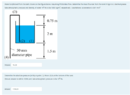
I am struggling to find the solution at Q2 and Q3. For Q2 the absolute pressure at point 1 is at the bottom of the tank, so do i need to use the formula P=Patm+qgh ? If using this formula I've got a bigger number than 100Pa.
Same issue for Q3, isn't the pressure at point 2 equal the one at point 1, being at the same height? The question mention that the answer should be within 500 Pa.

Thank you
 

Attachments

  • 1648664369822.png
    1648664369822.png
    18.1 KB · Views: 163
  • 1648664389874.png
    1648664389874.png
    7.9 KB · Views: 187
Physics news on Phys.org
Franklie001 said:
I am struggling to find the solution at Q2 and Q3
I suppose Q2 is in the first picture ?
I find it a struggle to even read the questions in the second picture. Can you type them out ? At least Q3 ?

Franklie001 said:
If using this formula I've got a bigger number than 100Pa
Yes, 105 + ##\rho g \Delta h\ ## is a lot more than 100. Is your answer not accepted ? I get the same. I resent that the dumb computer doesn't see units.

I also get the same for Q1 (almost :smile:: 16.27 kg/s)

Please post your work.

##\ ##
 
The pressure at point 2 is not equal to the pressure at point 1. At point 2 (immediately inside the pipe) the velocity has built up in the approach to to the pipe (within the tank) from zero at point 1 (and other locations at the bottom significantly removed from the pipe entrance) to full pipe velocity at point 2. So the pressure at point 2 is significantly lower than at point 1.
 
Hello Chet ! You apparently have been able to read Q3. But OP asks about Q2 (which is legible) as well.

##\ ##
 

Similar threads

  • · Replies 13 ·
Replies
13
Views
1K
  • · Replies 4 ·
Replies
4
Views
3K
  • · Replies 6 ·
Replies
6
Views
2K
  • · Replies 8 ·
Replies
8
Views
9K
Replies
1
Views
2K
Replies
2
Views
1K
  • · Replies 1 ·
Replies
1
Views
3K
  • · Replies 2 ·
Replies
2
Views
5K
  • · Replies 6 ·
Replies
6
Views
3K
  • · Replies 1 ·
Replies
1
Views
2K