Flux & Gauss Law: Electric Field Lines & Types of Areas

Click For Summary

Discussion Overview

The discussion revolves around the concept of electric flux and its relationship with electric field lines, particularly in the context of Gauss's law. Participants explore the nature of the area through which electric flux is measured, including the orientation and shape of the surface, and the distinction between electric field magnitude and electric flux.

Discussion Character

  • Exploratory
  • Technical explanation
  • Conceptual clarification
  • Debate/contested

Main Points Raised

  • Some participants inquire about the types of areas through which electric flux can be defined, questioning whether the area must be perpendicular to the field lines or if it can be at an angle.
  • One participant asserts that all illustrated examples of surfaces are valid for measuring electric flux.
  • Another participant explains that the electric flux is calculated as a dot product of the electric field and the area, noting that the flux decreases when the surface is not perpendicular to the field lines.
  • It is mentioned that irregular shapes require the use of a differential formula for flux, which involves integration over the surface to account for varying flux across different portions.
  • One participant expresses curiosity about the application of integration in physics and questions whether Gauss's law simply states that flux is proportional to charge.
  • A participant discusses the independence of flux from the size of the closed surface surrounding a charge, suggesting that any shape can yield the same flux result as long as it encloses the charge.
  • There is confusion expressed regarding the difference between electric field magnitude and electric flux, with one participant clarifying that while field lines indicate field strength at a point, flux requires a defined area and depends on the area’s orientation relative to the field.
  • Several participants reference Walter Lewin's videos as a helpful resource for understanding these concepts.

Areas of Agreement / Disagreement

Participants generally agree on the validity of various surface types for measuring electric flux and the relationship between flux and charge as stated in Gauss's law. However, there remains some disagreement and confusion regarding the distinction between electric field magnitude and electric flux, indicating that the discussion is not fully resolved.

Contextual Notes

Participants express uncertainty about the implications of surface orientation and shape on electric flux calculations, as well as the mathematical steps involved in integrating over irregular surfaces. The discussion also highlights the need for clarity in understanding the definitions and relationships between electric field and flux.

EdTheHead
Messages
24
Reaction score
0
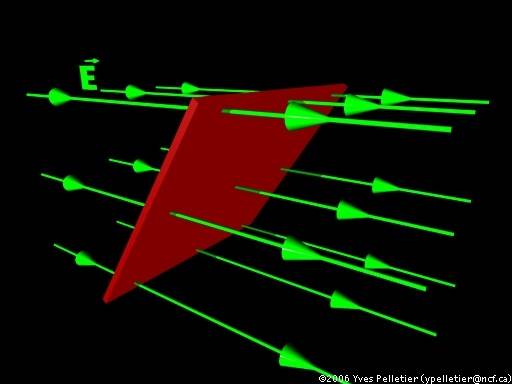
I know that electric flux is defined as the number of electric field lines passing through an area but what kinda area are we talking about. Does it have to be perpendicular to the field lines like this

or could it be at an angle like this
ElectricFlux.jpe

does it have to be a flat area on 1 plane like the previous 2 examples or could it be a 3D area like this
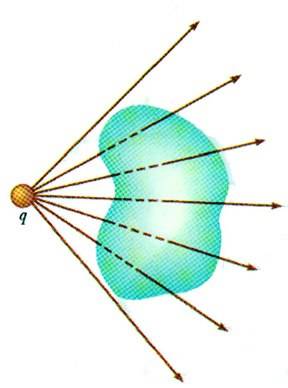
Fig24.08.jpg
 
Last edited by a moderator:
Physics news on Phys.org
All of your illustrations are perfectly OK examples of an electric flux through a surface.
 
A flux is defined as a dot product E dot A essentially, so your flux will be reduced if the surface is not perpendicular. Think about it like shining a flashlight at a friend. If you tilt the light away from him, he can still see the light, but it's not as bright. You can just imagine that less flux is reaching him because the light has been moved at an angle relative to his eyes.
 
Also, it doesn't have to be a nice shape. For example in your last picture, it is not, and in this case, you'd need to use the differential formula for the flux, which involves the integration over the surface. This just takes into account that the flux through different portions of your surface is not constant, and generally you'll need a function for the surface of your shape.
 
mooglue: So this surface function for the surface would take into account the angle between the field lines and the normal of the surface through the whole surface? This is the first physics application of integration I've run into so far. :smile:

Is Gauss's law then just the fact that the flux is proportional to the charge?
 
You should be able to reduce the problem of a complex blob like object to a simple plane though if it is a solid object or a membrane like a balloon.

http://ocw.mit.edu/OcwWeb/Physics/8-02Electricity-and-MagnetismSpring2002/VideoAndCaptions/detail/embed03.htm

"nd this is independent of the distance R.

And that's not so surprising because if you think of it as air flowing out then all the air has to come out somehow whether I make the sphere this big or whether I make the sphere this big.

So the flux being independent of the size of my sphere, the flux is given by the charge which is right here at the center divided by epsilon zero.

Now if I had chosen some other shape, not a sphere, but I have dented it like this, it's clear that the air that flows out would be exactly the same.

And so I don't have to take a sphere to find this result.

I could have taken any type of strange closed surface around this point charge and I would have found exactly the same result." -Walter Lewin
 
Last edited by a moderator:
EdTheHead said:
Is Gauss's law then just the fact that the flux is proportional to the charge?
Gauss's law states that the total flux through a closed surface is proportional to the charge enclosed. See: http://hyperphysics.phy-astr.gsu.edu/hbase/electric/gaulaw.html"
 
Last edited by a moderator:
Also I'm having serious trouble understanding the difference between electric field magnitude and electric flux. Both are defined by the density of field lines per area aren't they?
 
EdTheHead said:
Also I'm having serious trouble understanding the difference between electric field magnitude and electric flux. Both are defined by the density of field lines per area aren't they?
No, they are not. If you want to think in terms of field lines, then the density of field lines gives you a measure of the field at some point. But you won't know the flux until an area is defined. Field is at a point; flux is over an area and depends on the orientation of the area with respect to the field.
 
  • #10
I recommend watching Walter's videos, he is an expert advisor.
 
  • #11
LostConjugate said:
And that's not so surprising because if you think of it as air flowing out then all the air has to come out somehow whether I make the sphere this big or whether I make the sphere this big.

So the flux being independent of the size of my sphere, the flux is given by the charge which is right here at the center divided by epsilon zero.
Thanks for the analogy that cleared up a lot of the confusion I had about \phi = \frac{q}{\epsilon_0}. As long as the thing is enclosed the amount of flux lines hitting the total surface area will be equal but the bigger the balloon the smaller the flux will be for small segments of the balloons surface area. I wasn't really thinking about a charge being a source of a finite amount of electric field lines but thinking about it like that I get the concept.

Doc Al said:
Gauss's law states that the total flux through a closed surface is proportional to the charge enclosed. See: http://hyperphysics.phy-astr.gsu.edu/hbase/electric/gaulaw.html"
Thanks. I didn't really contemplate the "enclosed" part of that definition now I understand the concept.
 
Last edited by a moderator:

Similar threads

  • · Replies 30 ·
2
Replies
30
Views
3K
  • · Replies 1 ·
Replies
1
Views
2K
  • · Replies 83 ·
3
Replies
83
Views
5K
  • · Replies 7 ·
Replies
7
Views
1K
  • · Replies 25 ·
Replies
25
Views
3K
  • · Replies 9 ·
Replies
9
Views
3K
  • · Replies 1 ·
Replies
1
Views
2K
  • · Replies 9 ·
Replies
9
Views
2K
  • · Replies 29 ·
Replies
29
Views
2K
  • · Replies 9 ·
Replies
9
Views
2K