Follow-up question about my understanding on rectification

Join the discussion
Ask a follow-up here, or get your own question answered by working scientists, mathematicians and engineers — people, not an autocomplete.
Real named experts · corrections over time · the nuance an AI answer skips
4 replies · 1K views
nicy12
Messages
35
Reaction score
0
I understand the process of rectification but just only in theory. But I still have questions that I guess will be answered if I can experience or has experience about it (but sadly I don't have). Please kindly answer these questions:

1. Does the waveform of Vout can be considered as DC ( having imperfections in it) or it is still an AC?

2. Does the maximum voltage is still 220 VAC in the output waveform or I can apply the theoretical approach wherein there is some drop on LED (about 0.7 V) making the maximum voltage in the output waveform as 219.3 VAC?
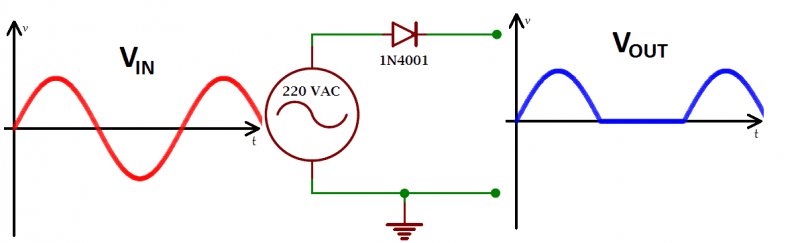
rectifying.png
 
Engineering news on Phys.org
1. Yes, DC. This is a basic topolgy of a half-wave rectifier
2. Output peak voltage is the same as input peak voltage (220√2 V), but output rms value is smaller.
 
Q1 - yes you have a DC voltage at the output or ripple voltage. The DC voltage read by a voltmeter is around (√2 * 220V)/Π ≈ 99V
Q2- Without any load Vout = 220V but if you connect a load resistance the output voltage will drop about 0.7 V because the voltage droop across the diode.
 
Jony130 said:
Q1 - yes you have a DC voltage at the output or ripple voltage. The DC voltage read by a voltmeter is around (√2 * 220V)/Π ≈ 99V
Q2- Without any load Vout = 220V but if you connect a load resistance the output voltage will drop about 0.7 V because the voltage droop across the diode.

If I add a load of 3k ohms (just for example). Does the output voltage will be sqrt(2)*220/2 - Vdrop of diode - Vdrop of resistor ?
 
Yes, Vout = √2 * 220V/2 - 0.7V ≈ 154.8V