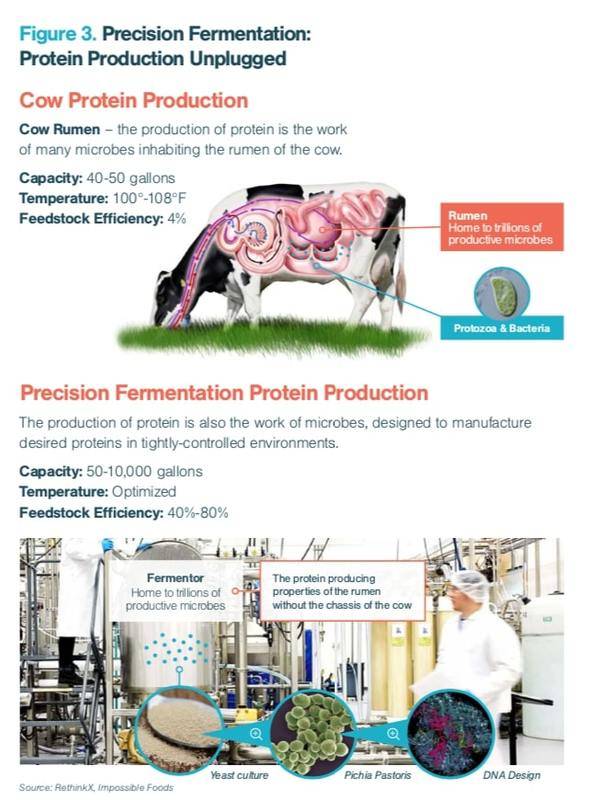
My impression after glancing at this is that they want to make proteins in bacteria to replace/supplement normal foods.
They claim economic benefits.
This seems to me, to be a kind of one dimensional version of food, in particular meat which they reference in the Impossible burger. "Normal" foods are derived from tissues, which cellular structures made of a vast assortment of different proteins, as well as other chemicals, like lipids and carbohydrates. This does not fall out of cultures producing a single kind of protein (or a few) in vast amounts. They would have to combined in some detailed manner to generate equivalent textures.
The impossible burger uses as starting material biological tissue from non-animal sources (but with a cellular structure containing their own complex chemical mixtures.
Perhaps, in the future, growing up only knowing non-textured foods would reduce the economic importance that difference.
Alternatively, you could grow tissue cultures of metazoan cells.
This would be much more difficult and produce cells at much lower densities.
More labor and more costly.
Its hard to believe that growing a crop (perhaps genetically redesigned) to generate a useful component for some complex "artificial" food, like the impossible burger, would not be cheaper ($/Kg) then metazoan tissue culturing it.
Simpler food, OK.