Force components acting on an airfoil

Click For Summary

Discussion Overview

The discussion revolves around the forces acting on an airfoil, specifically the lift and drag components derived from known force components obtained from computational fluid dynamics (CFD) software. Participants explore the correct formulations for lift and drag at non-zero angles of attack, addressing potential errors in existing literature and diagram conventions.

Discussion Character

  • Technical explanation
  • Debate/contested
  • Conceptual clarification

Main Points Raised

  • One participant presents equations for lift and drag based on force components from CFD, seeking validation of their correctness.
  • Another participant suggests that the Y-axis in the diagram must be inverted for the provided equations to be correct.
  • Concerns are raised about the reliability of statements made with confidence, emphasizing the need for caution.
  • Participants discuss the need to adjust signs in the equations based on the diagram's orientation.
  • There is a suggestion to test the equations under specific angles of attack (0 and 90 degrees) to ensure the sign convention is accurate.
  • One participant expresses confusion regarding the definitions of lift and drag, noting discrepancies between different diagram representations and their relation to the angle of attack.
  • Another participant emphasizes the importance of understanding that different axis systems may be preferred by various specialists, leading to different interpretations of lift and drag.
  • Some participants argue for a wind-relative approach to defining lift and drag, suggesting it simplifies understanding, especially in cases where the object is not a traditional wing.
  • There is a discussion about the implications of using the chord line versus wind direction for defining lift and drag, with some advocating for the former and others for the latter.

Areas of Agreement / Disagreement

Participants express differing views on the correct formulations for lift and drag, as well as the appropriate reference frames for these forces. No consensus is reached regarding the best approach to define these forces, indicating ongoing disagreement and exploration of the topic.

Contextual Notes

Participants note that the definitions and representations of lift and drag may vary based on the chosen coordinate system and that adjustments may be necessary depending on the context of the discussion.

FEAnalyst
Messages
348
Reaction score
149
TL;DR
Are these formulas for lift and drag correct ?
Hi,

I have a simple question but I want to be 100% sure that my reasoning is correct. Take a look at this picture showing forces acting on an airfoil:
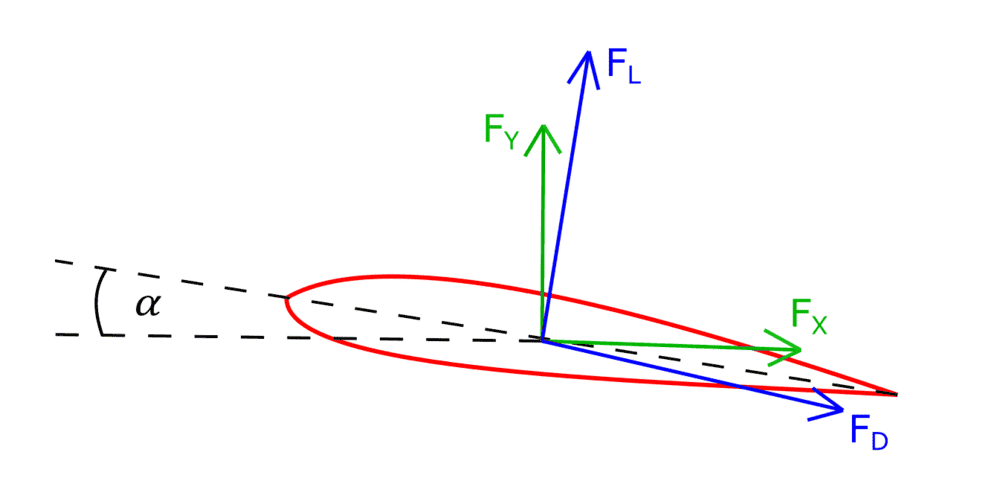
airfoil forces.PNG

Green forces (X and Y components) are known from CFD software but I need the values of blue components (lift and drag). Of course for zero angle of attack they will be equal to each other but I need formulas for nonzero angle. In the literature I've found the following equation for lift: $$F_{L}=F_{X} \sin{\alpha} - F_{Y} \cos{\alpha}$$ From this I figured out the formula for drag: $$F_{D}=F_{X} \cos{\alpha} + F_{Y} \sin{\alpha}$$ Are these equations correct ? If not then how they should look like ?

Thanks in advance for your help
 
Physics news on Phys.org
Y axis should be inverted in diagram above for equation you provide to be correct.
 
  • Like
Likes   Reactions: FactChecker
It's always the part that one is most confident about that turns out to be wrong. So be careful of any "of course" statements. :>)
 
Thanks for reply. Is the first formula (for lift) correct and second one (for drag) wrong ? Could you tell me what should be changed ? Only sign so that it becomes ##F_{D}=F_{X} \cos{\alpha}- F_{Y} \sin{\alpha}## ?
 
Either change your diagram or change every sign of ##F_Y## in your equations.

PS. Always test the cases of ##\alpha=0## and ##\alpha=90## to make sure that your sign convention is correct.
 
  • Like
Likes   Reactions: FEAnalyst and trurle
So, just to make sure, for the diagram I attached to my first post the correct formulas are: ##F_{L}=F_{X} \sin{\alpha}+ F_{Y} \cos{\alpha}## and ##F_{D}=F_{X} \cos{\alpha}- F_{Y} \sin{\alpha}##, right ?
 
Looks good to me.
 
Thank you very much. Apparently there was an error in the article where I’ve found the first formula which confused me and I couldn’t figure out how to derive it.
 
FEAnalyst said:
Thank you very much. Apparently there was an error in the article where I’ve found the first formula which confused me and I couldn’t figure out how to derive it.
Any time you get such an equation from a different source, the chances are good that they do not use the same coordinates and sign convention. So you must make the appropriate conversions.
 
  • #10
The vectors should be drawn to scale. That will make things easier to visualize and allow you to check your work.
 
  • #11
My understanding is that, irrespective of the shape or angle of attack of the wing, lift is a force at right angles to the wind and drag is a force in line with the wind. That is different to the diagram.
 
  • Like
Likes   Reactions: FactChecker
  • #12
tech99 said:
My understanding is that, irrespective of the shape or angle of attack of the wing, lift is a force at right angles to the wind and drag is a force in line with the wind. That is different to the diagram.

That's interesting aspect. Some diagrams show lift and drag as always vertical and horizontal, irrespective of the angle of attack (like green vectors on my drawing). But others show these forces as parallel and perpendicular to chord line (like blue vectors on my drawing). For example:

https://www.grc.nasa.gov/www/k-12/airplane/climb.html

The definition of drag is force acting opposite to velocity vector which follows chord line changing for different angles of attack. This would suggest that the second way of representing forces acting on airfoil is correct. Lift definition is less clear in this sense. On the other hand it seems that most diagrams follow the first approach. Thus I'm confused which way is correct.
 
  • #13
FEAnalyst said:
That's interesting aspect. Some diagrams show lift and drag as always vertical and horizontal, irrespective of the angle of attack (like green vectors on my drawing). But others show these forces as parallel and perpendicular to chord line (like blue vectors on my drawing). For example:

https://www.grc.nasa.gov/www/k-12/airplane/climb.html

The definition of drag is force acting opposite to velocity vector which follows chord line changing for different angles of attack. This would suggest that the second way of representing forces acting on airfoil is correct. Lift definition is less clear in this sense. On the other hand it seems that most diagrams follow the first approach. Thus I'm confused which way is correct.
The NASA diagram is of a plane in a climb, so the actual direction of motion is not horizontal. In the text, they define lift and drag as "aerodynamic forces relative to the flight path".

One must be aware that different axis systems may be used and preferred by different specialists. Stability and control people like the wind axis. Others may prefer the body axis. Appropriate conversions are necessary. That being said, the term "lift" should probably be reserved only for the wind axis while something like ##-F_z## used to denote upward force in the body axis (z is often positive down).
 
  • #14
It seems to me more logical to refer lift and drag to the wind direction. The "aerofoil" might not be a wing - it could be an irregular object such as a building, or a golf ball, where we have no chord to refer to.
If we refer to the chord of the wing, it becomes difficult when the aeroplane has sink and glide angle.
Further, it is messy if lift and drag are not at right angles and if lift is not in line with weight.
I have found that for sailing vessels, where we do not have a simple aerofoil, to refer everything to the wind makes the understanding so much easier, and allows simpe explanation of leeway (equivalent to glide angle for an aeroplane).
 
  • #15
tech99 said:
It seems to me more logical to refer lift and drag to the wind direction. The "aerofoil" might not be a wing - it could be an irregular object such as a building, or a golf ball, where we have no chord to refer to.
Eventually, one is usually interested in the forces in terms of other coordinates anyway. So conversions are necessary.
If we refer to the chord of the wing, it becomes difficult when the aeroplane has sink and glide angle.
Further, it is messy if lift and drag are not at right angles and if lift is not in line with weight.
If there is a sink rate, then the wind axis does not line up with the Earth axis anyway and lift is not in line with weight. The same can be said if there is any roll angle.
That being said, the wind axis is as good as any and better (i.e. more convenient) for aerodynamics and wind tunnel work.
 
Last edited:

Similar threads

  • · Replies 6 ·
Replies
6
Views
3K
  • · Replies 2 ·
Replies
2
Views
966
  • · Replies 21 ·
Replies
21
Views
3K
Replies
11
Views
1K
  • · Replies 7 ·
Replies
7
Views
5K
Replies
13
Views
2K
  • · Replies 1 ·
Replies
1
Views
2K
  • · Replies 8 ·
Replies
8
Views
1K
  • · Replies 1 ·
Replies
1
Views
1K
Replies
17
Views
2K