Force field in spherical polar coordinates

Join the discussion
Ask a follow-up here, or get your own question answered by working scientists, mathematicians and engineers — people, not an autocomplete.
Real named experts · corrections over time · the nuance an AI answer skips
20 replies · 2K views
MatinSAR
Messages
673
Reaction score
207
Homework Statement
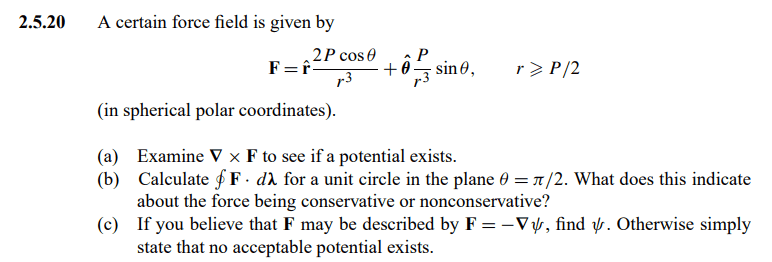
A certain force field is given to me and I should do the following tasks to find out is it a conservative field or not.
Relevant Equations
pls see below.
Picture of question:
1702943544674.png

Part (a) : ##\nabla \times \vec F = 0## so a Potensial exists. I don't have problem with this part.
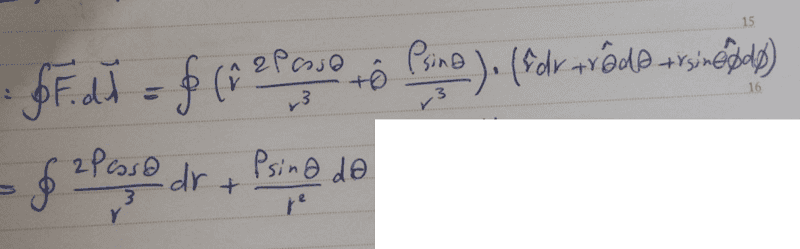
Part (b) : what I've done :
1702943893692.png

First experssion is 0 because ##\theta = \dfrac {\pi} {2}##. I don't know how to integrate over ##\theta ## when it is a constant.
 
Physics news on Phys.org
Go back to where you wrote correctly $$d\vec{\lambda} = \hat r dr + r \hat \theta d \theta + r \sin \theta \hat \phi d \phi$$
Simplify this for integrating along the given unit circle.
 
Reply
  • Like
Likes   Reactions: MatinSAR
The problem doesn't state whether or not the unit circle is centered at the origin of the coordinate system. So, I don't know if you are meant to assume that it is.
 
Reply
  • Like
Likes   Reactions: MatinSAR
TSny said:
Go back to where you wrote correctly $$d\vec{\lambda} = \hat r dr + r \hat \theta d \theta + r \sin \theta \hat \phi d \phi$$
Simplify this for integrating along the given unit circle.
Is it the only way? I haven't done this before and I cannot understand what you mean ...
TSny said:
The problem doesn't state whether or not the unit circle is centered at the origin of the coordinate system. So, I don't know if you are meant to assume that it is.
I guess I don't want to assume that. According to the book final answer should be 0.

1702945890697.png
 
MatinSAR said:
Is it the only way? I haven't done this before and I cannot understand what you mean ...

I guess I don't want to assume that. According to the book final answer should be 0.
Let's assume the unit circle is centered at the origin. For ##d\vec{\lambda}## along this circle, what can you say about the values of ##r##, ##dr##, ##d\theta## and ##\sin \theta##?

Thus, what does ##d\vec{\lambda}## simplify to?
 
Reply
  • Like
Likes   Reactions: MatinSAR
TSny said:
Let's assume the unit circle is centered at the origin. For ##d\vec{\lambda}## along this circle, what can you say about the values of ##r##, ##dr##, ##d\theta## and ##\sin \theta##?

Thus, what does ##d\vec{\lambda}## simplify to?
I have checked my book again yet I could not find sth similar to this. I guess:
##r=1##
##\sin \theta=1##
##dr=dr##
##d \theta= 0##

If I'm right the second expression should be 0 to and I will get 0 as final answer.
 
MatinSAR said:
I have checked my book again yet I could not find sth similar to this. I guess:
##r=1##
##\sin \theta=1##
##dr=dr##
##d \theta= 0##
OK, these look right. But you should be able to say more about ##dr##. Then you should be able to simplify the expression for ##d \vec \lambda## to a very simple result (which should make sense intuitively).

Then you can go on to think about the expression ##\vec F \cdot d\vec \lambda##
 
Reply
  • Like
Likes   Reactions: PhDeezNutz and MatinSAR
TSny said:
OK, these look right. But you should be able to say more about ##dr##. Then you should be able to simplify the expression for ##d \vec \lambda## to a very simple result (which should make sense intuitively).

Then you can go on to think about the expression ##\vec F \cdot d\vec \lambda##
Sorry for taking your time ... Should ##dr## be 0 for the circle?

Can't I answer without ##dr##? The first expression was zero and ##dr## doesn't change anything.
 
MatinSAR said:
Sorry for taking your time ... Should ##dr## be 0 for the circle?
MatinSAR said:
Homework Statement: A certain force field is given to me and I should do the following tasks to find out is it a conservative field or not.
Relevant Equations: pls see below.

Picture of question:
View attachment 337396
Part (a) : ##\nabla \times \vec F = 0## so a Potensial exists. I don't have problem with this part.
Part (b) : what I've done :
View attachment 337397
First experssion is 0 because ##\theta = \dfrac {\pi} {2}##. I don't know how to integrate over ##\theta ## when it is a constant.
Is this from a published source?? If so, please identify.
 
Reply
  • Like
Likes   Reactions: MatinSAR
hutchphd said:
Is this from a published source?? If so, please identify.
Yes.
This book is Arfken mathematical methods for physicists.
 
Orodruin said:
You tell us. What is the definition of dr?
Radial spacing element If I have translated correctly.
Actually translating it to english is harder than its explanation for me.
 
Orodruin said:
So how does radius change along the circle if r=1?
It doesn't change since radius is constant for a circle.
 
Do you have access to Griffiths? Chapter 3.4.4. This field looks a lot like a dipole pointing in the z-direction. Just sayin’

That should answer part C.

Edit: A lot of dipole questions this week.
 
Reply
  • Like
Likes   Reactions: MatinSAR
PhDeezNutz said:
Do you have access to Griffiths? Chapter 3.4.4. This field looks a lot like a dipole pointing in the z-direction. Just sayin’

That should answer part C.
Yes. I will check. Thanks.
 
For part B can’t you use part A……via Stokes Theorem. Although I do think it is instructive to do the line integral directly.
 
Reply
  • Like
Likes   Reactions: MatinSAR
PhDeezNutz said:
For part B can’t you use part A……via Stokes Theorem. Although I do think it is instructive to do the line integral directly.
Good idea!
Orodruin said:
And therefore dr is …
0 i think.
 
Reply
  • Like
Likes   Reactions: PhDeezNutz