Force vs. Displacement graph question

Click For Summary

Discussion Overview

The discussion centers around calculating kinetic energy and speed of an object based on a force vs. displacement graph. Participants explore the application of work-energy principles, particularly how to determine work done from the area under the graph and its implications for kinetic energy at various displacements.

Discussion Character

  • Technical explanation
  • Mathematical reasoning
  • Debate/contested

Main Points Raised

  • One participant calculates work done at different displacements using the area under the force vs. displacement graph, initially assuming a straightforward multiplication for positive forces.
  • Another participant corrects the initial calculation, emphasizing that kinetic energy is equal to the total work done from the start to the moment in question, given that the object starts from rest.
  • A later reply provides a detailed calculation for work done, suggesting a formula involving the area of a rectangle and a triangle, leading to a specific value for kinetic energy.
  • Concerns are raised about the calculation of velocity, with a participant indicating that the method used to derive velocity from kinetic energy is incorrect and suggesting a reevaluation of the equations used.

Areas of Agreement / Disagreement

Participants do not reach consensus on the correct method for calculating velocity from kinetic energy, with differing views on the accuracy of the calculations presented.

Contextual Notes

There are unresolved issues regarding the correct application of formulas for calculating work and velocity, particularly when dealing with negative forces and the area under the curve.

Plasm47
Messages
10
Reaction score
0
In the graph below, forces labelled positive act in the direction of motion of the object, forces labelled negative oppose the motion. The object under consideration has a mass of 2.0kg and was initially at rest. Calculate its kinetic energy and speed when
a) d= 2.0m
b) d= 4.0m
c) d=6.0m
d) d= 8.0m
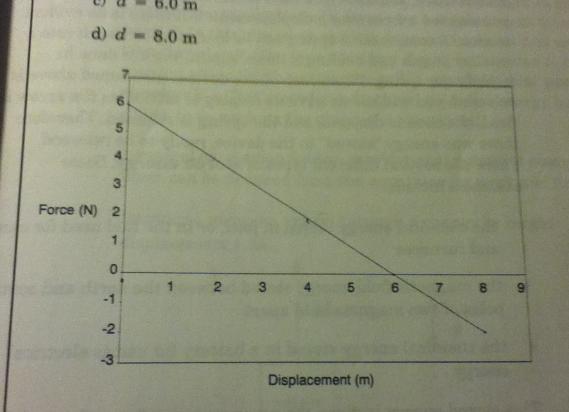
1CQ8P.jpg


I know W is area under the graph, but not positive how to apply it. I assume the question is only asking for that moment in time, and NOT a time period.
so for (a) it would be W= 4.0N x 2.0m = 8J; which would also be Ek
and V= 2.83m/s
if this is correct then b and c follow the same method, so i got those right aswell.
Not sure of the procedure when the Force is negative.
 
Last edited:
Physics news on Phys.org
No, this is not right. The kinetic energy at a given moment is equal to the work done from the beginning to that moment - given that it starts from rest so in the beginning has zero KE.
The work done can be calculated form the area under the curve, as you said (but did not do).
 
nasu said:
No, this is not right. The kinetic energy at a given moment is equal to the work done from the beginning to that moment - given that it starts from rest so in the beginning has zero KE.
The work done can be calculated form the area under the curve, as you said (but did not do).

okay, in that case:
a)to calculate work, solve for area under curve
W= l x w + (bXh)/2
W= 2m x 4N + (2m x (6N-4N)/2
W= 8J + 2J
w= 10 J
The Ek is equivilant to w since there is no work lost in the process.
Ek= 10J

now, solve for velocity
Ek= 0.5 (m)v2
v2= 0.5(2.0kg)/10J
v2= 0.1
v= √0.1
v=0.3m/s (to two sig digs)

if this is correct, then (b), (c), and (d) follow the same process
 
The value of the work looks OK.
Solving for v is not done properly (you can convince yourself calculating the KE with v=0.3m/s and m=2 kg).
Look again at the equation to solve.
 

Similar threads

  • · Replies 8 ·
Replies
8
Views
3K
  • · Replies 41 ·
2
Replies
41
Views
4K
Replies
6
Views
2K
  • · Replies 5 ·
Replies
5
Views
2K
  • · Replies 5 ·
Replies
5
Views
1K
  • · Replies 1 ·
Replies
1
Views
18K
  • · Replies 3 ·
Replies
3
Views
8K
  • · Replies 12 ·
Replies
12
Views
11K
  • · Replies 2 ·
Replies
2
Views
3K
Replies
1
Views
2K