High School Forced Oscillations: Pendulum 1 Driving Neighboring Pendulum

Click For Summary
The discussion focuses on the behavior of coupled pendulums when one is set into motion, leading to energy transfer through a connecting rod. Initially, the neighboring pendulums oscillate at their natural frequency, which is determined by their length and gravitational acceleration. Over time, dissipative forces cause their natural frequencies to diminish, resulting in oscillation at the frequency of the driving pendulum. The natural frequency represents oscillation in isolation, while the amplitude of forced oscillations depends on the natural frequency and the Q factor, which indicates energy dissipation. The interaction between the pendulums is most effective when their natural frequencies are similar and their Q factors are high.
Kaushik
Messages
282
Reaction score
17
TL;DR
.
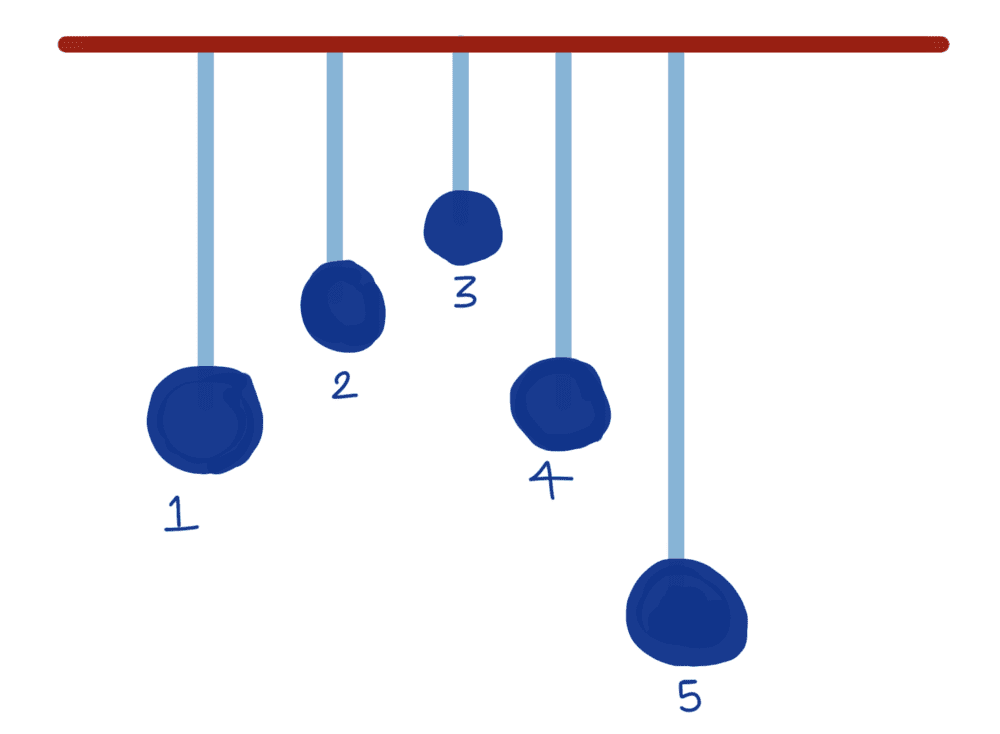
Consider the following setup:
Screen Shot 2020-01-22 at 10.21.27 AM.png

In this, let us set the pendulum 1 into motion. The energy gets transferred through the connecting rod and the other pendulum starts oscillating due to the driving force provided by the oscillating pendulum 1. Isn't it?
So the neighbouring pendulum starts oscillating with their natural frequency at first but as time passes, the natural frequency die out due to dissipative forces. Then once the natural frequency dies out, they start oscillating with the frequency of pendulum 1.
So I don't understand how the pendulum starts oscillating with 'natural frequency' even though the cause for oscillation is the external force due to pendulum 1. This is probably because of my misinterpretation of natural frequency.
 
Physics news on Phys.org
The natural frequency of oscillation of any given pendulum depends on only its length (and g). The driver will be significantly more massive than the other pendula.

If we set the driver in motion, it has the effect of applying a driving force to each of the other pendula (via the connecting rod). It is possible to derive the steady state phase difference between force and displacement for a damped driven oscillator; do you know what the phase difference is in the cases when the forcing frequency is less than, equal to or greater than the natural frequency, considering each of the pendula 2, 3, 4 and 5 in turn?
 
Last edited by a moderator:
Kaushik said:
Summary:: .

This is probably because of my misinterpretation of natural frequency.
Natural frequency is the frequency of oscillation in total isolation from other forces. You can force oscillations at other frequencies and the amplitude of the oscillation will depend on the natural frequency and the Q factor. The Q ('Quality') factor is a function of dissipative forces and will be higher as the friction etc gets less. Q represents the rate at which energy builds up or dissipates in a resonant system. The multiple pendula in your OP are 'coupled' to each other by the top string. Ignore any friction / damping and the energy will constantly couple from one to another so that their amplitudes build up and decay. The frequencies of their oscillations will be near but not equal to their individual natural frequencies because they are 'forced' oscillations. The experiment works best when the differences in natural frequencies is not too great and when the Q factors are very high. Best to consider only two pendula first.
 
Thread 'What is the pressure of trapped air inside this tube?'
As you can see from the picture, i have an uneven U-shaped tube, sealed at the short end. I fill the tube with water and i seal it. So the short side is filled with water and the long side ends up containg water and trapped air. Now the tube is sealed on both sides and i turn it in such a way that the traped air moves at the short side. Are my claims about pressure in senarios A & B correct? What is the pressure for all points in senario C? (My question is basically coming from watching...

Similar threads

  • · Replies 11 ·
Replies
11
Views
2K
  • · Replies 131 ·
5
Replies
131
Views
8K
  • · Replies 9 ·
Replies
9
Views
2K
  • · Replies 17 ·
Replies
17
Views
3K
  • · Replies 4 ·
Replies
4
Views
3K
  • · Replies 1 ·
Replies
1
Views
2K
  • · Replies 8 ·
Replies
8
Views
2K
  • · Replies 7 ·
Replies
7
Views
2K
  • · Replies 5 ·
Replies
5
Views
3K
Replies
9
Views
2K