Forces at rear brake caliper of motorcycle

Click For Summary
SUMMARY

The discussion focuses on the design of a rear brake caliper for motorcycles, specifically the necessity of a torque arm or brake stay to prevent caliper rotation during braking. Key considerations include the forces acting on the brake stay and the optimal distance from the axle for mounting. It is established that mounting the brake stay further from the axle reduces the force on the bolts, thereby enhancing stability. The conversation also highlights modern adaptations, such as using a tab on the swingarm instead of a traditional torque arm.

PREREQUISITES
  • Understanding of motorcycle brake systems
  • Knowledge of torque arm mechanics
  • Familiarity with caliper mounting techniques
  • Basic principles of force and leverage
NEXT STEPS
  • Research motorcycle brake caliper design principles
  • Study the mechanics of torque arms in braking systems
  • Explore modern adaptations in motorcycle brake systems
  • Learn about the impact of leverage on force distribution in mechanical systems
USEFUL FOR

Motorcycle engineers, mechanical designers, and enthusiasts involved in brake system modifications and performance optimization.

jcw
Messages
6
Reaction score
0
Looking for some help with a rear brake caliper design.

The rear caliper bolts to a carrier that slides onto and rotates around an axle. An torque arm (motorcycle term) or brake stay is required to prevent the caliper from rotating when the rear brake is applied.

I have to figure a way to fabricate a brake stay and was trying to determine the forces involved and whether mounting the brake stay as far from the axle as possible is better than closer to the axle. I mean does the force on the bolts holding the brake stay in place increase as the distance from the axle decreases.
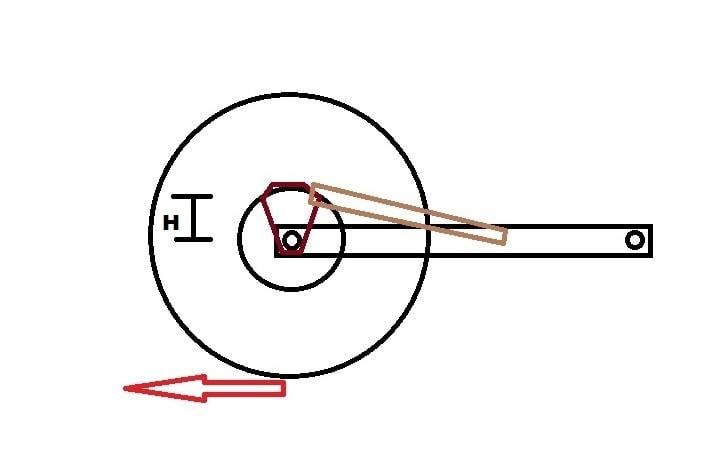
torque arm.jpg


Thanks in advance!
 
Physics news on Phys.org
jcw said:
... A torque arm ... is required to prevent the caliper from rotating when the rear brake is applied.
So, how would you push something to stop it rotating?
Say, for eg, I held a stick out horizontally and tried to turn on the spot, rotating about my vertical axis. To stop me you would push the stick in the opposite direction. For most effect, where would you push on the stick? At the end, in the middle, near where I'm holding it?
In what direction would you push? Like, at 45o to the stick, perpendicular to the stick, parallel to the stick, etc.? (Rough estimates will do.)

If that tells you the optimum way to push, presumably any other way is less effective and requires more force, which has to be provided by the mounting bolt.

Edit: PS there may be another consideration - the bending of the trailing arm.
 
  • Like
Likes   Reactions: jcw
Thanks. I knew that was probably the answer but I wanted to make sure I wasn't completely off base.
Modern motorbikes instead of a long torque arm use a tab on the swingarm that fits in a slot on the brake stay.

http://burntrubber-burntrubbermotor.netdna-ssl.com/21100-large_default/kawasaki-zx10r-rear-brake-caliper-bracket.jpg

This is a picture of what I'm having to adapt to an older motorbike that previously used a long plate or torque arm.

I'm thinking the length of the torque arm doesn't matter as long as the angle of the arm to the mounting point and axle is the same.
And taken to the extreme, a simple tab on the swingarm is the same.
 
Last edited by a moderator:

Similar threads

  • · Replies 10 ·
Replies
10
Views
2K
  • · Replies 44 ·
2
Replies
44
Views
8K
Replies
10
Views
3K
  • · Replies 5 ·
Replies
5
Views
2K
  • · Replies 15 ·
Replies
15
Views
7K
  • · Replies 7 ·
Replies
7
Views
14K
  • · Replies 12 ·
Replies
12
Views
22K
Replies
90
Views
12K
  • · Replies 2 ·
Replies
2
Views
2K
  • · Replies 28 ·
Replies
28
Views
2K