Forces help (friction, tension, etc.)

Click For Summary
SUMMARY

The discussion focuses on solving a physics problem involving two boxes connected by a taut massless string on an incline at an angle of θ = 33.00 degrees. Given the masses m1 = 6.8 kg and m2 = 1.2 kg, along with coefficients of friction μ1 = 0.20 and μ2 = 0.10, participants analyze the forces acting on the boxes. The key takeaway is the importance of correctly orienting the x-y axes for free body diagrams (FBDs) to simplify calculations of acceleration and forces. The discussion emphasizes the need to express forces in terms of sine and cosine components for accurate results.

PREREQUISITES
  • Understanding of Newton's laws of motion
  • Familiarity with free body diagrams (FBDs)
  • Knowledge of trigonometric functions (sine and cosine)
  • Basic algebra for solving equations
NEXT STEPS
  • Learn how to construct and analyze free body diagrams for inclined planes
  • Study the application of Newton's second law in multi-body systems
  • Explore the effects of friction on motion in physics
  • Practice solving problems involving tension in strings and pulleys
USEFUL FOR

Students studying physics, educators teaching mechanics, and anyone interested in understanding the dynamics of systems involving tension and friction on inclined planes.

Reizor1989
Messages
1
Reaction score
0
First off, I want to apologize if anything is made unclear. I'm ultra-stressed right now, I'm sure I can get over this physics problem. I just need a layman's explanation of this.

1. A taut massless string connects two boxes as shown below. The boxes are placed on an incline plane at θ = 33.00. What is the acceleration of boxes as they move down the incline, given m2 = 1.2 kg, m1 = 6.8 kg, μ2 = 0.10 and μ1 = 0.20
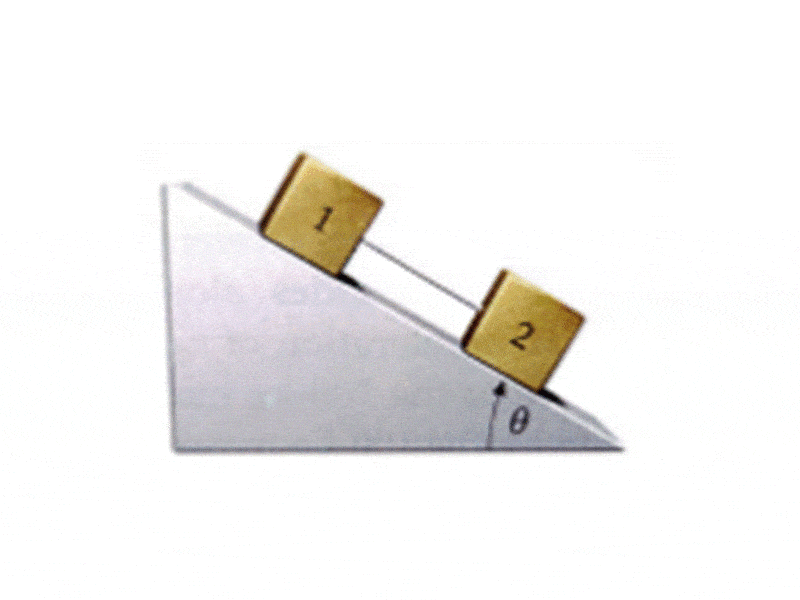
QujSMww.gif
. 2. Constructed free body diagram for M1 (mass 1) with normal force (n) along the positive y-axis, friction (f) along the negative x-axis, tension (T) along the positive x-axis, and Force of gravity (Fg) in quadrant IV, 33 degrees from the negative y-axis. (a=acceleration, mu=coefficient of friction)

a.) Summed forces of x as Fx = T - f + Fgx = M1*a ->
-> M1 * a - mu*n + M1*g = M1 * a
-> (This is where I think I'm screwing up. I want to isolate the first (a), but I have no idea how.)

b.) Summed forces of y as Fy = n - Fgy = M1 * a ->
-> n - Fgy = 0 (acceleration is 0)
-> n = Fgy

3. Constructed free body diagram for M2 (mass 2) with (n) along the positive y-axis, (f) along the negative x-axis, tension (T) along the positive x-axis, and Force of gravity (Fg) in quadrant IV, 33 degrees from the negative y-axis. (a=acceleration, mu=coefficient of friction)

a.) Same as 2a
b.) Same as 2b

4. Basically I have no idea where to go from here. Did I screw up on the diagram? Is something wrong with my algebra? What can I do next?
 
Physics news on Phys.org
Reizor1989 said:
First off, I want to apologize if anything is made unclear. I'm ultra-stressed right now, I'm sure I can get over this physics problem. I just need a layman's explanation of this.

1. A taut massless string connects two boxes as shown below. The boxes are placed on an incline plane at θ = 33.00. What is the acceleration of boxes as they move down the incline, given m2 = 1.2 kg, m1 = 6.8 kg, μ2 = 0.10 and μ1 = 0.20
QujSMww.gif
.2. Constructed free body diagram for M1 (mass 1) with normal force (n) along the positive y-axis, friction (f) along the negative x-axis, tension (T) along the positive x-axis, and Force of gravity (Fg) in quadrant IV, 33 degrees from the negative y-axis. (a=acceleration, mu=coefficient of friction)

a.) Summed forces of x as Fx = T - f + Fgx = M1*a ->
-> M1 * a - mu*n + M1*g = M1 * a
-> (This is where I think I'm screwing up. I want to isolate the first (a), but I have no idea how.)

b.) Summed forces of y as Fy = n - Fgy = M1 * a ->
-> n - Fgy = 0 (acceleration is 0)
-> n = Fgy

3. Constructed free body diagram for M2 (mass 2) with (n) along the positive y-axis, (f) along the negative x-axis, tension (T) along the positive x-axis, and Force of gravity (Fg) in quadrant IV, 33 degrees from the negative y-axis. (a=acceleration, mu=coefficient of friction)

a.) Same as 2a
b.) Same as 2b

4. Basically I have no idea where to go from here. Did I screw up on the diagram? Is something wrong with my algebra? What can I do next?

Welcome to the PF.

It sounds like you are setting up your x-y coordinates so that x is parallel to the inclined plane. It is more traditional to have x be horizontal, parallel to the ground, with y vertical. Then you write the forces on the inclined plane for the FBDs in terms of sin(θ) and cos(θ) components.

Can you re-write your FBD equations with the x-y axes in the more traditional orientation? That will make it a lot easier to check your work. :smile:
 
Welcome to PF!

Reizor1989 said:
a.) Summed forces of x as Fx = T - f + Fgx = M1*a ->
-> M1 * a - mu*n + M1*g = M1 * a
-> (This is where I think I'm screwing up. I want to isolate the first (a), but I have no idea how.)

Look's like you assumed T = M1a. Only the net force on M1 equals M1a. For Fgx it looks like you didn't get the x component correct.

b.) Summed forces of y as Fy = n - Fgy = M1 * a ->
-> n - Fgy = 0 (acceleration is 0)
-> n = Fgy
Good. You'll just need to get an explicit expression for Fgy.

3. Constructed free body diagram for M2 (mass 2) with (n) along the positive y-axis, (f) along the negative x-axis, tension (T) along the positive x-axis, and Force of gravity (Fg) in quadrant IV, 33 degrees from the negative y-axis. (a=acceleration, mu=coefficient of friction)

What direction is the tension on M2?

Treating T and ##a## as unknowns you should be able to solve for ##a##.

[EDIT: I see I wasn't quick enough. berkeman posted while I was still constructing my response. I think it's good to choose the orientation of the axes as you did. Then the acceleration has only an x component.]
 

Similar threads

  • · Replies 6 ·
Replies
6
Views
2K
Replies
2
Views
2K
  • · Replies 1 ·
Replies
1
Views
2K
  • · Replies 17 ·
Replies
17
Views
2K
  • · Replies 13 ·
Replies
13
Views
1K
  • · Replies 33 ·
2
Replies
33
Views
3K
  • · Replies 6 ·
Replies
6
Views
3K
  • · Replies 3 ·
Replies
3
Views
2K
Replies
4
Views
2K
Replies
43
Views
2K