Forces that cause acceleration due to conservation laws

Click For Summary

Discussion Overview

The discussion revolves around understanding the forces that cause acceleration in a string-mass system linked to a rod, particularly in the context of conservation laws such as kinetic energy (KE) and angular momentum. Participants explore two scenarios: one where a force pulls the string while the mass spins, and another where the string wraps around the rod as the mass spins. The focus is on identifying the forces responsible for acceleration in these cases.

Discussion Character

  • Exploratory
  • Technical explanation
  • Conceptual clarification
  • Debate/contested

Main Points Raised

  • One participant expresses difficulty in identifying the forces behind acceleration in both cases, noting that in case (a), the force is central and angular momentum is conserved, while in case (b), the force is not central and angular momentum is not conserved.
  • Another participant states that if kinetic energy is constant in case (b), the velocity remains constant, which contradicts the initial claim of increasing velocity.
  • Concerns are raised about how the radial force acts in case (a), with a participant questioning the relationship between radial and angular velocities as the string length changes.
  • One participant explains that the velocity in the angular direction changes due to the motion itself, suggesting that the radial direction also changes as the object moves, which affects angular momentum.
  • Further clarification is sought regarding how the radial direction can change during motion, with a participant asserting that different points require vectors pointing in different directions.

Areas of Agreement / Disagreement

Participants do not reach a consensus on the nature of the forces involved or the implications of conservation laws in the scenarios discussed. Multiple competing views remain regarding the relationship between forces, velocities, and conservation principles.

Contextual Notes

Participants express uncertainty about the assumptions underlying their arguments, particularly concerning the definitions of radial and angular velocities and the conditions under which conservation laws apply.

Soren4
Messages
127
Reaction score
2
I find difficulties in identify the forces acting behind the acceleration of objects that are considered consequence of conservation principles (for istance of KE and angular momentum). I'll make an example to explain. The same string-mass system is linked to a rod. In case (a) a force pull the string while the mass is spinning, in case (b) the string goes around the rod as the mass spins. In both cases the mass will accelerate but I'm trying to understand what are the forces behind this acceleration.
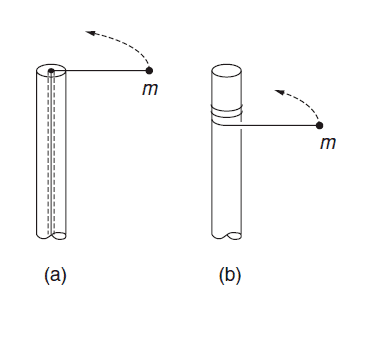
eeeeeeeeeeeeeeeeeeeeeeeeee.png


I'm ok with case (a): the force is central and so angular momentum is conserved. The force is not completely radial and the component of the force parallel to displacement change the velocity (in fact kinetic energy is not conserved)

But in case (b) the force is not central and angular momentum is not conserved, while energy is because force is always parallel to the displacement. From the conservation of KE we find that the velocity increases. But which is the force responsible for that? I mean: there must be a force acting in the direction of the displacement if the velocity increases. Where is this force?
 
Physics news on Phys.org
Soren4 said:
The force is not completely radial and the component of the force parallel to displacement change the velocity (in fact kinetic energy is not conserved)
The force is completely radial in (a), but the velocity is not in the angular direction when you are pulling the string.
 
  • Like
Likes   Reactions: Soren4
Soren4 said:
From the conservation of KE we find that the velocity increases.
If kinetic energy is constant, the velocity is constant in case (b). This is also consistent with some quick scribbles I made.
 
  • Like
Likes   Reactions: Soren4
Thanks for your answer! About case (a) I don't see very well how does the force act. It is radial but it is not centripetal. So, using polar coordinates v_r increases, while v_{\theta} remains constant. But if v_{\theta} i constant, if we imagine to look at the circular motion of the mass when the length of the string is \frac{l}{2}, then the velocity of that motion should be the same as the one at the beginning, nevertheless the mass perform a faster circular motion. This imply that v_{\theta} must change but I really do not see why, could you give some further suggestion?
 
Soren4 said:
Thanks for your answer! About case (a) I don't see very well how does the force act. It is radial but it is not centripetal. So, using polar coordinates v_r increases, while v_{\theta} remains constant. But if v_{\theta} i constant, if we imagine to look at the circular motion of the mass when the length of the string is \frac{l}{2}, then the velocity of that motion should be the same as the one at the beginning, nevertheless the mass perform a faster circular motion. This imply that v_{\theta} must change but I really do not see why, could you give some further suggestion?

The velocity in the ##\theta## direction changes due to the motion in the ##\theta## direction. This is always true regardless of whether there are forces acting on an object or not. The reason is that as the object moves, what is the ##\theta## direction changes. For an object moving in a straight line with constant velocity, this means that ##v_\theta## is going to depend on time. In the same fashion, what is the radial direction also changes and so the radial velocity is translated into a velocity in the ##\theta## direction. In order to keep the angular momentum constant, ##v_\theta## will increase as you pull the string.
 
  • Like
Likes   Reactions: Soren4
Orodruin said:
The velocity in the ##\theta## direction changes due to the motion in the ##\theta## direction. This is always true regardless of whether there are forces acting on an object or not. The reason is that as the object moves, what is the ##\theta## direction changes. For an object moving in a straight line with constant velocity, this means that ##v_\theta## is going to depend on time. In the same fashion, what is the radial direction also changes and so the radial velocity is translated into a velocity in the ##\theta## direction. In order to keep the angular momentum constant, ##v_\theta## will increase as you pull the string.

Thanks for this answer! I got the fact that ##\theta## direction changes but I really don't see how can the radial direction change actually during the motion. Of course the vector ##r## changes but the radial direction is always linking the point to the origin ##O##. How can that be?
 
Soren4 said:
Thanks for this answer! I got the fact that ##\theta## direction changes but I really don't see how can the radial direction change actually during the motion. Of course the vector ##r## changes but the radial direction is always linking the point to the origin ##O##. How can that be?

Because in order to connect the origin to two different points, you need vectors which point in different directions.
 

Similar threads

  • · Replies 10 ·
Replies
10
Views
2K
  • · Replies 3 ·
Replies
3
Views
3K
  • · Replies 30 ·
2
Replies
30
Views
3K
  • · Replies 6 ·
Replies
6
Views
2K
  • · Replies 40 ·
2
Replies
40
Views
5K
  • · Replies 77 ·
3
Replies
77
Views
6K
  • · Replies 53 ·
2
Replies
53
Views
5K
  • · Replies 15 ·
Replies
15
Views
3K
  • · Replies 2 ·
Replies
2
Views
3K
  • · Replies 9 ·
Replies
9
Views
2K