Forces while squeezing toothpase tube

  • Context: Undergrad 
  • Thread starter Thread starter jyhghy
  • Start date Start date
  • Tags Tags
    Forces squeezing Tube
Click For Summary

Discussion Overview

The discussion revolves around the mechanics of squeezing a toothpaste tube, focusing on the forces involved and how they affect the movement of the toothpaste. Participants explore concepts related to pressure, fluid dynamics, and the behavior of particles within the tube.

Discussion Character

  • Exploratory
  • Technical explanation
  • Conceptual clarification
  • Debate/contested

Main Points Raised

  • One participant questions why a horizontally applied force results in vertical movement of the toothpaste, suggesting a need for clarification on the mechanics involved.
  • Another participant argues that the orientation of the tube does not affect the outcome, emphasizing that pressure builds regardless of how the tube is held.
  • A different viewpoint explains that squeezing the tube increases pressure, which acts equally in all directions, causing the toothpaste to move out of the tube.
  • Some participants reference Pascal's principle, noting that fluids under pressure transmit force uniformly, which is relevant to the behavior of the toothpaste.
  • One participant seeks a simpler explanation for why particles in a fluid expand or move under pressure, prompting further discussion on the nature of fluids and their volume stability.
  • Another participant clarifies that fluids do not expand in volume when squeezed, and that the toothpaste must exit the tube to maintain volume, highlighting the relationship between pressure and movement.
  • A participant expresses confusion about the forces at play on a molecular level, specifically questioning whether electromagnetic forces are responsible for the movement of atoms in the toothpaste.
  • One response confirms that the forces between atoms are indeed electromagnetic, addressing the participant's inquiry about atomic movement.

Areas of Agreement / Disagreement

Participants express various viewpoints on the mechanics of pressure and movement in fluids, with some agreeing on the principles of pressure transmission while others seek further clarification on specific aspects. The discussion remains unresolved regarding the deeper understanding of atomic interactions and the nature of fluid behavior under pressure.

Contextual Notes

Some participants' claims depend on assumptions about fluid dynamics and the nature of forces at the atomic level, which are not fully explored or agreed upon in the discussion.

jyhghy
Messages
3
Reaction score
0
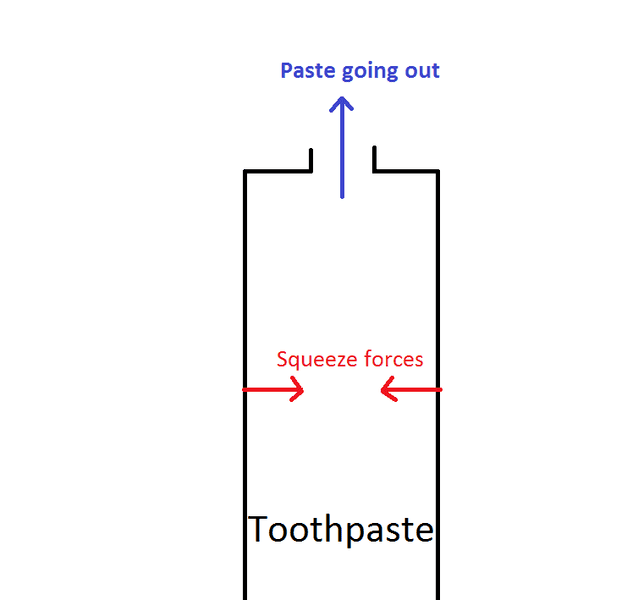
When I squeeze tube of toothpaste, I am working with 2 squeeze forces toward tube. Why it moves vertically from horizontally applied force (when I think of paste as a group of particles inside a tube I cannot imagine that) ?
1or4WSk.png
 
Physics news on Phys.org
hi jyhghy

welcome to PF

vertical , horizontal its irrelevant. That's just the way you are holding the tube
if the tube was lying flat on the table and you squeezed the sides, do you think it would make any difference?

if the cap was on the tube and you were squeezing the tube, the pressure is built up without any opening to release it. take the cap off and the pressure can be released. That is regardless of the orientation of the tube (up, down or sideways)

what do you think ?

cheers
Dae
 
I think that you're asking how a force applied in the direction of the red arrow can cause toothpaste to move in the direction of the blue arrow? Squeezing the tube increases the pressure in the tube, which pushes equally in all directions. The blob of toothpaste in the neck of the tube is subject to this pressure from one side but the other so moves down the neck and out of the tube.
 
The red arrows are just the forces you apply to the tube. The forces that the tube applies to the paste are distributed all over its inner surface. But there are none at the opening, so that's where the paste goes.

If you have problems visualizing how fluids distribute directed forces into pressure that acts in all directions, consider a ball pit:
http://en.wikipedia.org/wiki/Ball_pit
 
Last edited:
This is all related to Pascal's principle which roughly says that a fluid under pressure transmits force equally in all directions. Here is a link on Pascal's principle: http://en.wikipedia.org/wiki/Pascal's_law

Chet
 
Thx all for answers. Could any of you explain please in simple words what causes particles of fluid or gas to expand (move) when they are under pressure (what force cause it)?
 
jyhghy said:
Thx all for answers. Could any of you explain please in simple words what causes particles of fluid or gas to expand (move) when they are under pressure (what force cause it)?

They aren't expanding. What makes a fluid a fluid (and different from a gas) is that no matter how hard you squeeze a fluid, its volume doesn't change.

Toothpaste is a fluid (a rather thick fluid, but still a fluid). So when I squeeze the sides of the tube and reduce the volume of the tube, the volume of the toothpaste stays the same. The only way that can happen is if some of the toothpaste leaves the tube because there's less room for it in the tube.

You could try putting your thumb over the mouth of the tube, holding it closed while you squeeze the tube from the sides. You will feel the toothpaste in the tube pushing against your thumb. That's pressure caused by your thumb holding the toothpaste in the neck in place; as long as that toothpaste can't move nothing can leave the tube so the volume of the tube can't change; . The harder you squeeze the tube, the greater the pressure - the only way the sides of the tube can move inwards reducing the volume of the tube is if some of the toothpaste in the tube forces your thumb aside so that it can escape.
 
I understand that volume must stay the same but I can't understand why. If I imagine toothpaste inside the tube as a group of atoms. When I move some of them ( my hand squeezing) all the other atoms are moving as well in all directions (pressure). Is that Electromagnetic force or something that causes these atoms to move ?
 
jyhghy said:
Is that Electromagnetic force or something that causes these atoms to move ?
Yes the forces between atoms are electromagnetic.
 

Similar threads

  • · Replies 2 ·
Replies
2
Views
2K
  • · Replies 9 ·
Replies
9
Views
3K
  • · Replies 9 ·
Replies
9
Views
4K
  • · Replies 7 ·
Replies
7
Views
3K
  • · Replies 19 ·
Replies
19
Views
3K
  • · Replies 18 ·
Replies
18
Views
7K
  • · Replies 5 ·
Replies
5
Views
3K
  • · Replies 17 ·
Replies
17
Views
5K
  • · Replies 18 ·
Replies
18
Views
5K
Replies
11
Views
2K