Fourier Transform Scaling Property help

Click For Summary

Discussion Overview

The discussion revolves around the Scaling Property of the Fourier Transform, specifically the transition from the integral form of the Fourier Transform to its scaled version. Participants are trying to clarify the mathematical steps involved in this property, focusing on the definitions and substitutions used in the derivation.

Discussion Character

  • Technical explanation
  • Mathematical reasoning
  • Debate/contested

Main Points Raised

  • Uan expresses confusion about the transition from the integral to the scaled term in the proof of the Scaling Property of the Fourier Transform.
  • Some participants reiterate the definition of the Fourier Transform and provide a detailed calculation involving a substitution of variables.
  • There is a discussion about the correct form of the integral and whether it should include g(u/c) or g(u) with a modified exponential term.
  • One participant points out a potential oversight regarding the function g in the integrals presented.
  • Another participant clarifies the steps leading to the scaled Fourier Transform, emphasizing the substitution of f/c and the multiplication by 1/c.

Areas of Agreement / Disagreement

Participants do not reach a consensus on the clarity of the transition from the integral to the scaled form. While some provide calculations and clarifications, others express confusion and seek further explanation.

Contextual Notes

There are unresolved questions regarding the assumptions made in the substitutions and the definitions used in the Fourier Transform. Participants are navigating through the mathematical details without a clear resolution on the discrepancies noted.

Uan
Messages
14
Reaction score
0
Hi,

I'm following the proof of the "Scaling Property of the Fourier Transform" from here:

http://www.thefouriertransform.com/transform/properties.php

...but don't understand how they went from the integral to the right hand term here:
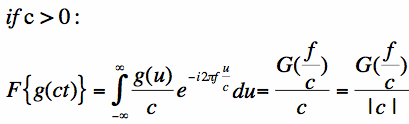
scalingP2.gif


The definition of the Fourier Trasform they use is this:
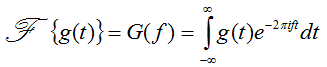
fourierDefinition.gif


Thanks,
Uan
 
Physics news on Phys.org
I don't understand, where there is a problem, because it's simply the definition of the Fouier transform. The full calculation goes as follows. We start with the definition of the Fourier transform:
[tex]\mathcal{F}\{g(c t)\}=\int_{\mathbb{R}} \mathrm{d t} g(t) \exp[-2 \pi \mathrm{i} f t].[/tex]
Now we substitute [itex]u=c t[/itex], which gives
[tex]\mathcal{F}\{g(c t)\}=\frac{1}{|c|} \int_{\mathbb{R}} \mathrm{d} t \exp[-2 \pi \mathrm{i} u (f/c)]=\frac{1}{|c|} G(f/c),[/tex]
where
[tex]G(f)=\mathcal{F}\{g(t)\}(f).[/tex]
 
vanhees71 said:
I don't understand, where there is a problem, because it's simply the definition of the Fouier transform. The full calculation goes as follows. We start with the definition of the Fourier transform:
[tex]\mathcal{F}\{g(c t)\}=\int_{\mathbb{R}} \mathrm{d t} g(t) \exp[-2 \pi \mathrm{i} f t].[/tex]
Now we substitute [itex]u=c t[/itex], which gives
[tex]\mathcal{F}\{g(c t)\}=\frac{1}{|c|} \int_{\mathbb{R}} \mathrm{d} t \ exp[-2 \pi \mathrm{i} u (f/c)]=\frac{1}{|c|} G(f/c),[/tex]
where
[tex]G(f)=\mathcal{F}\{g(t)\}(f).[/tex]

Hi vanhees71,

I get the substitution but I don't see how they went from the integral to the next bit. To me, the form of the integral doesn't quite match the definition in my first post, it has got g(u) but the exponential has exp(-i*2*pi*f*(u/c)), so this is where I get hung up...

Needs to be [STRIKE]either[/STRIKE] g(u/c) [STRIKE][or exp(-i*2*pi*f*u)^(1/c) ? ] (sorry forget this)[/STRIKE] or something to be able to apply the definition. Feels like I'm missing something simple.

One more thing, are you missing g(ct) from your first integral and g(u) on your second integral?

[tex]\mathcal{F}\{g(c t)\}=\int_{\mathbb{R}} \mathrm{d t} g(c t) \exp[-2 \pi \mathrm{i} f t].[/tex]

[tex]\mathcal{F}\{g(c t)\}=\frac{1}{|c|} \int_{\mathbb{R}} \mathrm{d} t \ g(u) exp[-2 \pi \mathrm{i} u (f/c)]=\frac{1}{|c|} G(f/c),[/tex]
 
Last edited:
Uan said:
Hi vanhees71,

I get the substitution but I don't see how they went from the integral to the next bit. To me, the form of the integral doesn't quite match the definition in my first post, it has got g(u) but the exponential has exp(-i*2*pi*f*(u/c)), so this is where I get hung up...
Start with the definition of the Fourier transform:
$$G(f) = \int_{-\infty}^{\infty} g(u) \exp[-2\pi i f u] du$$
Now substitute ##f/c## in place of ##f##:
$$G(f/c) = \int_{-\infty}^{\infty} g(u) \exp[-2\pi i (f/c) u] du$$
Multiply by ##1/c##:
$$\frac{1}{c} G(f/c) = \int_{-\infty}^{\infty} \frac{g(u)}{c} \exp[-2\pi i (f/c) u] du$$
which is the second equality in your displayed equation.
 
  • Like
Likes   Reactions: 1 person
jbunniii said:
Start with the definition of the Fourier transform:
$$G(f) = \int_{-\infty}^{\infty} g(u) \exp[-2\pi i f u] du$$
Now substitute ##f/c## in place of ##f##:
$$G(f/c) = \int_{-\infty}^{\infty} g(u) \exp[-2\pi i (f/c) u] du$$
Multiply by ##1/c##:
$$\frac{1}{c} G(f/c) = \int_{-\infty}^{\infty} \frac{g(u)}{c} \exp[-2\pi i (f/c) u] du$$
which is the second equality in your displayed equation.

Cheers jbunniii, just what I was after! :thumbs:
 

Similar threads

  • · Replies 3 ·
Replies
3
Views
12K
  • · Replies 5 ·
Replies
5
Views
3K
  • · Replies 12 ·
Replies
12
Views
12K
  • · Replies 2 ·
Replies
2
Views
2K
  • · Replies 2 ·
Replies
2
Views
3K
  • · Replies 3 ·
Replies
3
Views
2K
  • · Replies 4 ·
Replies
4
Views
2K
  • · Replies 5 ·
Replies
5
Views
2K
  • · Replies 8 ·
Replies
8
Views
5K
  • · Replies 4 ·
Replies
4
Views
2K