fog37
- 1,566
- 108
Hello,
When solving statics or dynamics problems, one important step is to draw the free body diagram (FBD) with all the external forces acting ON the system. The "chosen" system may be composed of a single or multiple entities. The external forces have components that must be projects on the coordinate system which can be polar, Cartesian, etc.
My question is about the location of the origin ##O## and the orientation of the axes. In general, one rule of thumb is to place the origin ##O## where the point mass is or where the ##CM## of the system is. As far the system axes' orientation, it is mathematically convenient to align one of the axes with the net force direction. In this case, the axes are fixed in direction. In other situations, I have seen the origin ##O## being fixed at a specific spatial point with the two axes also fixed in direction.
The third option, which is also very common, is to choose a local coordinate system ##O′x′y′## with origin ##O′## centered on the particle and moving with the particle itself. It is effectively a local and moving Cartesian system. In the 2D case, one of the axis is parallel to the tangent to the trajectory and always aligned with the instantaneous velocity vector ##\vec{v}(t)## with the other axis is automatically perpendicular to the first axis. The acceleration vector ##\vec{a}(t)## is then decomposed into two components: the tangential component ##a_{tan}## and the radial or centripetal component ##a_{centr}##.
Is this coordinate system choice ##O'x'y'## (local and moving with the particle, with one axis parallel to the direction of motion) always the most suitable and mathematically convenient choice? It looks like.
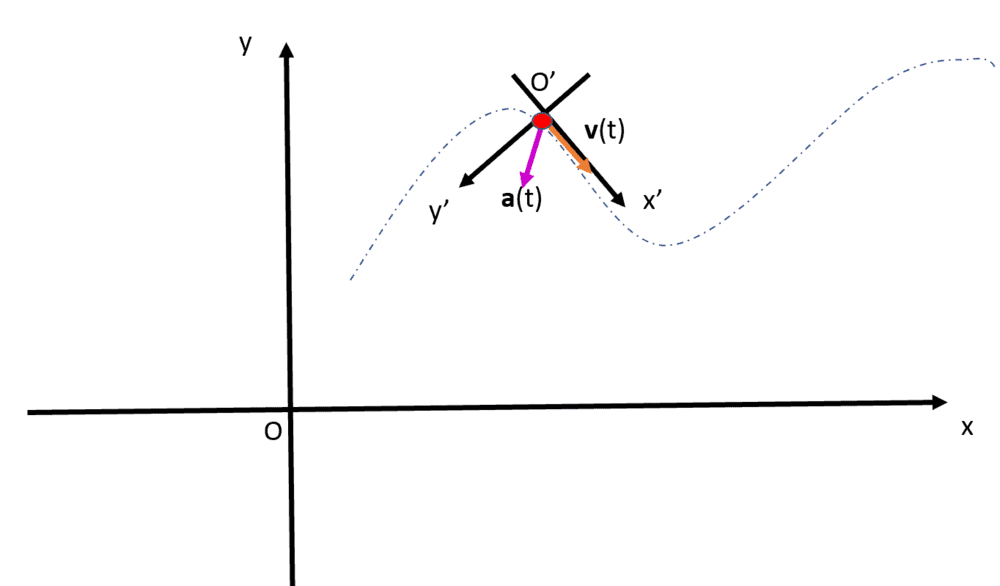
I struggle to see situations in which we would pick a coord. system ##Oxy## with origin ##O## not centered on the moving particle and with its axes in fixed directions instead of changing direction. It looks like the description of motion and the resolution of dynamics problems would be always more complicated.
On the other hand, the polar coordinate system has a fixed origin but its unit vectors change directions as the particle occupies different spatial positions...
Thanks!
When solving statics or dynamics problems, one important step is to draw the free body diagram (FBD) with all the external forces acting ON the system. The "chosen" system may be composed of a single or multiple entities. The external forces have components that must be projects on the coordinate system which can be polar, Cartesian, etc.
My question is about the location of the origin ##O## and the orientation of the axes. In general, one rule of thumb is to place the origin ##O## where the point mass is or where the ##CM## of the system is. As far the system axes' orientation, it is mathematically convenient to align one of the axes with the net force direction. In this case, the axes are fixed in direction. In other situations, I have seen the origin ##O## being fixed at a specific spatial point with the two axes also fixed in direction.
The third option, which is also very common, is to choose a local coordinate system ##O′x′y′## with origin ##O′## centered on the particle and moving with the particle itself. It is effectively a local and moving Cartesian system. In the 2D case, one of the axis is parallel to the tangent to the trajectory and always aligned with the instantaneous velocity vector ##\vec{v}(t)## with the other axis is automatically perpendicular to the first axis. The acceleration vector ##\vec{a}(t)## is then decomposed into two components: the tangential component ##a_{tan}## and the radial or centripetal component ##a_{centr}##.
Is this coordinate system choice ##O'x'y'## (local and moving with the particle, with one axis parallel to the direction of motion) always the most suitable and mathematically convenient choice? It looks like.
I struggle to see situations in which we would pick a coord. system ##Oxy## with origin ##O## not centered on the moving particle and with its axes in fixed directions instead of changing direction. It looks like the description of motion and the resolution of dynamics problems would be always more complicated.
On the other hand, the polar coordinate system has a fixed origin but its unit vectors change directions as the particle occupies different spatial positions...
Thanks!
Attachments

Last edited: