greypilgrim
- 583
- 45
Hi.
Usually, the clarinet is presented as acting like a pipe system closed at one end, which only allows for harmonics that are odd multiples of the fundamental frequency. I used the app "SpectrumView" by OxfordWaveResearch to measure the following spectrum:
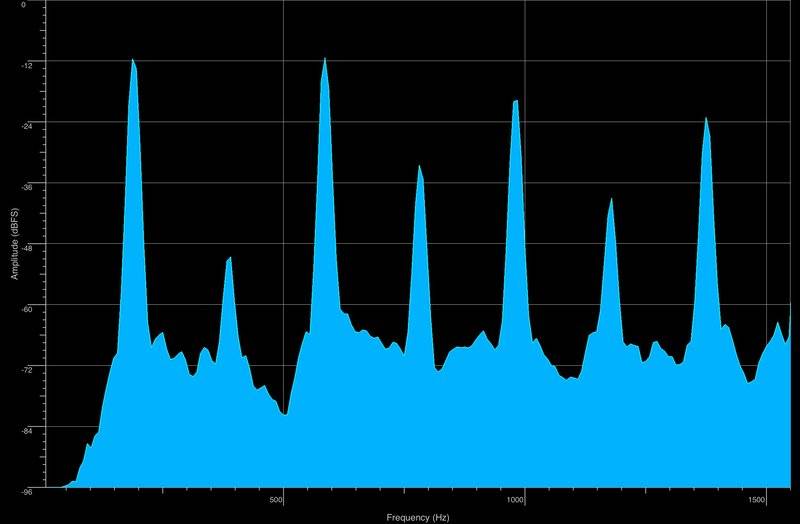
Fair enough, the amplitudes of the odd harmonics are considerably smaller than the ones of the even harmonics, but far from "absent". I assume that no real-world system satisfies boundary conditions such as "closed pipe" and "open pipe" perfectly and are a mixture between them, but I still would have expected the amplitudes of the odd harmonics to be much smaller.
Is something wrong with my measurement, or is the closed-pipe-nature of a clarinet really THAT indistinct?
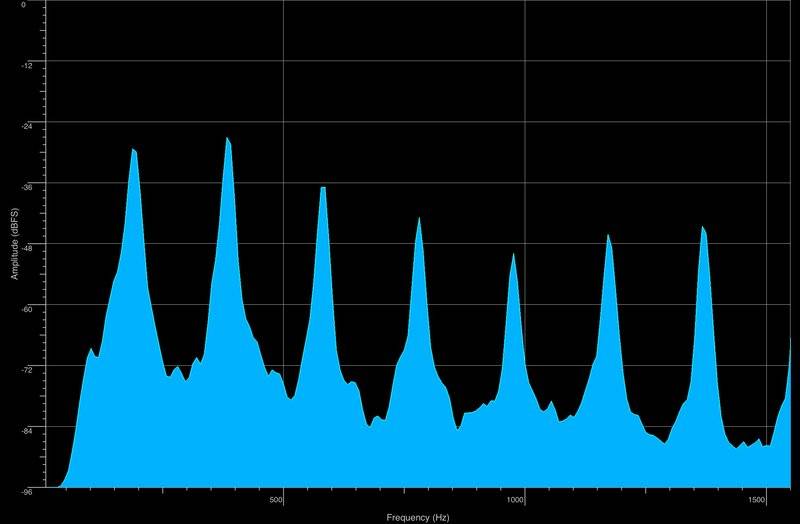
As a comparison, the spectrum of the G string of a guitar (which resembles a pipe closed at both ends), which has the same fundamental frequency:
Usually, the clarinet is presented as acting like a pipe system closed at one end, which only allows for harmonics that are odd multiples of the fundamental frequency. I used the app "SpectrumView" by OxfordWaveResearch to measure the following spectrum:
Fair enough, the amplitudes of the odd harmonics are considerably smaller than the ones of the even harmonics, but far from "absent". I assume that no real-world system satisfies boundary conditions such as "closed pipe" and "open pipe" perfectly and are a mixture between them, but I still would have expected the amplitudes of the odd harmonics to be much smaller.
Is something wrong with my measurement, or is the closed-pipe-nature of a clarinet really THAT indistinct?
As a comparison, the spectrum of the G string of a guitar (which resembles a pipe closed at both ends), which has the same fundamental frequency:
Attachments

