Fresnel's Equations: Reflections and Total Internal Reflection

Click For Summary
SUMMARY

This discussion focuses on the derivation of phase shift equations related to total internal reflection (TIR) as presented in S. O. Kasap's "Optoelectronics and Photonics." The participants analyze Fresnel's equations, specifically the reflection coefficients for transverse electric (TE) and transverse magnetic (TM) light, which become complex-valued during TIR. Key points include the derivation of Eq (6) and the significance of the half-angle in the expression for tan(ΦTE). The conversation emphasizes the need for clarity in understanding the transition from complex reflection coefficients to their polar representation.

PREREQUISITES
  • Understanding of Fresnel's equations
  • Knowledge of complex numbers and their polar representation
  • Familiarity with phase shifts in optics
  • Basic concepts of total internal reflection (TIR)
NEXT STEPS
  • Study the derivation of Fresnel's equations in detail
  • Learn about complex reflection coefficients in optics
  • Research the significance of phase shifts in total internal reflection
  • Explore the mathematical representation of light behavior at dielectric interfaces
USEFUL FOR

Students and professionals in optics, physicists studying light behavior at interfaces, and anyone seeking to deepen their understanding of total internal reflection and its mathematical foundations.

loginorsinup
Messages
54
Reaction score
2
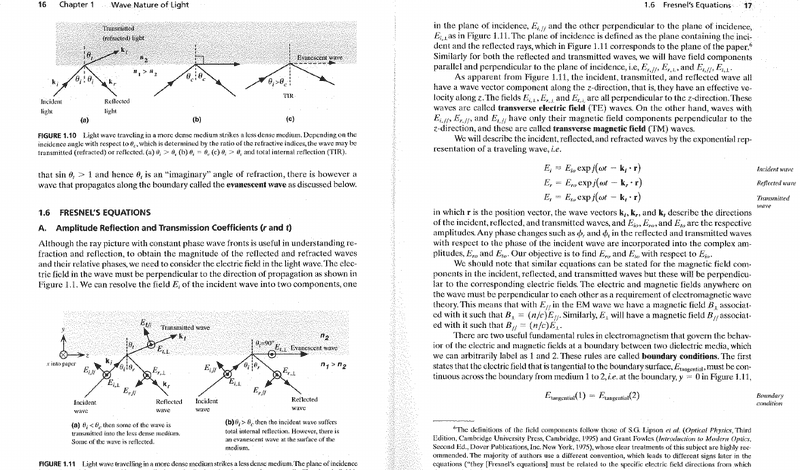
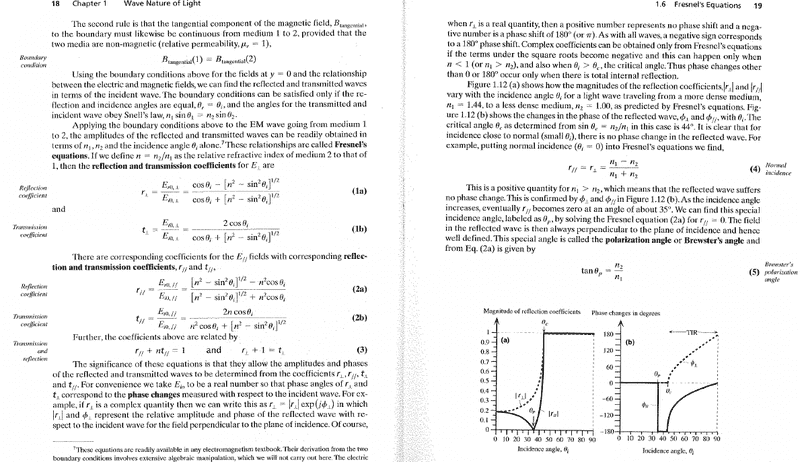
I am trying to understand the derivation behind the equations for the phase shift incurred when light hits an interface between two lossless dielectrics under total internal reflection (TIR) from what I gathered in S. O. Kasap's Optoelectronics and Photonics.

On the final pair of pages presented here for context there are two equations for the phase shift. I have several questions.
WdOWqY8.png

DpR5ItB.png

zER1MDq.png


1) Where did this expression come from?
  • I get to the point where this comes from Fresnel's equations and that the reflection coefficients can be expressed as complex numbers with magnitudes and phases, but I don't see how that follows to the end result. This book often just jumps to a conclusion, and unless you've seen it before, you end up feeling like you're memorizing something you'll forget in like 3 months.
  • Typically, when I see an equation like this I think of some imaginary part divide some real part of something. I am guessing what they somehow did is took the reflection coefficient and expressed it in rectangular coordinates as a complex number, then divided the imaginary component by the real component.
2) That brings me to my next question, in the expression, you aren't provided tan(ΦTE) but tan(1/2 * ΦTE). Where did the 1/2 come from?

3) How can I use the fact that I know that somehow when TIR occurs, the reflection coefficients for both TE and TM light become complex-valued, and can therefore be represented in polar coordinates (amplitude and phase)?

Lecture slides from just about everywhere on the Internet just take this for granted. I don't even know what to Google for because half the time what I search for turns up stuff about transmission lines and the other half of the time I just get this stuff thrown at me without context.

Thanks in advance for the help.
 

Attachments

  • WdOWqY8.png
    WdOWqY8.png
    91.3 KB · Views: 805
Physics news on Phys.org
1) Where did this expression come from?
... where did which expression come from?
Each equation is numbered so that you can easily point it out. Do you mean eq(6)?

(2) - the 1/2 comes from taking a half-angle.
The derivation comes in the section immediately above eq(6) and below the pic of Brewster.
You will need to refer to the other equations mentioned to make sense of it better.

(3) That is also described in the passage leading to equ(2) ... how do the coefficients fit in with the components of E?
Note: all complex numbers can be written in polar form like they did here.
 
Yes, sorry for being vague. I meant eq(6) and eq(7).

Thanks for your input.

In parallel, I was able to derive Eq (6), but Eq (7) and the addition of pi is confusing to me. Shouldn't it be

tan(1/2*π - 1/2*Φ//) = tan(1/2*[π - Φ//) = [... the rest which I have also derived... ]?

instead of

tan(1/2*Φ// + 1/2*π) ?

My rationale is that you're measuring tangent in the second quadrant as r// can be written as (jy-x)/(jy+x) where x and y are real numbers (and jy is an imaginary number with real magnitude y). So, manipulating that into polar form requires you to find the polar form of the numerator and the phasor / polar form of the denominator.

This should be: √(x^2 + y^2) ∠ atan(y/(-x)). This, graphically, would be a triangle with leg / side lengths y and x in the second quadrant of the complex plane. Naturally, the denominator would be √(x^2 + y^2) ∠ atan(y/x). I know the π term in eq(7) comes from the numerator. But I can't quite figure out why it's written as is.

Thanks for your help.
 

Similar threads

  • · Replies 5 ·
Replies
5
Views
1K
  • · Replies 6 ·
Replies
6
Views
2K
  • · Replies 1 ·
Replies
1
Views
951
  • · Replies 4 ·
Replies
4
Views
2K
  • · Replies 6 ·
Replies
6
Views
1K
  • · Replies 2 ·
Replies
2
Views
2K
  • · Replies 14 ·
Replies
14
Views
4K
  • · Replies 8 ·
Replies
8
Views
3K
  • · Replies 9 ·
Replies
9
Views
3K
  • · Replies 2 ·
Replies
2
Views
3K