Friction and the difference between rear-wheel, front-wheel and four-wheel

  • Thread starter Thread starter piacere_space
  • Start date Start date
  • Tags Tags
    Difference Friction
Click For Summary

Discussion Overview

The discussion revolves around determining the steepest grade a car can drive up at constant speed based on its drive type (rear-wheel, front-wheel, and four-wheel drive). Participants explore the calculations involved, including the effects of static friction and the car's weight, while seeking validation of their results.

Discussion Character

  • Technical explanation
  • Mathematical reasoning
  • Debate/contested

Main Points Raised

  • One participant presents calculations for the maximum angle of ascent for each drive type, yielding angles of 10.18°, 17.17°, and 26.57° for rear-wheel, front-wheel, and four-wheel drive, respectively.
  • The calculations involve determining normal forces and applying equilibrium conditions, with specific equations provided for each drive type.
  • Another participant expresses agreement with the method and results, suggesting that the center of gravity affects the comparison between front-wheel and rear-wheel drive vehicles.
  • A third participant asks for clarification on the calculations, specifically regarding the numerical values used in the equations.

Areas of Agreement / Disagreement

While one participant agrees with the calculations and method presented, there is no consensus on the correctness of the results, as some participants seek further clarification and validation of the calculations.

Contextual Notes

Participants have not fully resolved the implications of the center of gravity on the comparison between front-wheel and rear-wheel drive vehicles, nor have they clarified the assumptions made in the calculations.

Who May Find This Useful

This discussion may be useful for individuals interested in automotive physics, vehicle dynamics, or those studying the effects of friction in mechanical systems.

piacere_space
Messages
2
Reaction score
0
The car weighs 15kN. The coefficient of static friction between the car tires and the road is \mus=0.5. Determine the steepest grade (the largest value of the angle of \alpha) the car can drive up at constant speed if the car has (a) rear-wheel drive, (b) front-wheel drive, and (c) four-wheel drive.
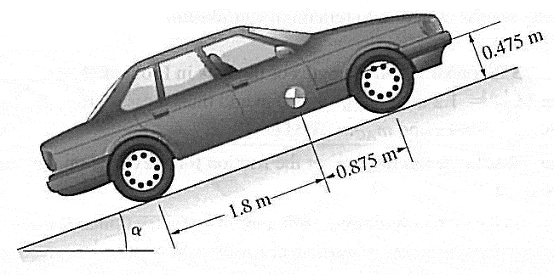
image002.gif

My answers are (a)10.18o (b)17.17o (c)26.57o. I just wonder if they are really correct. Thanks!

Sorry yeah I forgot to post my attempt...

Let the normal forces at the rear wheel and the front wheel be NA and NB respectively. Also let the contact points at the rear and front wheel be A and B respectively.

(a)(1)0.5NA-15sin\alpha=0 then NA=30sin\alpha (2)0.875*15cos\alpha+0.475*15sin\alpha-2.675NA=0 then 13.125cos\alpha+7.125sin\alpha-2.675NA=0. Now from (1) and (2) tan\alpha=7/39 then \alpha=10.18o

Here I assume the rolling friction at the point B is ignorable. (1) is about the equilibrium of all forces in the horizontal direction. (2) is about the equations of moments around B.

Basically I did the same things for (b) and (c).

(b)tan\alpha=72/233 then \alpha=17.17o

(c)tan\alpha=0.5 then \alpha=26.57o
 

Attachments

Last edited:
Physics news on Phys.org
With a rough calc, they seem to be in the ballpark; if you post your attempt and show how you arrived at these figures, perhaps someone can check the math and method.
 
piacere_space said:
The car weighs 15kN. The coefficient of static friction between the car tires and the road is \mus=0.5. Determine the steepest grade (the largest value of the angle of \alpha) the car can drive up at constant speed if the car has (a) rear-wheel drive, (b) front-wheel drive, and (c) four-wheel drive. View attachment 20672
My answers are (a)10.18o (b)17.17o (c)26.57o. I just wonder if they are really correct. Thanks!

Sorry yeah I forgot to post my attempt...

Let the normal forces at the rear wheel and the front wheel be NA and NB respectively. Also let the contact points at the rear and front wheel be A and B respectively.

(a)(1)0.5NA-15sin\alpha=0 then NA=30sin\alpha (2)0.875*15cos\alpha+0.475*15sin\alpha-2.675NA=0 then 13.125cos\alpha+7.125sin\alpha-2.675NA=0. Now from (1) and (2) tan\alpha=7/39 then \alpha=10.18o

Here I assume the rolling friction at the point B is ignorable. (1) is about the equilibrium of all forces in the horizontal direction. (2) is about the equations of moments around B.

Basically I did the same things for (b) and (c).

(b)tan\alpha=72/233 then \alpha=17.17o

(c)tan\alpha=0.5 then \alpha=26.57o
Sorry for not responding sooner.
I agree exactly with your method and answers, nice work! Intuitively, one would expect an all wheel drive vehicle to handle a grade steeper than front wheel or rear wheel drive only. But between front and rear wheel drive, you've got to crunch out the numbers to see which amongst the two can handle the steeper grade, because it depends on the location of the car's center of gravity. You've shown that quite nicely.
 
hello. i have a question. How do you do to find these numbers i don't understand so much.. 72/233... its the answer of question B.. thank you so much.
 

Similar threads

  • · Replies 6 ·
Replies
6
Views
3K
Replies
8
Views
2K
Replies
4
Views
2K
  • · Replies 5 ·
Replies
5
Views
2K
  • · Replies 24 ·
Replies
24
Views
2K
  • · Replies 12 ·
Replies
12
Views
2K
Replies
16
Views
3K
  • · Replies 18 ·
Replies
18
Views
2K
Replies
15
Views
7K
  • · Replies 5 ·
Replies
5
Views
2K