Undergrad Fundamental Theorem of Arithmetic - Bhattacharya et al

Click For Summary
SUMMARY

The forum discussion centers on the proof of the Fundamental Theorem of Arithmetic (FTA) as presented in "Basic Abstract Algebra" by Bhattacharya et al. Participants analyze the implications of the Second Principle of Induction in proving the uniqueness of prime factorization. Specifically, they explore how the expression involving prime factors leads to contradictions when assuming non-unique factorizations. The conversation emphasizes the necessity of understanding the algebraic manipulations involved in the proof.

PREREQUISITES
  • Understanding of the Fundamental Theorem of Arithmetic
  • Familiarity with the Second Principle of Induction
  • Basic algebraic manipulation skills
  • Knowledge of prime factorization concepts
NEXT STEPS
  • Study the proof of the Fundamental Theorem of Arithmetic in detail
  • Learn about the Second Principle of Induction and its applications
  • Practice algebraic proofs involving prime factorization
  • Explore advanced topics in number theory related to unique factorization domains
USEFUL FOR

Mathematics students, educators, and anyone interested in number theory, particularly those studying the Fundamental Theorem of Arithmetic and its proofs.

Math Amateur
Gold Member
MHB
Messages
3,920
Reaction score
48
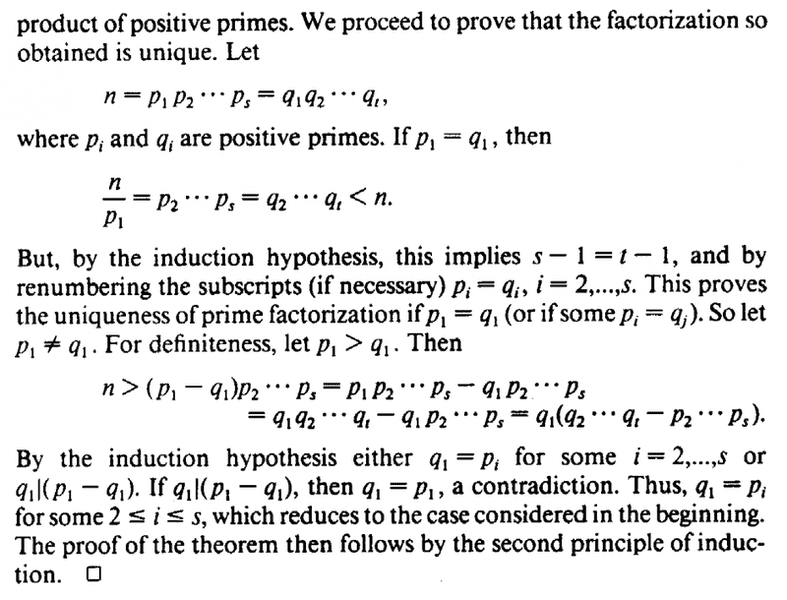
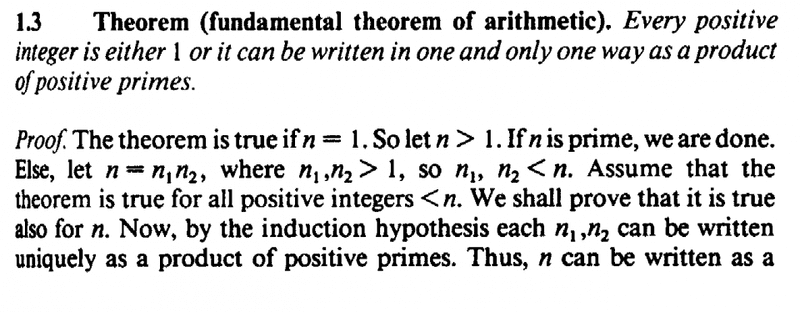
I am reading the book, Basic Abstract Algebra by P.B. Bhattacharya, S.K. Jain, and S.R. Nagpaul ... ... and am currently focused on Chapter 2: Integers, Real Numbers and Complex Numbers ...I need help with an aspect of the proof of the Fundamental Theorem of Arithmetic in Section 1.3 ... ...The Fundamental Theorem of Arithmetic and its proof as presented by Bhattacharya et al reads as follows:
?temp_hash=527395e91194c9b9972ae8b938d4b624.png

?temp_hash=527395e91194c9b9972ae8b938d4b624.png


In the above text we read the following:" ... ... So let ##p_1 \neq q_1##. For definiteness, let ##p_1 \gt q_1##. Then

##n \gt (p_1 - q_1) p_2 \ ... \ p_s = p_1p_2 \ ... \ p_s - q_1p_2 \ ... \ p_s##

##= q_1q_2 \ ... \ q_t - q_1p_2 \ ... \ p_s = q_1 (q_2 \ ... \ q_t - p_2 \ ... \ p_s)##

By the induction hypothesis either ##q_1 = p_i## for some ##i = 2, \ ... \ , s## or

##q_1 | (p_1 - q_1)##. ... ... "I do not follow how

##n \gt (p_1 - q_1) p_2 \ ... \ p_s = p_1p_2 \ ... \ p_s - q_1p_2 \ ... \ p_s##

##= q_1q_2 \ ... \ q_t - q_1p_2 \ ... \ p_s = q_1 (q_2 \ ... \ q_t - p_2 \ ... \ p_s)##

leads to

either ##q_1 = p_i## for some ##i = 2, \ ... \ , s## or ##q_1 | (p_1 - q_1)##. ... ...
Can someone slowly and clearly explain exactly how the above follows ...Hope someone can help ... ...

Peter

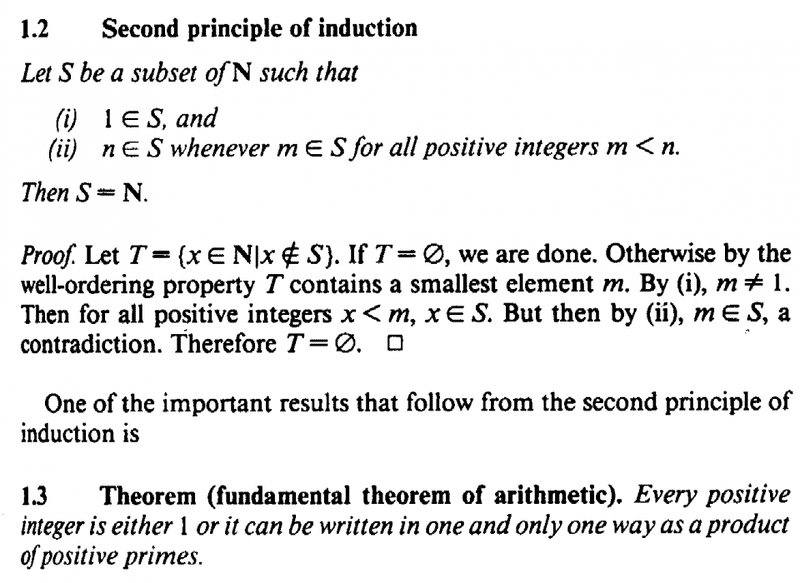
======================================================The above refers to what Bhattacharya et al call the Second Principle of Induction ... this principle reads as follows in their text ... ... :
?temp_hash=527395e91194c9b9972ae8b938d4b624.png
 

Attachments

  • Bh et al - 1 - Fundamental Theorem of Arith.png
    Bh et al - 1 - Fundamental Theorem of Arith.png
    39.1 KB · Views: 1,304
  • Bh et al - 2 - Fundamental Theorem of Arith.png
    Bh et al - 2 - Fundamental Theorem of Arith.png
    66.7 KB · Views: 6,242
  • Bhattacharya et al - Second Principle of Induction.png
    Bhattacharya et al - Second Principle of Induction.png
    91.3 KB · Views: 960
Physics news on Phys.org
The basis of this proof is that, if the FTA does not hold, then there must be a least whole number that has a non-unique prime factorisation. He's assuming that

##n = p_1 \dots p_s = q_1 \dots q_t##

is that whole number. And that any whole number less than ##n## must, therefore, have a unique prime factorisation.

I would change the proof slightly. If the two prime factorisations are different, then we know that they have no primes in common (otherwise we could cancel the common prime). In particular, this means that (without loss of generality) ##p_1 > q_1## and ##q_1## is distinct from all the ##p's##.

Now, a bit of algebra gives:

##n > m = (p_1 -q_1)p_2 \dots p_s = q_1(q_2 \dots q_t - p_2 \dots p_s)##

Now, this number ##m## is less than ##n## so must have a unique prime factorisation. In particular, ##q_1## must appear in the prime factorisation of ##(p_1 -q_1)p_2 \dots p_s##.

And, as we know ##q_1## is distinct from the ##p's## (*) it must appear in the prime factorisation of ##(p_1 -q_1)## and so, in fact, ##p_1 = q_1##, which is a contradiction. You might want to prove this last bit yourself.

(*) note also that ##p_2 \dots p_s < n## so has a unique prime factorisation and cannot have an alternative factorisation involving ##q_1##.
 
  • Like
Likes Math Amateur
Thanks for the help PeroK ... much appreciated...

... just working through your post now ...

Thanks again,

Peter
 
PeroK said:
The basis of this proof is that, if the FTA does not hold, then there must be a least whole number that has a non-unique prime factorisation. He's assuming that

##n = p_1 \dots p_s = q_1 \dots q_t##

is that whole number. And that any whole number less than ##n## must, therefore, have a unique prime factorisation.

I would change the proof slightly. If the two prime factorisations are different, then we know that they have no primes in common (otherwise we could cancel the common prime). In particular, this means that (without loss of generality) ##p_1 > q_1## and ##q_1## is distinct from all the ##p's##.

Now, a bit of algebra gives:

##n > m = (p_1 -q_1)p_2 \dots p_s = q_1(q_2 \dots q_t - p_2 \dots p_s)##

Now, this number ##m## is less than ##n## so must have a unique prime factorisation. In particular, ##q_1## must appear in the prime factorisation of ##(p_1 -q_1)p_2 \dots p_s##.

And, as we know ##q_1## is distinct from the ##p's## (*) it must appear in the prime factorisation of ##(p_1 -q_1)## and so, in fact, ##p_1 = q_1##, which is a contradiction. You might want to prove this last bit yourself.

(*) note also that ##p_2 \dots p_s < n## so has a unique prime factorisation and cannot have an alternative factorisation involving ##q_1##.
PeroK,

Thanks again for your help ...

BUT ... I need help to show that ##q_1## appearing in the prime factorization of ##(p_1 -q_1)## leads to ##p_1 = q_1## ... ...

Can you help further ...

Peter
 
Math Amateur said:
PeroK,

Thanks again for your help ...

BUT ... I need help to show that ##q_1## appearing in the prime factorization of ##(p_1 -q_1)## leads to ##p_1 = q_1## ... ...

Can you help further ...

Peter

Yes, but if you can't do something simple like that for yourself, then you are going to struggle.

##p_1 - q_1 = rq_1## for some ##r##

##p_1 = (r+1)q_1##

(That itself could be taken to be the contradiction, as you have an alternative prime factorisation for ##p_1##)

Or, to continue:

##r = 0## and ##p_1 = q_1##

You need to get used to doing this for yourself. You can't learn number theory by letting Bhattacharya (or me) just spoon feed you all the steps.
 
Thanks again for your help,

Peter
 

Similar threads

Replies
4
Views
2K
  • · Replies 5 ·
Replies
5
Views
3K
  • · Replies 35 ·
2
Replies
35
Views
5K
  • · Replies 5 ·
Replies
5
Views
2K
  • · Replies 4 ·
Replies
4
Views
2K
  • · Replies 4 ·
Replies
4
Views
3K
  • · Replies 5 ·
Replies
5
Views
3K
  • · Replies 2 ·
Replies
2
Views
2K
  • · Replies 12 ·
Replies
12
Views
11K
  • · Replies 197 ·
7
Replies
197
Views
33K