Gauche Effect & SN2 Reactions: Sigma-Sigma* Orbital Interactions

Click For Summary
SUMMARY

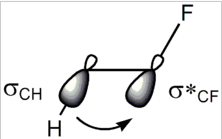
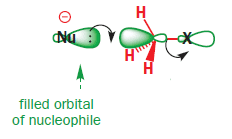
The discussion centers on the gauche effect and SN2 reactions, specifically focusing on sigma-sigma* orbital interactions as described in March's advanced organic chemistry. In 1,2-diflouroethane, the C-F bonding orbital transitions to an antibonding orbital, allowing the C-H sigma orbital to overlap with the empty C-F sigma orbital. In SN2 mechanisms, the C-X bond becomes an antibonding orbital, enabling nucleophilic attack on the carbon's empty sigma orbital. The conversation highlights the complexity of molecular orbital theory and its representation in organic chemistry literature.

PREREQUISITES
  • Understanding of molecular orbital theory
  • Familiarity with SN2 reaction mechanisms
  • Knowledge of the gauche effect in organic compounds
  • Experience with bonding and antibonding orbitals
NEXT STEPS
  • Study the implications of sigma-sigma* interactions in organic reactions
  • Explore the nuances of molecular orbital theory in advanced organic chemistry
  • Investigate the role of electron density in bonding and antibonding orbitals
  • Review literature on the gauche effect and its applications in stereochemistry
USEFUL FOR

Chemistry students, organic chemists, and researchers interested in advanced molecular orbital theory and its applications in reaction mechanisms.

Titan97
Gold Member
Messages
450
Reaction score
18
Recently, I read two chapters from March's advanced organic chemistry. I came across gauche effect and SN2 reactions. In both phenomena, ##\sigma-\sigma^*## orbital interactions is involved. In gauche effect present in 1,2-diflouroethane, the C-F bonding orbital becomes an antibonding orbital so that C-H ##\sigma## orbital can overlap with the empty C-F ##\sigma## orbital.
Capture2.PNG


In SN2 mechanism, C-X bonding becomes antibonding orbital so that the nucleophile can attack the empty ##\sigma## orbital of Carbon
Capture.PNG


Am I correct? Is there any flaw in my understanding?
 
Chemistry news on Phys.org
No, it is just that electron density from a near by orbital (e.g. the filled orbital on Nu) is brought into the anti-bonding orbital (C-X). This compensates the bonding by the filled C-X sigma orbital. It is not so that the latter one is emptied somehow.
 
C-X bond has a bonding and an antibonding orbital. Initially 2 electrons are filled in BO. That is, if the reactant was CH3Cl, then a +sp3 orbital of C and a p-orbital of Cl would overlap. This forms BMO. But how can C-Nu bond form when C-Cl ABMO is filled?

Also, how can BMO and ABMO be formed simultaneously? Its given everywhere that 2 orbitals overlap to give two molecular orbitals. But each MO requires a different configuration of orbital.
 
Last edited:
O-chem books are not a good place to learn about MO-theory.
 

Similar threads

  • · Replies 1 ·
Replies
1
Views
5K
Replies
6
Views
21K
  • · Replies 2 ·
Replies
2
Views
3K
  • · Replies 10 ·
Replies
10
Views
3K
  • · Replies 4 ·
Replies
4
Views
2K
  • · Replies 1 ·
Replies
1
Views
2K
Replies
6
Views
7K
  • · Replies 1 ·
Replies
1
Views
2K
  • · Replies 21 ·
Replies
21
Views
5K
  • · Replies 1 ·
Replies
1
Views
5K