Gauss' law in differential form

Join the discussion
Ask a follow-up here, or get your own question answered by working scientists, mathematicians and engineers — people, not an autocomplete.
Real named experts · corrections over time · the nuance an AI answer skips
6 replies · 4K views
Leo Liu
Messages
353
Reaction score
156
Homework Statement
.
Relevant Equations
.
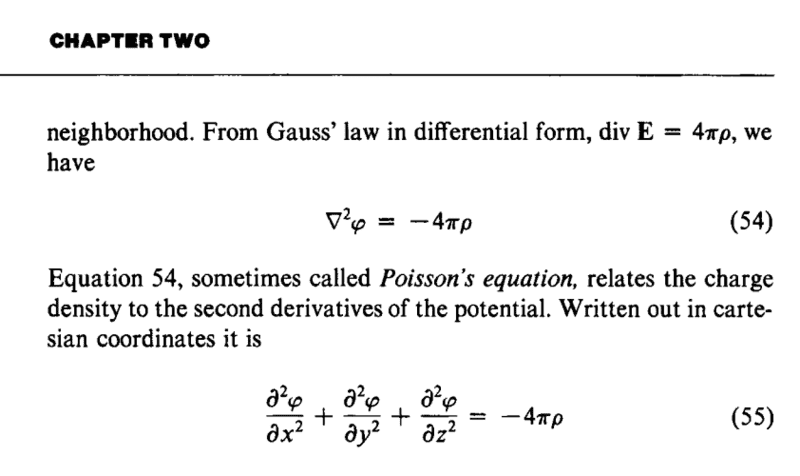
My book claims that the diff. form of Gauss' law is
$$\nabla\cdot\mathbf E=4\pi\rho$$
Can someone tell me why it isn't ##\nabla\cdot\mathbf E=\rho/\epsilon_0##?
1628476968434.png
 
  • Like
Likes   Reactions: Delta2
Physics news on Phys.org
I'm sure @TSny would go into more detail but trust me you do not wish to do that and he has chosen not to. Just get used to different factors of 4pi and epsilon and mu in equations and understand there is no problem. The pictures in your head should not depend upon these details.
 
  • Like
Likes   Reactions: Leo Liu
hutchphd said:
I'm sure @TSny would go into more detail but trust me you do not wish to do that and he has chosen not to. Just get used to different factors of 4pi and epsilon and mu in equations and understand there is no problem. The pictures in your head should not depend upon these details.
Thanks. But why do we need two sets of units for EM? Doesn't SI suffice all of our needs?
 
Both systems have their pluses and minuses.
Conventionally, theoretical physics, especially particle physicists, tend to go with cgs. But today there seems to be a strong trend to go rationalized mks, aka SI. Personally I won't deal with cgs though that is what I had to deal with in my own introductory physics course. A long time ago, thank goodness.

One thing I don't like about cgs is that it has no separate unit for charge Q. For an EE like myself that is unacceptable. I'll let the particle physicists defend cgs.

Of course, the presence/absence of Q is a tradeoff of sorts. In general, increasing the number of characters in a vocabulary shortens the text but at the expense of extra characters in the "alphabet". Cf. English vs. Chinese.

Another example is avoidance of extra parameters even within a given system. Some teachers prefer a minimum of parameters, others like abbreviated text. E.g. you can avoid ## \bf D ## and ## \bf H ## since ## \bf D = \epsilon \bf E ## and ## \bf B = \mu \bf H ## but personally I find that awkward. Clutters the Maxwell equations, for example. Richard Feynman even avoids using ## \mu ##, sticking to ## c ## and ## \epsilon ##. If you're SI it makes his cgs-based Lectures hard to follow at times.

Etc.
 
  • Informative
  • Like
Likes   Reactions: Leo Liu and Delta2