Gauss' law in line integral, Q=##ϵ_0 ∮E.n dl=-ϵ_0 ∮∂ϕ/∂n dl##

Join the discussion
Registration is free. Ask a follow-up in this thread, or start your own.
2 replies · 2K views
mdn
Messages
49
Reaction score
0
I know the Gauss law for surface integral to calculate total charge by integrating the normal components of electric field around whole surface . but in above expression charge is calculated using line integration of normal components of electric field along line. i don't understand this relation. any help please.
 
Engineering news on Phys.org
Is this a 2D problem? Because integrating over a closed curve (ie the "surface" of an area) is the 2D equivalent of integrating over the surface of a volume. By Green's Theorem, [tex] \begin{split}<br /> \int_{\Omega} \nabla \cdot \mathbf{E}\,dA &= \oint_{\partial\Omega} (-E_y, E_x, 0)\cdot \mathbf{t}\,dl \\<br /> &= \oint_{\partial \Omega} (\mathbf{k} \times \mathbf{E}) \cdot \mathbf{t}\,dl \\<br /> &= \oint_{\partial \Omega} \mathbf{E} \cdot (\mathbf{t} \times \mathbf{k})\,dl \\<br /> &= \oint_{\partial \Omega} \mathbf{E} \cdot \mathbf{n}\,dl<br /> \end{split}[/tex] since [itex]\mathbf{k} = \mathbf{n} \times \mathbf{t}[/itex] where [itex]\mathbf{t}[/itex] is the unit tangent of the curve traversed anticlockwise and [itex]\mathbf{n}[/itex] is the outward unit normal.
 
  • Like
Likes   Reactions: mdn and topsquark
pasmith said:
Is this a 2D problem? Because integrating over a closed curve (ie the "surface" of an area) is the 2D equivalent of integrating over the surface of a volume. By Green's Theorem, [tex] \begin{split}<br /> \int_{\Omega} \nabla \cdot \mathbf{E}\,dA &= \oint_{\partial\Omega} (-E_y, E_x, 0)\cdot \mathbf{t}\,dl \\<br /> &= \oint_{\partial \Omega} (\mathbf{k} \times \mathbf{E}) \cdot \mathbf{t}\,dl \\<br /> &= \oint_{\partial \Omega} \mathbf{E} \cdot (\mathbf{t} \times \mathbf{k})\,dl \\<br /> &= \oint_{\partial \Omega} \mathbf{E} \cdot \mathbf{n}\,dl<br /> \end{split}[/tex] since [itex]\mathbf{k} = \mathbf{n} \times \mathbf{t}[/itex] where [itex]\mathbf{t}[/itex] is the unit tangent of the curve traversed anticlockwise and [itex]\mathbf{n}[/itex] is the outward unit norm
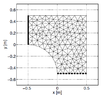
yes, this is the 2D problem. i am trying to calculate the total charge on conductor, shown by bold lines in 2D
1664674830832.png

domain. i have calculated potential distribution at each point using Laplace equation in finite element method, now i want to calculate total charge Q on this conductor, from this charge i want to calculate the capacitance. i want to use gauss divergence theorem to calculate charge ##E\bar =-\nabla\phi##, where ##\phi =potential##. here is my real problem. how to calculate total charge on conductor in above case and which normal components of electric field (in terms of scalar potential ##\nabla\phi##) should i integrate to get total charge?

from my side i have written equation like this..
##Q=\oint (E. n) dl##
Q=##\nabla\phi .n##
=##\oint(\partial\phi/\partial x +\partial \phi/\partial y)## dl
=##\oint {\partial \phi/ \partial x} dl +\oint {\partial \phi/ \partial y} dl##
=##\oint {\partial \phi/ \partial x} dy +\oint {\partial \phi/ \partial y} dx##
is this correct?
 

Attachments

  • 1664674694036.png
    1664674694036.png
    15.3 KB · Views: 172
Last edited: