General equation for light intensity entering half circle

Click For Summary
SUMMARY

The discussion focuses on calculating the light intensity entering a half-circle cylinder exposed to sunlight with an intensity of 1030 W/m². Participants emphasize the importance of considering the angle of incidence, which affects the transmission of light through the material. The conversation highlights the need to apply Fresnel's equations to compute the transmitted and reflected light accurately. Numerical integration over the sphere's surface is suggested as a method to achieve this calculation.

PREREQUISITES
  • Understanding of light intensity and its measurement in watts per square meter (W/m²).
  • Familiarity with Fresnel's equations for calculating light transmission and reflection.
  • Basic knowledge of geometric optics, particularly the effects of angle of incidence.
  • Proficiency in numerical integration techniques for surface calculations.
NEXT STEPS
  • Study Fresnel's equations in detail to understand light behavior at interfaces.
  • Learn numerical integration methods applicable to spherical geometries.
  • Explore geometric optics principles related to angle of incidence and light transmission.
  • Investigate computational tools or software for simulating light interactions with surfaces.
USEFUL FOR

Physicists, optical engineers, and anyone involved in light transmission calculations or material science will benefit from this discussion.

tylerscott
Messages
28
Reaction score
0
Hello,

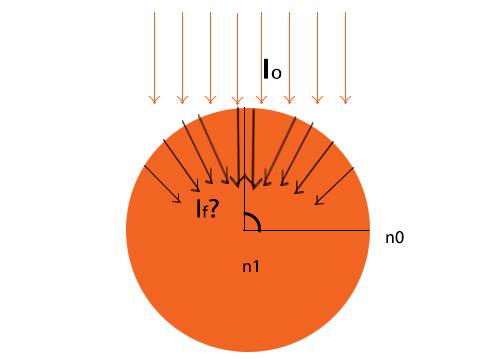
I am currently working on a problem to calculate the light that makes it through a half circle. For example, say I put a cylinder out in the sun, where the intensity is known to be 1030 W/m^2. I would like to compute the intensity/energy/power that makes it into this. Now, given the curvature of this half circle, I know this will somehow need to incorporate an integration over the sphere based upon the angle, but I'm thinking I'm missing some fundamental physics equation in the process.

See attached picture for the idea I have in my mind.
MzKZ6SW.jpg
 
Science news on Phys.org
hello tylerscott! :smile:

doesn't the intensity of the light falling on a body simply depend on how wide it is? :confused:
 
The intensity falling on it will be constant, yes. But the angle at which the light hits will determine how much is transmitted through the material. This is what I'm trying to figure out.
 
tylerscott said:
But the angle at which the light hits will determine how much is transmitted through the material.

your diagram shows the light coming "from infinity" (like sunlight) and falling perpendicularly on the cylinder :confused:

what angle do you mean?

the amount of sunlight hitting a body is the measured precisely by the size of its shadow
 
Hi guys!
I guess you ask that in terms of transmitted and reflected light?
In that case you should compute the fresnel's equations over the sphere surface.
 
Ah! That's what I was looking for. So, how do you suggest integrating these over the surface?
 
Numerically with respect to the sphere tangent over small areas, i think
 

Similar threads

  • · Replies 8 ·
Replies
8
Views
2K
  • · Replies 5 ·
Replies
5
Views
4K
  • · Replies 2 ·
Replies
2
Views
2K
  • · Replies 13 ·
Replies
13
Views
7K
  • · Replies 1 ·
Replies
1
Views
2K
  • · Replies 11 ·
Replies
11
Views
2K
  • · Replies 1 ·
Replies
1
Views
2K
  • · Replies 3 ·
Replies
3
Views
5K
Replies
1
Views
2K
  • · Replies 1 ·
Replies
1
Views
5K