RubinLicht
- 131
- 8
So i don't have issues with most of his problems, but once in a while a question that requires a ridiculous math trick that i had no way of knowing comes up and i just wonder if this is something you pick up from various places, or can attain through a focused study of mathematics. the question that prompted me to post this was this:

and solution:
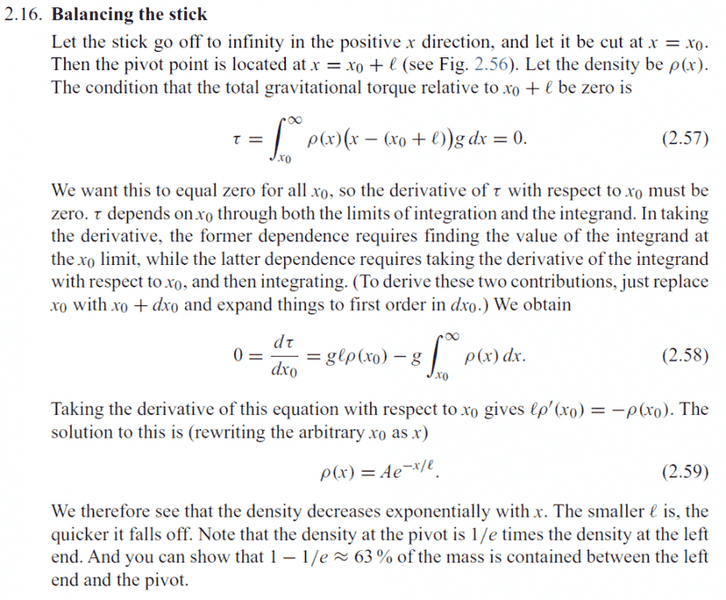
I get completely lost once i get to "In taking the derivative, the former dependence requires finding the value of theintegrand at the x0 limit...". and then i can follow the solution again once you get to "the solution to this is -> exponential"
The problem i had with this is that i immediately knew that the solution would be an exponential with some dependence on l in the exponent, however, there was simply no way for me to reach the solution because i had to use what ever math tricks he used here.
background: i can comfortably do approximations with taylor series and binomial theorem, so I'm not completely new to the world of approximations.
tldr i would like to know where to gain the math knowledge for these kind of tricks
and solution:
I get completely lost once i get to "In taking the derivative, the former dependence requires finding the value of theintegrand at the x0 limit...". and then i can follow the solution again once you get to "the solution to this is -> exponential"
The problem i had with this is that i immediately knew that the solution would be an exponential with some dependence on l in the exponent, however, there was simply no way for me to reach the solution because i had to use what ever math tricks he used here.
background: i can comfortably do approximations with taylor series and binomial theorem, so I'm not completely new to the world of approximations.
tldr i would like to know where to gain the math knowledge for these kind of tricks